Friday, July 4, 2014

We Ship This: Top 10 Movie Spaceships

As published in Issue #54 F*** Magazine

Shoutout to F***'s art director M.KWAN for the gorgeous layout. Disclaimer: The ships are arranged in order, but the layout changes the top four places. It should be the Close Encounters mothership, then the Serenity, then the Enterprise, then the Falcon in top place. Anyway, enjoy! 


---

Text:

WE SHIP THIS

Top 10 Movie Spaceships

By Jedd Jong


In Guardians of the Galaxy, Star-Lord’s ride is a spiffy spacecraft named The Milano, which in addition to sporting a yellow and blue paint job has somehow given us a craving for Pepperidge Farm cookies. Anyway, there has long been a sci-fi movie tradition of cool, cool spacecraft, ranging from the spectacularly outlandish to the intriguingly plausible. Raise your shields and join F*** for a look at 10 of the most awesome ships to blaze through the cosmos!

SPACE BATTLESHIP YAMATO from SPACE BATTLESHIP YAMATO


Nothing quite says “national pride” like dredging up a sunken battleship, retro-fitting it with a Wave Motion Engine and a Wave Motion Gun created with alien technology and sending it into battle with alien invaders. Such was the premise of the 1974 anime Space Battleship Yamato, which was re-packaged into the English-language Star Blazers. In 2010, fans of the anime finally got to see their beloved space battleship in full live-action glory, in the feature film directed by Takashi Yamazaki. Star Takuya Kimura voluntarily took a pay cut so that the CGI space battle sequences in the film could be improved. Though many fans were somewhat disappointed, the end result was visually impressive given the film’s $23.9 million budget, small in comparison to that of most Hollywood sci-fi extravaganzas. Sing it with us, in your best Steven Tyler wail, “loves lives” – and so does the resurrected Yamato.

GUNSTAR ONE from THE LAST STARFIGHTER


1984’s The Last Starfighter, directed by Nick Castle, is a fondly-remembered nostalgic classic yet one that’s not often mentioned in the same breath as the likes of Ghostbusters or Who Framed Roger Rabbit. Regardless, the film tapped into the dreams of many a gamer with its premise of the Rylan Star League recruiting a teenager named Alex to fight the Ko Dan Empire on the basis of his arcade game high score. Alex co-pilots the Gunstar One, an untested experimental prototype equipped with the wonderfully-named Death Blossom laser volley weapons system. The Last Starfighter was revolutionary for being one of the first major films (alongside Tron from two years earlier) to heavily utilise computer-generated imagery. The Gunstar and the other vehicles in the film were designed by Ron Cobb, who has also worked on the likes of Star Wars, Alien and Conan the Barbarian.

TRIMAXION DRONE SHIP from FLIGHT OF THE NAVIGATOR
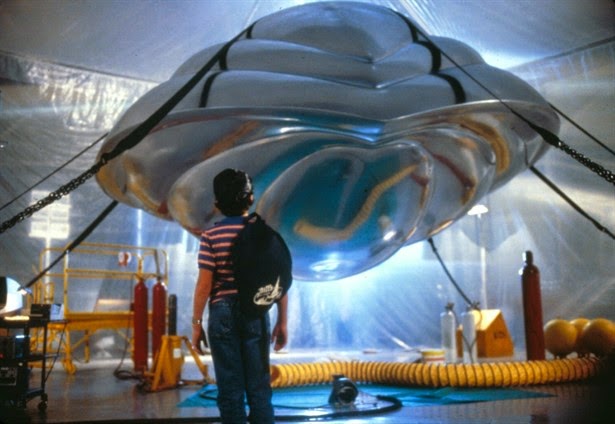

At first glance, most of the ships featured on this list do look kinda similar and, well, spaceship-y. The Trimaxion Drone Ship came from another beloved 80s kids’ film, The 1986 Disney flick Flight of the Navigator. In the movie, 12 year old David accidentally comes into contact with a crashed alien ship and enters into an eight-year-long coma. Scientists performing tests on him discover that schematics and instructions on how to fly a spaceship have been uploaded into his brain. The ship itself contacts David, who has taken on the role of “navigator”, needing his help to return home. The on-board artificial intelligence, nicknamed “Max”, was voiced by Paul Reubens a.k.a. Pee Wee Herman. Creating the chrome outer surface of the Trimaxion Drone Ship was a challenge back in the day and the filmmakers employed ground-breaking reflection mapping software. And hey, because of its shell-like appearance, it seems appropriate that the ship could also travel underwater.

DISCOVERY ONE from 2001: A SPACE ODYSSEY


Stanley Kubrick’s dazzling vision of a future 13 years ago was still 33 years away when 2001: A Space Odyssey was released. The third of four sections in the epic was “The Jupiter Mission”. On board the Discovery One spacecraft bound for the fifth planet from the sun were astronauts David Bowman and Frank Poole with three others in hibernation – as well as the ship’s somewhat untrustworthy artificial intelligence system HAL 9000. The Discovery One was powered by Cavradyne Plasma Propulsion Engines and featured a centrifuge to generate artificial gravity, hence the famous scene of David jogging around the circular interior of the crew’s quarters. The ship also held three extra-vehicular activity (EVA) pods, akin to mini-submersibles. Kubrick was a notorious perfectionist and hired spacecraft consultants Frederick Ordway and Harry Lange to work alongside production designer Anthony Masters and art director Ernest Archer to devise the designs in the movie. Legend has it that NASA administrator George Mueller and astronaut Deke Slayton nicknamed the studio “NASA East” because of the filmmakers’ level of technical accuracy.

CITY DESTROYERS from INDEPENDENCE DAY


Quite possibly above any other director working today, Roland Emmerich personifies the maxim “go big or go home”. After all, this is the man who basically wiped the surface of the earth clean in 2012 and made a movie with the tagline “size does matter”. In 1996, Emmerich unleashed Independence Day, a movie about aliens unleashing their forces on the world, on the world. Independence Day homages classic sci-fi flicks like Earth vs. The Flying Saucers and the 1953 take on War of the Worlds – except this time, the ships were truly colossal, their shadows hanging ominously over whole cities. “The size of the craft relates to the amount of aliens coming (to Earth) and basically, all their world is moving together, that's why it had to be so big,” explained production designer Patrick Tatopoulos. 36 of these craft were deployed by the alien mother ship, each one with a diameter of 25 km. The Destroyers would in turn release hundreds of small, agile fighter craft called Attackers. The Mothership floating in space was a whopping 800 km long along its longest axis. These dimensions are truly impressive, the ships’ weakness to computer viruses notwithstanding.

U.S.S. SULACO from ALIENS


Just look at the thing: doesn’t it seem like an assault rifle poised and ready to fire? The tagline for James Cameron’s sequel Aliens was “this time, it’s war” and the design of the U.S.S. Sulaco certainly reflected that. While the Nostromo from the first Alien film was essentially an interplanetary big rig truck, the Sulaco was more akin to a naval destroyer. According to designer and “visual futurist” Syd Mead, the Sulaco was not intentionally designed to look like the pulse rifles in the film. “I envisioned the Sulaco as a heavily armed, interplanetary/intergalactic freighter with loading doors along the side, a crane track and generally, an overlay of military hardware look onto a functional configuration for the drive element and the main body,” he said. “The massive 'guns' on each side may have generated that theory.” Mead’s initial designs were more spherical, but Cameron’s script called for “'forest of antennae coming into frame from the left,” something which would not require variable focus. What we ended up with was a ship as badass as its cargo of hardened Colonial Marines – and one Ellen Ripley.

THE MOTHERSHIP from CLOSE ENCOUNTERS OF THE THIRD KIND


Not all aliens want to destroy us, some just want to play us a neat five-note tune. In Steven Spielberg’s modern classic, probably the “benevolent alien” movie other than that other Spielberg benevolent alien movie, a suburban electrical lineman develops a peculiar obsession with UFOs. This culminates in scientists and the military gathering at the Devils Tower structure in Wyoming; the Mothership hovering just above. Designed by Star Wars artist Ralph McQuarrie and constructed by model maker Greg Jein, the look of the Mothership was inspired by an oil refinery rig Spielberg had come across in India. The ship’s interior was never meant to be shown, but the studio pressured Spielberg into filming a sequence showing it for a re-release. This scene was removed in Spielberg’s final cut years later. Tiny random bits stuck onto Mothership by model builders as inside jokes include a Volkswagen bus, a submarine, R2-D2, a U.S. mailbox, and a small cemetery plot. Should you ever be in Washington, D.C., you can check out the model of the Mothership on display at the Smithsonian Institution's Air and Space Museum.

SERENITY from SERENITY


Ask any geek worth their salt to name an excellent TV show that got cancelled after one season and they’ll all forlornly answer “Firefly”. Joss Whedon’s sci-fi Western series that got unceremoniously canned by Fox received a second lease of life in the 2005 feature film Serenity, which Whedon directed. The film opened with a tour through the titular ship by way of a tracking shot, cleverly re-establishing the characters and the different areas of the vessel itself. A rinky-dink Firefly-class freighter that always seemed in danger of falling apart, the Serenity was nevertheless a trusty ship for Captain Mal Reynolds and his ragtag crew. The Serenity was equipped with decoy buoys called “crybabies” that could be jettisoned to distract pursuing enemies. The Serenity was designed by director Joss Whedon, production designer Carey Meyer and visual effects supervisor Loni Peristere. Whedon was keen to establish the limited amount of space inside the ship. ''One of the first things I thought was, I'm gonna have a ship with a toilet,'' he said in an interview with Entertainment Weekly. ''I wanted a ship that felt lived-in.''

USS ENTERPRISE from STAR TREK


Throughout the various Star Trek series and films, there have been many incarnations of the ship that’s central to the franchise, the USS Enterprise. The classic Enterprise from the Original Series era captained by James T. Kirk was a Constitution-class starship with the designation NCC-1701. A re-fitted version of this ship appears in the films Star Trek: The Motion Picture, Star Trek II: The Wrath of Khan and Star Trek III: The Search for Spock, being destroyed in that last one. Following that, the rebuilt NCC-1701-A served as the setting for the remaining movies featuring the Original Series crew. For the Next Generation-era movies, Captain Jean-Luc Picard sat at the helm of the Sovereign-class NCC-1701-E. The art director on the Original Series, Matt Jeffries, was the primary designer of the original Enterprise, taking inspiration from the look of electric stove coils. With its warp drive, deflector shields, photon torpedoes and phasers, the Enterprise quickly became one of the most iconic spaceships in all of sci-fi, and with the re-imagined movie series, continues to fly across the silver screen (and be worshipped by primitive alien species).

MILLENNIUM FALCON from STAR WARS


Like Star Trek, several ships from Star Wars have become ingrained in popular culture but when push came to shove, we picked the loveable hunk of junk herself, the Millennium Falcon. The modified YT-1300 light freighter was the vessel of choice of smuggler Han Solo; the rogue having won the ship in a game of sabaac from his friend Lando Calrissian. Solo and his co-pilot Chewbacca made multiple modifications to the ship, including quad laser cannons and sensor jammers. The Falcon embodied the “used future” aesthetic seen in the original Star Wars trilogy; at a time when most sci-fi films featured sleek, clean environments dominated by white and chrome, it was novel to see a ship that had trouble starting up. Like its pilot, the ship is imperfect but has plenty of personality. The original design for the ship was too similar to that of the Eagle transporter in Space: 1999, so the Falcon was revised, its new look leading the staff at visual effects house ILM to nickname it the “Porkburger”. While it was George Lucas who had the burger brainwave, various designers including Ralph McQuarrie, Colin Cantwell, Joe Johnston, effects technician John Dykstra and production designer John Barry contributed to the design. The afore-mentioned Serenity can be seen as a direct descendant concept-wise of the Millennium Falcon. The Falcon will once again make its hyperspace jump in J. J. Abrams’ Star Wars Episode VII. Abrams jokingly posted a photo of a note claiming the Falcon would not be in the film – the note itself was resting on the famous Dejarik holochess board seen in the Falcon’s lounge. 

Tuesday, July 1, 2014

Begin Again

For F*** Magazine

BEGIN AGAIN

Director : John Carney
Cast : Mark Ruffalo, Keira Knightley, Adam Levine, Hailee Steinfeld, Mos Def, James Corden, CeeLo Green, Catherine Keener
Genre : Drama, Romance
Opens : 3 July 2014
Rating : NC16 (Coarse Language) 
Running time: 104 mins

Lovin’ a music man ain’t always what it’s supposed to be, and that goes for the music men behind the scenes as well. In this musical romantic comedy, Mark Ruffalo plays Dan Mulligan, the down-and-out exec of music label Distressed Records, who has an estranged wife (Keener) and daughter (Steinfeld). While drowning his sorrows at a bar one night, British singer-songwriter Gretta (Knightley) catches his attention and he immediately sets about getting a hold of her so they can collaborate on a record. It turns out that Gretta’s long-time boyfriend and songwriting partner Dave Kohl (Levine) has strayed after letting stardom get to his head. Gretta tries to leave Dave behind as she, Dan, her best friend Steve (Corden) and a motley crew of session musicians embark on recording an album on the streets of New York, guerrilla-style.

            Begin Again, formerly titled Can a Song Save Your Life?, is written and directed by John Carney of Once fame. The micro-budget Irish indie flick became a cult favourite after netting a Best Original Song Oscar for Falling Slowly and was adapted into an acclaimed musical running on Broadway and the West End. Begin Again can be seen as Carney “going Hollywood”, trading in a cheap video camera for a fancy Red Digital and having Hollywood names and pop stars in the cast. While Begin Again is certainly a glossier, slicker affair, it still retains a good measure of earnestness and sweetness and is sure to appeal to fans of music movies. In what might be somewhat meta commentary, the theme of “indie vs. big record label” crops up. There’s also a rather surprising bit of anti-product placement: Dan takes a sip of Pepsi and wonders aloud “God damn, how do people drink that?!”


            Many of the elements in Begin Again can be described as “formulaic” – there’s the maverick music producer who has been reduced to an unkempt mess but who gets a second wind upon discovering an ingénue, the disapproving ex-wife and the rebellious daughter and the ingénue’s unfaithful rock star boyfriend. An early scene has a frustrated Dan tossing demo CDs out of his car window, fed up with inane pop and in search of “real music”. However, the film does possess enough self-awareness such that it doesn’t drown in a morass of clichés and that there’s a still a soul to it. Carney also has a little fun with the structure of the first half of the film, starting in medias res before rewinding to the start of that day, telling the story from Dan’s point of view – and then rewinding further and telling it from Gretta’s. There’s also a wonderfully whimsical moment of visual invention, when upon first hearing Gretta sing, Dan begins to imagine possible arrangements for the song; the piano, drums, cello and violin sitting on stage suddenly playing by themselves in his imagination.


            Mark Ruffalo is pretty much scruffy-sexy incarnate. Once again, he looks like he badly needs a shower and a shave, but perhaps that is part of his charm. He convincingly essays a man who has fallen on hard times but who clearly once had drive and inspiration, and when that returns to him he comes alive again. Keira Knightley’s role was originally intended for Scarlett Johansson – while we don’t get the Hulk and Black Widow making sweet music together, Knightley is a perfectly acceptable substitute. Her singing voice is very pleasant and she consciously avoids turning Gretta into an idealised “manic pixie dream girl” type. When she says “I’m not Judy Garland off the greyhound bus looking for stardom”, this reviewer believes her – but wants to see her make it in the music biz all the same.


            When it comes to the casting of established singers like Adam Levine and his fellow The Voice coach CeeLo Green, it’s a Catch-22 situation: on one hand, having actual musicians in your music movie gives it credibility but on the other, it can be distracting enough to pull one out of the experience. Green’s appearance in the film is more tolerable because as hip-hop star and old pal of Dan’s nicknamed Troublegum, he could well be playing himself. However, Levine is not a brilliant actor and this reviewer happens to find his high-pitched whine of a singing voice somewhat grating. We’re also 90% sure that the name “Dave Kohl” is some kind of a dig at the similarly-named Foo Fighters frontman.


            Begin Again is a great date movie because it isn’t yet another a production line rom com and it never becomes unbearably cheesy and sappy. It won’t redefine the music flick genre, but it does have its share of sweet moments. The songs, co-written by New Radicals frontman Gregg Alexander with Danielle Brisebois, Nick Lashley, Rick Nowels and Nick Southwood, Once star Glen Hansard and Carney himself, are all very listenable if not especially memorable or catchy. And this is quite possibly the first movie to make splitter cables seem like very romantic objects.

SUMMARY: Begin Again’s formulaic elements are offset by its measured sweetness and charm.

RATING: 3.5 out of 5 Stars

Jedd Jong

Tuesday, June 24, 2014

Transformers: Age of Extinction

For F*** Magazine

TRANSFORMERS: AGE OF EXTINCTION

Director : Michael Bay
Cast : Mark Wahlberg, Stanley Tucci, Nicola Peltz, Jack Reynor, Kelsey Grammer, Li Bingbing, Sophia Myles, Titus Welliver, T. J. Miller and the voices of: Peter Cullen, Robert Foxworth, John Goodman, John DiMaggio, Ken Watanabe, Frank Welker
Genre : Action, Sci-Fi
Opens : 26 June 2014
Running time: 165 mins

Lord Bay of House Boom has returned locked and loaded for the fourth live-action Transformers film despite saying he would quit the franchise, this time with a new human cast. It has been four years since Chicago was decimated in the battle between Autobots and Decepticons and the U. S. government has decided to end their partnership with the Autobots, declaring them enemies. CIA official Harold Attinger (Grammer) is in charge of hunting them down, engaging the services of mercenary Savoy (Welliver) and ruthless Decepticon bounty hunter Lockdown (Ryan). Joshua Joyce (Tucci), owner of tech giant KSI, has a lucrative government contract to manufacture man-made facsimiles of the Transformers by reverse-engineering captured and dismantled Autobots and Decepticons. Meanwhile, Texan inventor Cade Yeager (Wahlberg), his best friend Lucas (Miller), his daughter Tessa (Peltz) and Tessa’s boyfriend Shane (Reynor) get drawn into the conflict when they unwittingly come into the possession of a beat-up old truck that just happens to be Optimus Prime (Cullen) himself. With the extinction of humanity imminent, Optimus and the remaining Autobots must defeat Attinger and the Decepticons in pursuit.


            Tennis champ Boris Becker said “you get used to eating caviar and at some point it tastes as ordinary as everything else.” In the context of action movies, explosions are akin to caviar. More doesn’t necessarily mean better, but director Michael Bay has wilfully rejected this notion and continues to stuff his films with more and more. He promised a “less goofy” outing but as this reviewer has learnt the hard way, a Michael Bay cannot change his spots. The elements in the second and third films that led to them being critically panned are still here, just in slightly more controlled doses. There’s still juvenile humour, there’s still racism and sexism, there’s still obnoxious product placement, the action scenes are still overwhelming flurries of whirling, clanging metal, it’s just reined in a bit and therefore slightly more tolerable than before. Bumblebee still talks using voice clips. Instead of an annoying actual dog, there’s an annoying homemade robot dog. Instead of Linkin Park, there’s Imagine Dragons. The film’s stabs at self-aware winking at the audience (an elderly movie theatre proprietor bemoans how all major releases are remakes and sequels) are more awkward and on the nose than anything else.


            Apologists of this film series have often used the “this is not Citizen Kane” argument. Well, even Citizen Kane had a running time of 119 minutes. This bad boy clocks in at 165 minutes, the longest Transformers movie yet. It’s overkill. Were this around 100 minutes long, we might’ve been really entertained. Still, there are definitely parts of the movie to commend. Bay and screenwriter Ehren Kruger have decided to make the human villain a CIA official, which combined with the decreased role of the military, makes this less of a jingoism party than the earlier films in the series. Having human scientists attempting to create their own Transformers without comprehending the danger and complexity of the technology is a perfectly viable angle to come at the story from, if somewhat Terminator-esque. And best of all, our protagonist is no longer the useless, unbearably annoying Sam Witwicky.


            Mark Wahlberg is certainly an upgrade from Shia LaBeouf, even if Marky Mech doesn’t break into an off-key rendition of the Transformers theme song “The Touch” like in Boogie Nights. Cade Yeager is a bundle of clichés: All-American everyman turned hero, amateur inventor whose workshop is filled with knick-knacks plus he’s an over-protective single dad who utterly disapproves of his daughter’s boyfriend just on principle. But Wahlberg being significantly less punch-worthy than LaBeouf makes a difference. Nicola Peltz of The Last Airbender infamy fulfils the pre-requisites of being the female lead in this series: she can’t act and she rocks the Daisy Dukes. Reynor is a typical modern Hollywood imported pretty-boy; some kind of attempt made at explaining away the Irish actor’s accent - Cade ends up disparagingly referring to his would-be son-in-law as “Lucky Charms”. Once again, at least he’s significantly less annoying than Shia LaBeouf.


            While Stanley Tucci is subjected to a good deal of embarrassment as a send-up of tech icons like Steve Jobs, he is spared the depths of indignity that the likes of John Turturro and John Malkovich suffered in the previous movies. Kelsey Grammer takes his role as primary human antagonist surprisingly seriously and his frighteningly pragmatic Attinger is a bright spot in the film, so many steps up from Patrick Dempsey in Dark of the Moon. Titus Welliver is also quite imposing and the sequence in which he pursues Cade as they cling to the exterior of a Hong Kong apartment building is plenty of fun. As the head of KSI in China, Li Bingbing is the stock boss lady and without Sally Cahill to dub over her like in Resident Evil: Retribution, she valiantly battles the English language. The voice acting is good as well, not only is definitive Optimus Prime performer Peter Cullen back, but the legendary Frank Welker reprises his role as Galvatron from the various animated series. Thankfully, Ken Watanabe and John Goodman’s distinct voices are still recognizable even after being treated with that robot voice filter. Watanabe also gets to deliver the film’s funniest line, Drift’s reaction upon first seeing the Dinobots transform.


            One thing has been true about this series: no matter how bad the rest of the film gets, the visual effects work certainly can’t be faulted and we’d like to salute visual effects supervisor Scott Farrar and the armies of artists and technicians who brought the Autobots, Decepticons and those fan-favourite Dinobots to life. Amidst the bombast, we also get genuinely beautiful shots, like those of the Autobots convening in Monument Valley and a shot in which Lockdown’s ship is reflected in Chicago’s Cloud Gate sculpture. We saw this in IMAX 3D and even though it is often pretty to look at, the constantly shifting aspect ratios can be very distracting. Transformers: Age of Extinction is more bearable than Revenge of the Fallen and Dark of the Moon, albeit certainly not the paradigm shift in quality it is touted to be. But hey, this is a movie with a humanoid robot semi-truck astride a giant robot T-rex charging into battle, so it’s not like anything we say matters too much anyway.


SUMMARY: While relatively better than its predecessors thanks to more likeable leads and less superfluous subplots, many of the problems that plagued the earlier Transformers movies are still very present throughout the 165 minute duration.


Mark Wahlberg, Jack Reynor and Nicola Peltz do not love the smell of napalm any time of the day.


RATING: 2.5 out of 5 Stars

Jedd Jong 

Wednesday, June 18, 2014

The Trials of Cate McCall

For F*** Magazine

THE TRIALS OF CATE MCCALL 

Director : Karen Moncrieff
Cast : Kate Beckinsale, Nick Nolte, James Cromwell, David Lyons, Clancy Brown, Mark Pellegrino, Taye Diggs, Isaiah Washington, Dale Dickey, Kathy Baker
Genre : Drama
Opens : 19 June 2014
Rating : NC16 – Some Coarse Language / 93 mins

It’s a case of the almost-Danza with Kate as Cate. Beckinsale plays Cate McCall, a high-flying L.A. legal eagle whose promising career is threatened by alcoholism and a custody battle, ex-husband Josh (Lyons) planning on moving to Seattle with their young daughter Augie (Ava Kolker). Cate is assigned to defend Lacey Stubbs (Anissimova), a young woman put on death row who claims that she was wrongly accused of first degree murder. With her Alcoholics Anonymous sponsor Bridges (Nolte) by her side, Cate takes on what many deem an impossible case. Among the obstacles that stand in her way are possibly-crooked police detective Welch (Pellegrino), womanising judge Sumpter (Cromwell), a man she prosecuted and who was proven innocent and released from jail (Washington) plus the army of protestors camped outside the courthouse, convinced of Lacey’s guilt.


            The thought running through this reviewer’s mind for the duration of this film was “gee, this looks like it belongs on TV”. It turns out that The Trials of Cate McCall was not granted a U.S. or U.K. theatrical run, bypassing a video release and airing on the Lifetime Channel as a movie of the week, a death knell if ever there was one. As a courtroom drama, The Trials of Cate McCall is pretty much par for the course, offering nothing one wouldn’t find in any law procedural television show. The central mystery is moderately interesting rather than downright riveting; several plot developments questionable if not preposterous. More than a handful of artistic license is taken and law students will be crying “objection!” but for the layperson, it all makes just enough sense.


            In some circles, Kate Beckinsale is thought of as merely a pretty face and little else, but the truth is that she is a capable actress and makes for a believable lawyer here, somewhat reminiscent of her turn in the under-seen Nothing but the Truth. She projects confidence and brokenness equally well and makes the title character into someone the audience does very much want to see succeed. We see Cate dishevelled and crying but also taking control of the courtroom and it’s certainly not a bad performance from Beckinsale. Nick Nolte has pretty much been out of it for the last 20 years but still has gotten steady work as a dependable supporting player and, as his Academy Award nomination for Warrior proves, can still do good work. Not too much is required of him in The Trials of Cate McCall but he’s got the “gruff but kind” mentor figure thing down pat. James Cromwell makes full use of his hawkish mien as Justice Sumpter; he may be best remembered for playing a kindly farmer in Babe but prepare to throw up in your mouth a little when he pervs on Kate Beckinsale. Who’s the pig now?


            The Trials of Cate McCall features a capable Kate Beckinsale leading the charge but it really is nothing that hasn’t been done before, rote rather than sensational. The need for an emotional subplot involving Cate’s inability to connect with her young daughter is there to show how Cate struggles with her demanding job and with being a mother (hence the plural “trials” in the title), but it seems unnecessary at times. Writer-director Karen Moncrieff, like her lead actress, is competent, but every so often we get lines like “I’m f**king good at what I do and I intend to win this!” It’s bland, but not quite as ham-fisted a mess as it could’ve been.

Summary:  Kate Beckinsale is a strong lead and the supporting cast of somewhat-familiar faces backs her up well, but that’s not enough to pull this also-rans courtroom drama up from the doldrums.

RATING: 2.5 out of 5 Stars

Jedd Jong 

Friday, June 13, 2014

A Million Ways to Die in the West

For F*** Magazine

A MILLION WAYS TO DIE IN THE WEST

Director : Seth MacFarlane
Cast : Seth MacFarlane, Charlize Theron, Amanda Seyfried, Neil Patrick Harris, Liam Neeson
Genre : Comedy, Western
Opens : 12 June 2014
Rating : NC16 (Coarse Language and Sexual References) / 116 mins

Directed by, starring and co-written by Seth MacFarlane, here’s the film that details why life in the American frontier was hard, no matter what your station. MacFarlane plays Albert, an unassuming sheep farmer in the town of Old Stump, Arizona whose girlfriend Louise (Seyfried) leaves him for Foy (Harris), a dashing, arrogant moustache tonic salesman. Anna (Theron), the wife of notorious outlaw Clinch Leatherwood (Neeson), arrives in Old Stump, hoping to lie low while her husband continues tearing up the region. She befriends and soon falls in love with Albert, the sheep farmer unaware that his new paramour is in fact married to the most dangerous man in the land.

            The marketing for this film includes an online flash game that is a funny, entertaining spoof of the classic educational video game The Oregon Trail. Alas, nothing in the film itself quite matches the creativity of that tie-in. A fair number of the jokes in A Million Ways to Die in the West land, but the film is overly reliant on lowbrow bodily-function gags and “shocking”, cartoony violence. The movie’s biggest laughs are provided by the surprise celebrity cameos and a joke involving an offensively-themed shooting gallery gets a satisfying payoff during the end credits. However, one of the best of these was completely spoiled in a TV spot, making this yet another example of a comedy where the laughs are run into the ground by the trailers.


            The film hinges on its main character, Albert the sheep-farmer, being likeable enough that audiences will want to root for him to survive all those million possible methods of death. Seth MacFarlane is not likeable. This is not a controversial statement. A Million Ways to Die in the West would have benefitted from a different lead actor but this being the vanity project it is, that was unlikely to happen. With Ted, he was able to hide behind a computer-generated stuffed toy but here, his shortcomings as a leading man are all too apparent. One adjective often used to describe the Family Guy creator is “smug”. “Smug” is pretty much on the opposite end of the spectrum from “hapless, sweet, unassuming and well-meaning”.


            MacFarlane has surrounded himself with an excellent supporting cast, but because he is positioned as the film’s focal point, their presence seems merely perfunctory. Charlize Theron makes for a fun, watchable Annie Oakley-type but as her on-screen husband, Liam Neeson gets the short shrift. While he has slightly more screen time than in Battleship, one can’t help but feel sorry for the actor who has redefined the term “badass” when he’s forced to bare, well, ass. Family Guy fans will be tickled by the casting, since one cutaway gag featured Liam Neeson struggling with his accent in a cowboy film (he retains his Northern Irish brogue here). Neil Patrick Harris relishes the chance to gnaw at the scenery and he certainly rocks that well-coiffed handlebar moustache, in addition to dancing to the Stephen Foster folk ditty “If You’ve Only Got a Moustache”. Giovanni Ribisi and Sarah Silverman are amusing as Albert’s best friend Edward and Edward’s prostitute girlfriend Ruth respectively, if you don’t mind hearing Sarah Silverman graphically describe sex acts.


            A comedic Western in this day and age is a fairly ambitious prospect and something of a gear change from Ted, but MacFarlane fails to mine the opportunities presented by the premise, this outing proving yet again to be too self-indulgent. At 116 minutes long, this does meander and there’s the threat of tumbleweeds, but it would be too harsh to say A Million Ways to Die in the West is completely laugh-free. Co-writers Alec Sulkin and Wellesley Wild, who also worked on Ted and Family Guy with MacFarlane, retain a somewhat mean-spirited sense of humour (the poster has a cactus resembling a hand flipping the viewer off) but once in a while do offer inspired gags. Just not quite often enough.

Summary: Doesn’t quite set our saddles ablaze.

RATING: 2.5 out of 5 Stars

Jedd Jong

Thursday, June 12, 2014

How To Train Your Dragon 2

As published in Issue #53 of F*** Magazine

HOW TO TRAIN YOUR DRAGON 2 

Director: Dean DeBlois
Cast: Jay Baruchel, Craig Ferguson, America Ferrera, Cate Blanchett, Djimon Hounsou, Kit Harington, Jonah Hill, Kristen Wiig, Christopher Mintz-Plasse, T.J. Miller
Genre: Action, Adventure, Animation,
Run Time: 103 mins
Rating: PG
Opens: 12 June 2014

From the Mother of Dragons to Smaug the Terrible, those mythical winged reptiles we know, love and sometimes fear have re-entered pop culture in a big way. 2010’s How to Train Your Dragon, inspired by Cressida Cowell’s book series, had a part to play in it as well. Five years have passed since the events of that film, humans now living peacefully alongside dragons in the Nordic island village of Berk. Hiccup (Baruchel), poised to inherit the role of chieftain from his father Stoick (Butler), has grown inseparable from his beloved Night Fury dragon, Toothless. Hiccup and Toothless stumble across a remote ice cavern, a secret dragon haven and home to Valka (Blanchett), a mysterious, feral dragon master. They also come into conflict with the fearsome dragon hunter Drago Bludvist (Hounsou), with whom Stoick had a treacherous encounter in the past.  


            The first How to Train Your Dragon is one of the best “A boy and his X” tales ever put on screen, right up there with the likes of E.T.: The Extra-Terrestrial and Iron Giant. It was also a breath-taking visual feast and in that regard, the sequel ups the ante. The flying sequences are as exhilarating as ever and the 3D effects are stunning, particularly when large ice structures break apart and fall towards the camera. The action sequences are fluid and dynamic and the character animation is lively and detailed. If you were struck by how adorable Toothless was in the first film (and really, who wasn’t) prepare to go “d’aww” and giggle more times than you can care to count. The animators optimise every inch of the cuddly Night Fury to convey his emotions: he’s swift and nimble one minute and friendly and silly the next. Oh, how we’ve missed Toothless on the big screen. This film also boasts a career best musical score from composer John Powell, who snagged his first Oscar nomination for How to Train Your Dragon.


            It pains us a little to say this, but when it comes to the story, How to Train Your Dragon 2 has a mild case of sequilitis. How to Train Your Dragon ended with such an equilibrium, the relationships between Hiccup and his father, between Hiccup and his girlfriend Astrid (Ferrera) and between Hiccup and Toothless all arriving at a satisfying place. We’re sure DreamWorks fully intended for it to spawn a franchise, but it concluded so neatly that there didn’t seem to be too many places to go in a sequel. The interactions between the characters are still fun to watch and there are still genuine emotional moments, but this just lacks the warmth and drive of its predecessor. We’ve also got a villain who’s simply kind of there, Drago’s design strongly reminiscent of Shan Yu from Disney’s Mulan. An attempt is made to connect him with Stoick’s past and Djimon Hounsou sounds sufficiently gruff and menacing, but Drago ends up being little more than a generic physically imposing bad guy, complete with scars and dreadlocks. His flame-retardant dragon skin cape is pretty cool, though.


            This reviewer’s theory as to why How to Train Your Dragon is one of the best movies in the DreamWorks Animation oeuvre is that it feels the most Pixar-like. This may sound like a back-handed compliment, but DreamWorks’ trademark all-star voice cast and hip, pop culture referencing humour did wear on many moviegoers’ nerves. How to Train Your Dragon didn’t have a gaggle of marquee name A-listers in the recording booth and was all the better for it. All of the major cast members from the first one, including Jay Baruchel, Gerard Butler, America Ferrera and Craig Ferguson, return here. Baruchel doesn’t have a typically heroic voice, and it works for Hiccup. Here, we get a Hiccup who has matured, Baruchel adjusting his performance accordingly. Cate Blanchett is an excellent addition to the cast, her delivery at once ethereal and earthy. Apparently, DreamWorks didn’t want a spoiler regarding her character Valka to be revealed, but marketing pushed its inclusion in the trailers anyway. It really does work better if you go into the film blind, hence our beating around the bush in this review. 

            Fans of the first film are unlikely to find anything to hate with the continuing adventures of Hiccup and Toothless. However, given how heartfelt How to Train Your Dragon was and how riveting the story of Hiccup and Toothless’ mutual bond was, one can’t help but feel let down by the sequel. There’s also a fair bit of mood whiplash going on, we get lots of pleasant humour but the transition to the rather heavy and dramatic climax is a tad sudden. Still, there are worse cinematic locales to return to than the island of Berk, and we have to admit we derived some glee from seeing those poor frightened sheep in jeopardy during the Quidditch-like dragon race at the beginning of the film.


Summary: How to Train Your Dragon 2 has sweeping visuals, great music and more of Toothless being cute, but also suffers from a weaker story, treading water in places.

RATING: 3.5 out of 5 Stars

Jedd Jong