Jedd's movie reviews, articles, movie-related musings and several other things.
Showing posts with label Tong Dawei. Show all posts
Tuesday, August 11, 2015
The Crossing II (太平轮:惊涛挚爱)
For F*** Magazine
THE CROSSING II (太平轮:惊涛挚爱)
Labels:
: Zhang Ziyi,
Amanda Qin,
Bowie Lam,
disaster,
Huang Xiaoming,
John Woo,
Masami Nagasawa,
Song Hye-Kyo,
Takeshi Kaneshiro,
The Crossing,
The Crossing II,
Tong Dawei,
war,
太平轮:惊涛挚爱
Wednesday, July 8, 2015
Hollywood Adventures (横冲直撞好莱坞)
For F*** Magazine
HOLLYWOOD ADVENTURES (横冲直撞好莱坞)
Director : Timothy Kendall
Cast : Zhao Wei, Huang Xiaoming, Tong Dawei, Sarah Li, Sung Kang, Rhys Coiro, Stephen Tobolowsky, Simon Helberg, Robert Patrick, Kat Dennings. Tyrese Gibson, Missi Pyle
Run Time : 115 mins
Opens : 9 July 2015
Rating : NC16 (Some Drug Use)
These
tourists turn tinsel town topsy-turvy. Say that three times fast. In this
action comedy, Huang Xiaoming stars as Beijing car salesman Xiaoming, who is
about to propose to his girlfriend Yan Yan (Li) when she up and leaves him to
become a production assistant in Hollywood. Xiaoming frantically grabs the last
available ticket to L.A., inadvertently joining the “Hollywood Adventures” tour
group with garrulous movie buff Dawei (Tong). They arrive in the City of
Angels, meeting up with tour guide Wei Wei (Zhao). In the process of his quest
to win back the love of his life, Xiaoming stumbles into a smuggling operation,
running afoul of various colourful characters including shady motel proprietor
Manny Love (Kang), irascible movie director Wronald Wright (Tobolowsky) and
diva movie star Gary Buesheimer (Coiro).
This China-U.S. co-production is
half showbiz satire, half “idiots abroad” comedy. Helmed by small-time TV
director Timothy Kendall and co-written and co-produced by Justin Lin of Fast and Furious fame, Hollywood Adventures is Lin’s attempt at
breaking into the lucrative Chinese film market. The film plays into China’s
growing consumption of and fascination with American popular culture, stuffed
to the gills with references to movies and TV shows. The creative team,
including Lin, Kendall and co-writers Brice Beckham and Philip W. Chung, are
all American, casting three of China’s biggest stars in a bid to appeal to
Chinese filmgoers. Unfortunately for Lin and company, the film raked in far
less than expected upon its opening in China.
There is the sense throughout the
film that the filmmakers are eager to pander to their target audience’s
larger-than-life perception of the United States in general and Hollywood in
particular. Hollywood Adventures is
filled with depictions of ludicrous film industry shenanigans and it portrays
Americans as simpletons easily appeased by mindless violence – in-story, a
reality TV show called “Punch Me” is
sweeping the nation. There are also several surprise celebrity cameos – Dawei
has a massive crush on Kat Dennings, whom he naturally runs into on a movie
set, and The Big Bang Theory’s Simon
Helberg shows up as a translator. The highlight of these is an appearance by a
certain Terminator star, who leaves
dignity at the door and skewers his most famous role with amusing aplomb.
While
often unfocused and very, very broad in its comedic stylings, the film does
have a fair number of laughs. The Dawei character is one of those guys who
speaks exclusively in movie references and quotes and is the source of
fourth-wall breaking meta-fictional humour – you’ll notice that all three
protagonists share the names of the actors playing them. It’s often very on the
nose – upon first seeing Manny, Dawei remarks that he “looks a lot like Han
from the Fast and Furious movies” –
both characters are played by Sung Kang. However, this type of winking
self-awareness is rare in Chinese comedies and fits right in with the L.A.
setting of the movie. The film trades in various well-worn formulas, but every
time a familiar trope shows up, Dawei is there to remark on it. That doesn’t
excuse its lack of originality but it does make it easier to go along with the
romp.
The
three leads are excellently cast – Huang Xiaoming plays the strait-laced
straight man, Tong Dawei is the silly sidekick and Zhao Wei is the plucky,
world-weary lass who has to guide the duo through the unfamiliarity of
Hollywood. Tong in particular is admirably game for a variety of
embarrassing/dumb scenarios – we somehow wind up witnessing him in drag astride
a motorcycle during the film’s climactic action sequence. As is often the case,
the de-facto main character is the least distinct, but Huang manages to make Xiaoming
adequately appealing. Zhao showcases the comic timing she’s become known for
and as she plays the only one of the three leads conversant in English, does
most of the interacting with the other characters for the other two. On the
other hand, Rhys Coiro is not even a tiny bit convincing as a big-shot movie
star involved in some illegal business. We also find it puzzling that the
character’s name is a play on “Gary Busey”, of all the “top movie stars” to
lampoon.
Hollywood Adventures is
stupid, but for the most part, it’s amiably so. As a send-up of typical
Hollywood excesses, the film ends up partaking in those same excesses, taking a
hard right in its third act into thriller territory. There are still gags, but
these take a backseat to a kidnapping, a showdown at an exclusive shindig and
lots of cars crashing into each other and flipping through the air. The three
main characters also rather conveniently become expert sharpshooters, martial
artists and stunt performers by the time the denouement rolls around. Even
given all that, there’s a fair amount to enjoy and despite its various
shortcomings, the movie has enough raucous energy for it to pass as a somewhat
entertaining diversion.
Summary: This rampage through Hollywood is brash and
very silly, but the strength of the three leads and a good dose of self-aware
humour carry it to the finish line.
RATING: 3 out of 5 Stars
Jedd
Jong
Labels:
Hollywood Adventures,
Huang Xiaoming,
Missi Pyle,
Rhys Coiro,
Sarah Li,
Stephen Tobolowsky,
Sung Kang,
Tong Dawei,
Tyrese Gibson,
Zhao Wei,
横冲直撞好莱坞
Friday, December 5, 2014
A-cross the Universe: The Crossing Press Conference
For F*** Magazine
A-CROSS THE UNIVERSE
John Woo, Zhang Ziyi and Tong Dawei in Singapore for The Crossing – Part 1
By Jedd Jong
Five years after the release of Red Cliff – Part 2, director John Woo
returns with the two-part romantic epic The
Crossing. The film, which focuses on three central romances that converge
aboard the ill-fated steamer Taiping
during the Chinese Civil War in 1949, has been chosen as a special presentation
for the opening night of the 25th Singapore International Film Festival
(SGIFF).
Woo, along with stars Zhang Ziyi,
Tong Dawei and his daughter Angeles, are in Singapore to kick off the SGIFF
festivities. F*** was at the press conference held at the ArtScience Museum in
Marina Bay Sands Singapore.
Woo, known for his “heroic
bloodshed” Hong Kong action films such as A
Better Tomorrow and Hard Boiled
and his Hollywood efforts including Face/Off
and Mission: Impossible 2, isn’t
necessarily a director one would associate with the romance genre. “I believe
in love, I believe that love can bring strength and warmth,” he enthuses.
“Seeing as this is a romance that takes place in tumultuous times, it is very
moving. Making the film was a challenge because of the upheaval that took place
during this period in history, making it a very painful chapter in time.” He
goes on to explain that the two-parter looks at how the three central romances
go through a trial by fire in the face of war and disaster.
Star Zhang
Ziyi says that while making the film was far from a walk in the park, it was
worth it for the chance to work with the famed director. “Everyone endured the
hardships of making this film for the opportunity to work with John Woo. I was
very moved after reading the script because the characters within are all drawn
very vividly. Everyone hopes to be able to work with John Woo. He is a good
person, he cares for us all very much.”
It is Tong
Dawei’s first time in Singapore and he wonders aloud what sweet treats he
should take back home for his kid. Zhang suggests he get some pandan cake from
the airport. Tong last worked with director Woo on Red Cliff. Regarding The
Crossing, Tong says “I feel that this is the most challenging film I’ve
worked on to date. We were filming for nearly a whole year and be it for the
actors or filmmakers, there were many firsts that we encountered. It was
physically demanding and there were a lot of special effects involved.” The
major set piece in Part 2 of the film
is the dramatic sinking of the Taiping
and shooting that required the actors to spend hours shooting in a water tank.
On the
subject of working with Zhang Ziyi, Tong reveals “Ziyi and I have been good
friends for a while but this is the first time we are working on a film
together. On the first day, it was a little awkward because under normal
circumstances, we don’t really discuss work. All of a sudden, we were working
together and it was a little weird. Furthermore, we had to film a pretty heavy
scene on the first day, the farewell scene.”
However,
Woo confirms that the actors were able to get into the swing of things quickly,
saying he was moved by their performances. “They are both very skilled actors
and brought real emotion to the roles, there was genuine feeling to it. While I
was watching them, I started tearing up.”
The Crossing is something of a family affair for Woo. His
wife Annie Woo Ngau Chun-lung has a cameo in the film and his daughter Angeles
Woo, also present at the press conference, has a supporting part as the
sister-in-law of Takeshi Kaneshiro’s character. “It’s my first time working
with my dad on a feature film. It’s my first time in Singapore too so I’m very
excited,” Angeles says. “It’s something I never thought would happen and I’m
very fortunate to be able to experience it in this film and it’s something that
I’ve learned a lot from as an actress.” She adds that having grown up mostly in
Los Angeles, it was challenging to play a character from a very different place
and time. The role required her to brush up on her Mandarin and also learn Min
Nan, the Taiwanese dialect. Host Danny Yeo jests that a scene in which Angeles
tucks Takeshi Kaneshiro into bed must make her the envy of many of the
heartthrob’s fans.
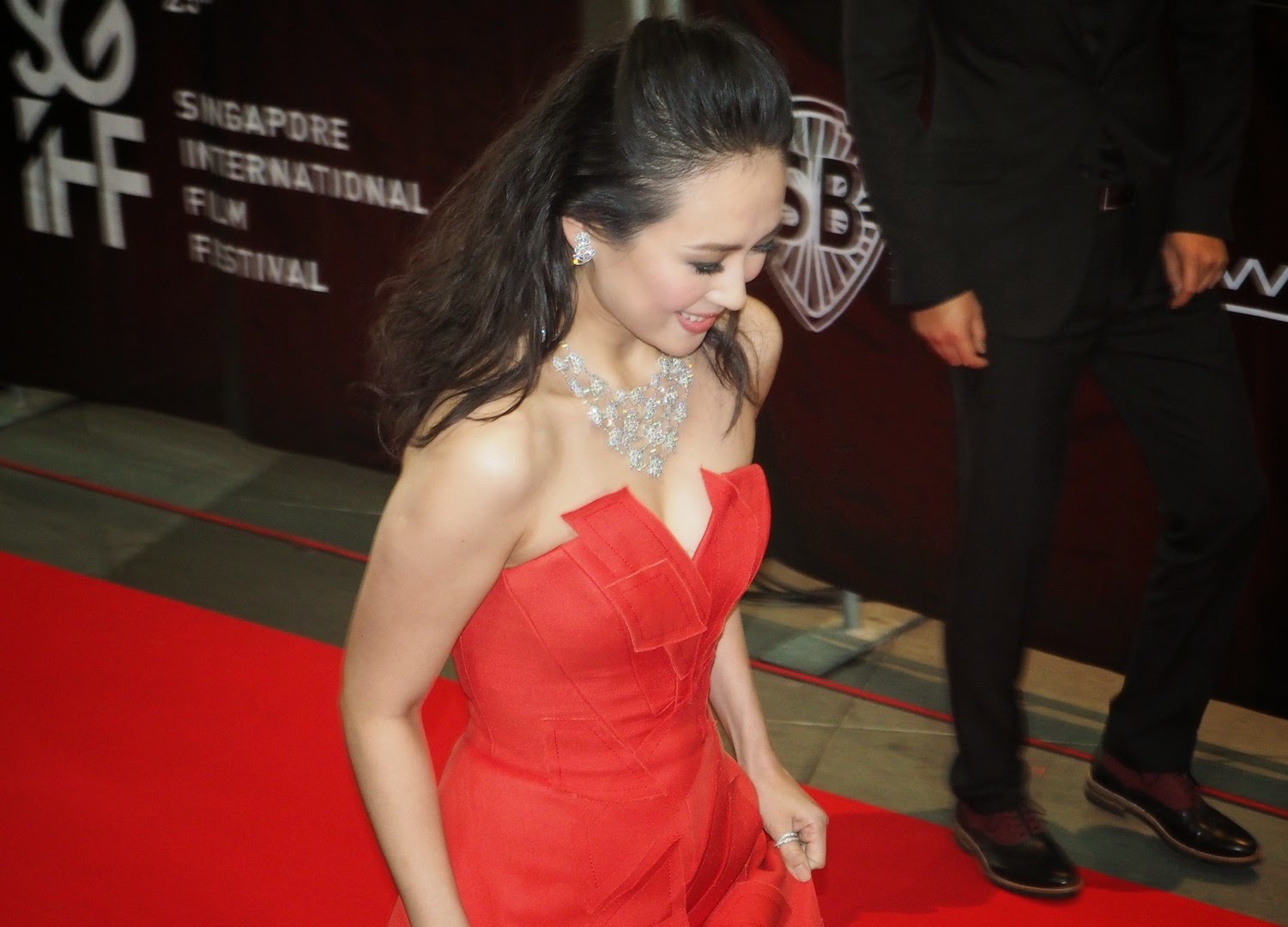
Zhang Ziyi
states that she is not a believer in over-preparing for a role. “Acting is an
emotional process and a lot of these emotions manifest themselves on the day as
you play opposite the other actors. It’s also influenced by the environment;
the costumes and the sets. If you’re in a special environment, it will draw out
emotions that you cannot prepare for. A lot of it is in the moment…if you spend
too much time worrying about every last technical detail of your performance,
it becomes rote. I don’t think that’s what performing is about.”
Touching on
the myriad struggles that her character in The
Crossing must endure, Zhang says “both Dawei and I portray characters of
the lowest social strata. They’re like wild grass, even though they grow in a
rough environment, they are very resilient. After the war, she goes to Shanghai
and has to become a prostitute. To a person this low on the social ladder, the
challenges in her life are great. She has a resilience, an ability to
persevere. This resilience is something that all successful people, be they men
or women, have to possess.”
A reporter
bravely broaches a personal question, asking Zhang about starting a family with
her boyfriend, rocker Wang Feng.” It’s actually not me pushing him to get
married, it’s the media,” she says with a chuckle. “I have never given him any
actual pressure. I feel that marriage has to happen naturally. There’s no way
to rush it, we never know what tomorrow may bring. In the meantime, we have to
care for each other.” Zhang gets her own back at the reporter, who asked the
question in English, with a dash of condescension. “Do you understand? You
won’t misquote me, right?”
The film
was post-converted into 3D and is being released in IMAX 3D. Woo explains his
personal attitudes towards the stereoscopic format, saying “there are battle
scenes and a disaster at sea, there were large-scale sequences that justify the
use of 3D effects so the decision was made to convert it. It was more
challenging while I was making the film because I had to pay special attention
to angles and focus. That was a challenge because I still look at films as a 2D
medium.” He admits that 3D doesn’t really excite him because of the limitations
in making a film in that format. “I still think it’s better to make movies in
2D because I look at making movies as like painting, composing a frame. I feel
that sometimes, 3D movies feel fake. There’s a sense of artifice, a house can
look like a doll’s house and cars and buildings look like toys. However, there
are advantages to the format but I still prefer traditional 2D movies. “
The
director famous for stylishly violent action movies reveals his softer side
when discussing the romantic elements of the film. “Normally, I’m more of a shy
person. I have to find ways to express my romantic side. Sometimes, on my way
back, I’ll pick a flower from the yard to give as a present to my wife.” Woo
and his wife have been married for 38 years. In the film, there is a waltz
sequence shared by Huang Xiaoming and Song Hye-kyo. Woo shares that when he was
younger, he enjoyed dancing with his wife, dedicating the scene to her. He also
believes in leaving his work on the movie set, saying “the general in the film
doesn’t bring the war home and spares his wife from the ugly side of war.
Similarly, I don’t bring my work home, I just want to support and care for my
wife. That’s how I express ‘romance’.”
Angeles
corroborates this, saying “At home he’s very caring and he doesn’t bring the
work home and he likes to make dinner for everyone, that’s just another way of
showing his affection. In this film, he used some memories past to really
illustrate the love story happening and that’s a very nice touch. “
“Even
though there are tragic elements to the romances in this film, I don’t want it
to be a depressing experience for the audience and I hope for audiences to
ultimately find it hopeful and uplifting,” the director concludes.
The Crossing – Part 1 opens on 4 December. Part 2 is due in May 2015.
Labels:
Angeles Woo,
feature article,
John Woo,
press conference,
The Crossing,
Tong Dawei,
Zhang Ziyi
Monday, December 1, 2014
The Crossing - Part 1 (太平轮: 乱世浮生 –上)
THE CROSSING - PART 1(太平轮: 乱世浮生 –上)
Director : John Woo
Cast : Zhang Ziyi, Song Hye Kyo, Takeshi Kaneshiro, Huang Xiaoming, Tong Dawei, Masami Nagasawa, Hitomi Kuroki, Lin Mei Hsiu, Jack Kao
Genre : Romance/Drama
Run Time : 129 mins
Opens : 5 December 2014
Rating : NC-16 (Battle Scenes)
It’s been five years since the release of Red Cliff – Part 2 and director John Woo
is back with the first film of another two-part historical epic, albeit one of
a different stripe. It is 1945 and Chinese general Lei Yi Fang (Huang) defeats
the Japanese troops, resulting in the capture of Yan Ze Kun (Kaneshiro), a
Taiwanese doctor working for the Japanese army. Lei falls in love with Zhou Yun
Fen (Song), who comes from a wealthy Shanghainese family. After Yan is released
from the prisoner-of-war camp, he discovers his girlfriend Masako (Nagasawa)
has been repatriated back to Japan. In 1948, as the Chinese Revolution begins
to take shape, Lei is thrown back into the thick of battle. In the meantime,
signaller Tong Daqing (Tong) has a chance encounter with volunteer nurse Yu
Zhen (Zhang), with whom he is immediately smitten. Unbeknownst to him, Yu Zhen
has to moonlight as a prostitute in order to make ends meet. We follow these
three couples as their paths converge, leading them to the Taiping, a Chinese steamer bound for Taiwan, a last ray of hope as
the Revolution heats up.
Everyone
has been referring to this film as the Chinese equivalent of Titanic. Well, that will have to wait
until Part 2. First, we have to sit
through what can be described as the Chinese equivalent of Pearl Harbour, a big, tragic wartime romance. Just as Michael Bay,
a filmmaker known for bombastic action films, struggled with the hokey romance
in Pearl Harbour, John Woo seems to
have difficulty reconciling the tender love stories with the battlefield
carnage in The Crossing – Part 1. The
film lurches awkwardly from bodies being blasted apart in combat to lovers
casting longing glances at each other, without ever really gelling. This is a
decidedly unsubtle film and to call it “overwrought” would be an
understatement. Every last wartime romance cliché in the book is flung into
Wang Hui-ling’s screenplay – there’s even a “wife writes a love letter as we
cut to the husband caught in battle” scene. This isn’t just cheesy, it’s cheese
that’s set on fire and one can almost hear director Woo exclaiming “Saganaki!”
in the background.
Yes,
this can be called “lush”, with faithful period recreations of post-war
Shanghai and explosive battle scenes, but the beautiful cinematography by Zhao
Fei is undercut by stilted editing and transitions, not to mention gobs of
slow-motion even where it’s plainly unnecessary. The film’s pacing suffers in
places and it is often painfully obvious that things are being padded out so the
story can be split into two films. This is a war movie that features a subplot
in which a woman struggles to compose a song for her husband. While it is
evident that this is a big-budget production (by Mainland Chinese film
standards), there are lapses in production values such as some unconvincing
digital seagulls. We saw the 2D version but even then, a moment in which a tank
hatch hurtles straight at the audience is embarrassingly gimmicky. If you have
a thing for trucks flipping over as they explode, then the climactic battle
between the Nationalists and Communists will leave you satisfied.
The
three male leads are appealingly charming in their own ways. Huang Xiaoming is
classically heroic and dashing, Takeshi Kaneshiro has the sexy/vulnerable thing
down pat and Tong Dawei’s goofy earnestness does provide welcome respite from
the heaviness of the rest of the film. Unfortunately, the female characters are
somewhat side-lined and mostly relegated to the role of “pining for significant
other while he is out at war”. Of the women in the film, Zhang Ziyi has the
most significant role, paring down her usual glamour to play the poor,
illiterate Yu Zhen. Of the three central relationships, that between Tong
Daqing and Yu Zhen is the most interesting – having never met before, Daqing
takes a phony “family photo” with Yu Zhen and a random baby so he can be
granted extra rations. It’s a shame that Lei Yi Fang and Zhou Yun Feng’s love
story is downright dreary in comparison.
The Crossing – Part 1 is a better war
movie than it is a sweeping romance, and even then it isn’t an outstanding war
movie at all. Constructed as a crowd-pleasing historical epic, the film’s
transitions from brutal war violence to soppy sentimentality are jarring to say
the least. John Woo is in his element for less than half the time here and at
least there’s an all-star cast to enact all the shop-worn tropes. Here’s hoping
Part 2, centred on the sinking of the
Taiping itself, is more focused.
Summary: The Crossing –
Part 1 is unsuccessful at being a passionate romantic epic and fares only
slightly better as an explosive war movie. Also, you’ll have to wait until May
2015 for any actual “crossing” to happen.
RATING:
2.5 out of 5 Stars
Jedd Jong
Jedd Jong
Labels:
: Zhang Ziyi,
Huang Xiaoming,
John Woo,
Masami Nagasawa,
romance,
Song Hye Kyo,
Takeshi Kaneshiro,
The Crossing,
Tong Dawei,
war,
太平轮: 乱世浮生 –上
Subscribe to:
Posts (Atom)


