Showing posts with label period drama. Show all posts

Saturday, May 7, 2016

The Witch

For F*** Magazine

THE WITCH

Director : Robert Eggers
Cast : Anya Taylor-Joy, Ralph Ineson, Kate Dickie, Harvey Scrimshaw, Ellie Grainger, Lucas Dawson, Bathsheba Garnett
Genre : Horror
Opens : 5 May 2016 (exclusively at The Projector)
Rating : M18 (Some Nudity)

Gather the children, board up the windows and shut the doors because the witching hour is upon us. In this historical horror drama, one 17th century New England family finds themselves tormented by demonic phenomena. William (Ineson), his wife Katherine (Dickie) and their children Thomasin (Taylor-Joy), Caleb (Scrimshaw), twins Mercy (Grainger) and Jonas (Dawson), and baby Samuel are excommunicated from a Puritan plantation and have to make a living on the outskirts of a New England settlement. The sudden disappearance of baby Samuel sets off a series of eerie happenings, with the possibility that a witch living in the woods beyond the family farm has abducted Samuel. The devoutly religious family attempts to make sense of these occurrences – is Thomasin herself a witch? Is the black goat Phillip being used as a vessel for Satan? When Caleb is struck with a mysterious ailment, is the illness the work of witches? And perhaps most importantly, where exactly is God in this family’s time of crisis?

            The Witch is the feature film debut of writer-director Robert Eggers, who drew on actual historical documents such as court transcripts and diaries to assemble the dialogue of the film. It’s become a festival darling, with Eggers netting the Best Directing in a U.S. Drama award at Sundance in 2015. There are several pitfalls associated with low-budget indie debuts: the film can be too indulgent and appeal only to its makers, production values might look cheap, the acting might be stilted or attempts to play around with structure might come off as clumsy. The Witch avoids practically all of these. Eggers displays a meticulous eye for detail and the cinematography by Jarin Blaschke, using mostly available light, is sumptuous in its gloominess. Going against the old Hollywood adage, Eggers had to work extensively with children and animals on this project. Additionally, he could not afford to shoot the film in New England, where the story is set, and had to settle for the remote location of Kiosk, Ontario in Canada, where he eventually found suitable forests in which to shoot. The Witch is dripping with ominous atmosphere, yet not in a distracting manner.


            There was a bit of a stir when the Satanic Temple offered its hearty endorsement of The Witch. So, this means the Satanists in the film are the good guys, right? It’s definitely not so cut and dried. The Witch is a remarkably compelling portrait of how someone’s strongly-held religious beliefs can define their way of life and their attitudes towards their loved ones. The tenets of the Puritan Calvinist faith, which are generally viewed today as repressive, govern the family at the centre of The Witch. The fear of God’s judgement hanging over their heads leads to everyone keeping secrets from each other - William wishes to keep his family together as a pious head of the household, but various factors drive them apart, with no heavenly solace in sight. While the old-timey speech and the 1600s setting might seem like an obstacle in getting invested in the story, this reviewer found himself gradually reeled in. There’s also some verisimilitude in the things that never change – the young twin siblings Mercy and Jonas can get pretty annoying, and younger siblings getting on one’s nerves seems like a universal constant.


            Young actress Taylor-Joy has to do a great deal of dramatic heavy lifting, and is supported by character actors Ralph Ineson and Kate Dickie, who were both on Game of Thrones. Taylor-Joy reminded this reviewer of a young Scarlett Johansson – Thomasin projects a sense of obedience and innocence, but there’s adolescent rebellion bubbling beneath the surface. There’s the danger that child actors can pull one out of a period film, but Scrimshaw is excellent in the role of Thomasin’s younger brother Caleb. Caleb is tempted by lust, and growing up in a Puritanical household, most certainly hasn’t had the ‘sex talk’. This could come off as very awkward, but is just provocative enough without being distasteful. Ineson’s hangdog demeanour and Dickie’s severity serve their respective characters well; these are parents who are desperately trying to hold the fort as other-worldly forces threaten to rend their family asunder.
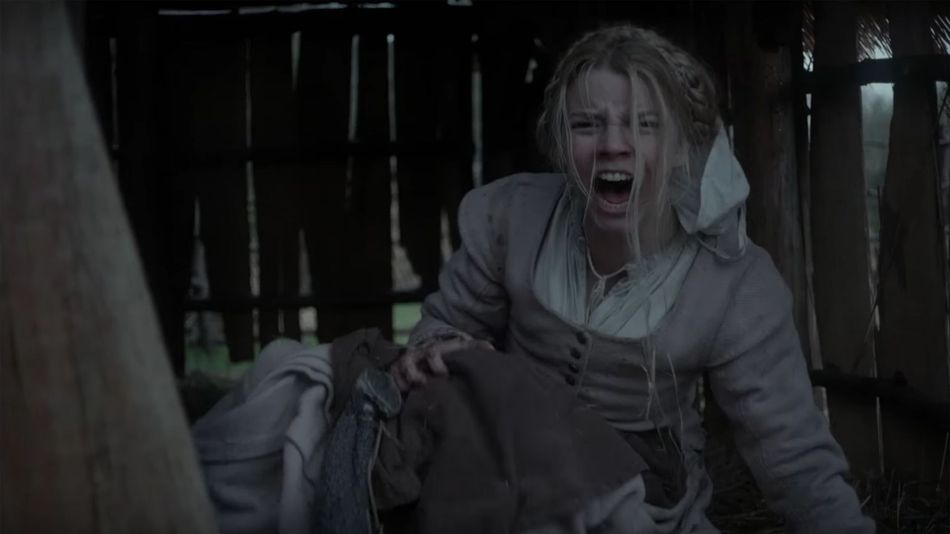


            It’s easy to see why The Witch isn’t for everyone. It’s a slow burn, and those in search of more conventional horror movie elements might be turned off by the ponderous drama and grappling with religious themes present throughout. It’s also played so seriously that certain moments can carry the slightest hint of unintentional humour. Mark Korven’s soundtrack, heavy on the waterphones, is probably the most formulaic horror movie component of The Witch. However, this reviewer did find more than enough to sink his teeth into. Genres like horror and sci-fi can be utilised as vehicles for powerful allegories; such is the case with The Witch. It’s a masterclass in creepiness that serves as a fine antidote to the production line teen-aimed horror flicks which flood cineplexes these days.


Summary: An assured directorial debut from Robert Eggers, The Witch is thought-provoking, unsettling and richly foreboding.

RATING: 4 out of 5 Stars


Jedd Jong 

Please visit this link to find out more: http://theprojector.sg/filmsandevents/the-witch/

Tuesday, October 13, 2015

Bridge of Spies

For F*** Magazine

BRIDGE OF SPIES

Director : Steven Spielberg
Cast : Tom Hanks, Mark Rylance, Amy Ryan, Alan Alda, Austin Stowell, Will Rogers, Sebastian Koch
Genre : Drama
Run Time : 142 mins
Opens : 15 October 2015
Rating : PG13 (Some Coarse Language)

We’ve had our late-summer fun with The Man From U.N.C.L.E., but with fall awards movie season upon us, it’s time to revisit the Cold War in a far more serious manner. It is 1957 and Soviet spy Rudolf Abel (Rylance) is captured by the FBI in Brooklyn. The Brooklyn Bar Association elects for insurance attorney James Donovan (Hanks) to serve as Abel’s counsel. Three years later, after U-2 spy plane pilot Francis Gary Powers (Stowell) is captured by the Soviets, Donovan is tasked with negotiating his release. The deal is an exchange of Abel for Powers. Naturally, things aren’t that clear-cut, and the East Germans have American student Frederic Pryor (Rogers) in custody. With the odds stacked high against him, Donovan flies to East Berlin to bargain for the safe return of both Americans as the threat of nuclear war between the two superpowers looms ever greater. 


Bridge of Spies is based on the 1960 U-2 incident, an actual event, with a screenplay by Matt Charman and rewritten by Joel and Ethan Coen. The title refers to Glienicke Bridge, which was the site for several prisoner exchanges between the Americans and Soviets. The film has been described as a “Cold War thriller”, but it’s more of a courtroom drama and not an action-driven spies vs. spies affair. Director Spielberg’s follow-up to 2012’s Lincoln is another sombre awards contender, but this is more accessible to the average filmgoer, less dense and scholarly. Bridge of Spies is an old-fashioned drama, with the bleakness of a rubble-strewn East Germany evoking the gloomy vision of Vienna as seen in the classic spy film The Third Man. There is a stillness about the film, which is very much a slow burn. Spielberg’s films are seen by many as varying degrees of schmaltzy. While Bridge of Spies certainly has its emotionally impactful moments, it is largely restrained and the feeling of frigid detachedness effectively captures the atmosphere of the Cold War.


If the film that surrounds him is cold, Hanks is Bridge of Spies’ warm, beating heart. In this, his fourth collaboration with Spielberg, Hanks is called upon to embody the archetype of a decent man in an indecent time. If there’s anything Hanks can play, it’s “decent” – he does that and so much more here. James Donovan is a consummate professional who is flung into unfamiliar territory but who always stands his ground, his attentiveness and upstanding nature recalling To Kill a Mockingbird’s Atticus Finch. It turns out that Gregory Peck almost played Donovan in 1965, with Alec Guinness set to play Abel opposite him, but the film was ultimately called off as the era was too fraught with political tension for it to be made. When Donovan arrives in East Germany, construction has just begun on the Berlin Wall, and the angle of a relatively ordinary man caught up in extraordinary circumstances is the audience’s way in. As Donovan is accosted by gang members, catches a cold and has to deal with Soviet and East German officials, he remains admirably steadfast, clinging to his principles, the ideal unassuming hero. 


Rylance, a veteran of the London stage, is coolly compelling as Rudolf Abel. Abel is a Russian spy, ostensibly the bad guy, but the film doesn’t demonise him, taking the stance that the Soviets had their spies and the Americans had theirs. Rylance’s Abel is unflappable and inscrutable, and the unlikely bond that Abel forms with Donovan makes for a fascinating and subtly moving dynamic. While audiences are very familiar with Hanks, Rylance isn’t as recognisable a name, and perhaps that unfamiliarity adds to Abel’s mystique. Spielberg apparently enjoyed working with the actor and Rylance will play the title character in Spielberg’s next film, The B.F.G. Defending Abel makes Donovan a very unpopular man indeed, and this takes its toll on his family, especially his wife Mary (Ryan). The scenes involving Donovan’s family and Pryor’s arrest at the border are the closest Spielberg comes to indulging his more sentimental sensibilities, but these moments are necessary to establish the personal stakes involved. 


Spielberg’s usual cinematographer Janusz Kaminski and editor Michael Kahn bring the technical polish that we’ve come to expect from his films, but one key collaborator is missing: composer John Williams. Owing to a minor health issue which has now been resolved, Williams was replaced by Thomas Newman. Newman’s score is appropriately dignified, containing his own trademark instrumentation while not sounding a million miles away from what Williams might have written. 


Spielberg has always been an idealist, and along with lead actor Hanks, he brings a reassuring, old-fashioned moral certainty to this tale set in one of the murkiest eras in modern history. Even so, Bridge of Spies avoids being naïve and manipulative in its account of the U-2 incident negotiation process. Perhaps this reviewer just isn’t that much of an intellectual, but the one action sequence in which Powers’ U-2 spy plane is shot out of the sky did make him hanker for another Spielberg-directed straight-up action adventure. Of course, that’s not the kind of film Bridge of Spies is, and it lives up to the pedigree before and behind the camera, succeeding at being a sturdy, well-made historical drama. 

Summary: As prestigious as prestige pictures get, Bridge of Spies is a restrained, quiet drama anchored by Tom Hanks’ reassuring presence, with thespian Mark Rylance stealing the show from him at times. 

RATING: 4 out of 5 Stars

Jedd Jong  

Tuesday, December 17, 2013

12 Years a Slave

For F*** Magazine

12 YEARS A SLAVE

Director: Steve McQueen
Cast:         Chiwetel Ejiofor, Michael Fassbender, Benedict Cumberbatch, Brad Pitt, Paul Dano, Paul Giamatti, Sarah Paulson, Lupita Nyong’o, Alfre Woodard
Genre: Drama
Run Time: 133 mins
Opens: 19 December 2013
Rating: M18 (Violence and Sexual Scenes)

The term “historical film” carries with it the old Hollywood-style notion of an epic scope, a cast of thousands and grandiose spectacle. In spite of the appeal of such films, what has been proven time and again is that audiences gravitate to personal, intimate stories, and that focusing on the journey of a single character or a small group of characters helps put history in perspective – especially the parts of the past that are hardest to come face to face with. 12 Years a Slave is perhaps the most pertinent of such films in recent memory.


Solomon Northup (Ejiofor) is a free black man living with his wife and two children in Saratoga Springs, New York, circa 1841. A skilled violinist, Solomon is approached by a pair of travelling performers who offer him a job as a circus musician. The next day, Solomon awakens chained in a bare room and realises he has been kidnapped and duped into slavery. In New Orleans, he is sold to plantation owner and preacher William Ford (Cumberbatch) and comes into conflict with Ford’s overseer John Tibeats (Dano). Solomon, forced to take on the slave name “Platt”, is later handed to another slave-owner, the savage Edwin Epps (Fassbender), who frequently brutalises the slaves under him. In the midst of his ordeal, Solomon meets the likes of Patsey (Nyong’o), who consistently picks the most cotton but is the most severely mistreated of the slaves, and Bass (Pitt), a Canadian construction worker sympathetic to his plight. Solomon continues to endure slavery, yearning to be freed and reunited with his family.


12 Years a Slave is based on Northup’s autobiography of the same name, a book which director Steve McQueen’s wife found and brought to his attention. McQueen had been looking to collaborate with screenwriter John Ridley (whose credits include U-Turn, Three Kings and Red Tails) on a film about slavery and settled on telling Northup’s story. McQueen, a video artist who made his feature film debut with 2008’s Hunger, has earned a reputation as a filmmaker who makes films that are worth watching but aren’t exactly easy to watch, and 12 Years a Slave definitely falls under that umbrella.


Issues of race and equality continue to rear their heads in a supposedly “post-racial” America, and different filmmakers have addressed this in their own ways. McQueen, his cast and crew have pulled off a truly commendable balancing act. 12 Years a Slave is raw and pulls no punches, but it does not come off as overwrought or emotionally manipulative and isn’t a jump-on-a-soapbox-style polemic. It’s a story that would be very easy to politicise, but McQueen resists. It’s a grim, well-painted portrait of one person’s extraordinary journey which comes off feeling largely bereft of the embellishments that tend to accompany films of the “based on a true story” genre.


Ejiofor has garnered positive buzz and has been named an awards season favourite for his portrayal of Northup, and it is very easy to see why. His performance is earnest and authentic; the determination, desperation, sadness and particularly, the humanity he displays coming together to create a person and not a faceless victim. It is also worth noting that one doesn’t get the impression that the role is a blatant awards bid, as is sometimes all too evident with other actors. It has been said that audiences might lose sight of the larger, horrific picture of the landscape of slavery at the time when presented with just Solomon’s story, but Ejiofor takes the responsibility of doing justice to Solomon Northup’s name as seriously as he should, and it works incredibly well.


The film’s supporting cast provides gravitas in spades and help populate an already-convincing period setting. Cumberbatch has had quite a year, what with Star Trek Into Darkness, The Fifth Estate and The Hobbit: The Desolation of Smaug. His William Ford continues that winning streak, the character’s presence raising issues of morality and ethics (he’s a preacher and a slave-owner) without calling too much attention to that theme. Fassbender, who was the lead in McQueen’s first two films, makes for a terrifying and truly despicable Edwin Epps and yet never makes the character a thin, monstrous cliché. The film holds the more decent Ford and the outright cruel Epps side by side and asks “Is one really worse than the other?” Lupita Nyong’o has been considered the film’s breakout star for her turn as Patsey, every bit as much the hero as Solomon is. Producer Brad Pitt’s appearance in the film is brief, a good thing since he would probably be distracting if he was in it for any longer.


At a press junket, director McQueen said “the only reason I’m here, because… people suffered and died for my freedom, and therefore, I cannot pull punches on them. It would be a disservice to them. It would be a disservice to Solomon.” And indeed, no punches are pulled in this searingly affecting biopic, Ejiofor conveying the profound agony of a man so deeply wronged. Hans Zimmer’s score lifts all too liberally from his earlier work for Inception, but that is but a small nit to pick and an insignificant complaint when measured against the thought-provoking, eye-opening and immensely powerful whole that is 12 Years a Slave.

SUMMARY: 12 Years a Slave is not easy viewing but then again, it shouldn’t be. Director Steve McQueen and a strong cast ensure Solomon Northup’s story is given the full weight and respect it deserves.

RATING: 4.5 out of 5 Stars

Jedd Jong


Friday, May 6, 2011

Water For Elephants


WATER FOR ELEPHANTS
2011 Release

Starring: Robert Pattinson, Reese Witherspoon, Christoph Waltz
Directed by: Francis Lawrence

            Based on the novel of the same name by Sara Gruen, this film seems to have all the elements for a sweeping romance: a historical setting, an orphan boy who runs away to join the circus, a forbidden love, heartthrob Robert Pattinson in the leading role...just add water. The end result is mostly delicious, but the water’s short by a cup or two.

            The film is undeniably very absorbing, thanks in most part to the lavish period setting of America circa 1931. There is old-world charm in spades, helped along by a lush and beautiful musical score by James Newton-Howard and lovely period costumes designed by Jacqueline West. The movie opens in the present day, with Hal Holbrook as an older Jacob popping up as a framing device, like in Titanic – strengthening the old-fashioned appeal.

            Unfortunately, a lot of it hinges on Robert Pattinson, who has some way to go as a leading man. His pulchritude only carries him so far, and especially acting against a force of nature like Christoph Waltz, Pattinson is stuck at the shallow end. Sorry Rob – but at times he even has trouble out-acting the elephant.

            Waltz plain steals the show out from under everyone’s noses. He’s one of those actors who can be charming and scary all at once, and displays formidable charisma reminiscent of his Oscar-winning turn in Inglorious Basterds. As ringmaster August, he plays the whole spectrum from crazed madman to insecure business-owner and weaselled husband.

            Reese Witherspoon puts in a good deal of effort, having to learn how to perform circus tricks opposite an elephant. As the woman pushed into a corner by a possessive, abusive and powerful man, she brings some palpable emotion to the table. Alas, the pairing of her and Pattinson never quite works, a spark very obviously missing between the two.

            Water for Elephants excels as a sweeping historical drama, but due mostly to the lack of chemistry between the leads doesn’t function as well as a romance. Still, it’s hard not to be pulled along by the train cars of this travelling circus.

SUMMARY: A sweeping and immersive historical drama, Water For Elephants is somewhat crippled by Robert Pattinson’s distinct lack of leading man chops, but has Christoph Waltz and an elephant to save the day.    

RATING: 3.5/5 STARS

Wednesday, May 4, 2011

The Eagle

As published in F*** Magazine
THE EAGLE
2011 Release

Starring: Channing Tatum, Jamie Bell, Donald Sutherland
Directed by: Kevin Macdonald

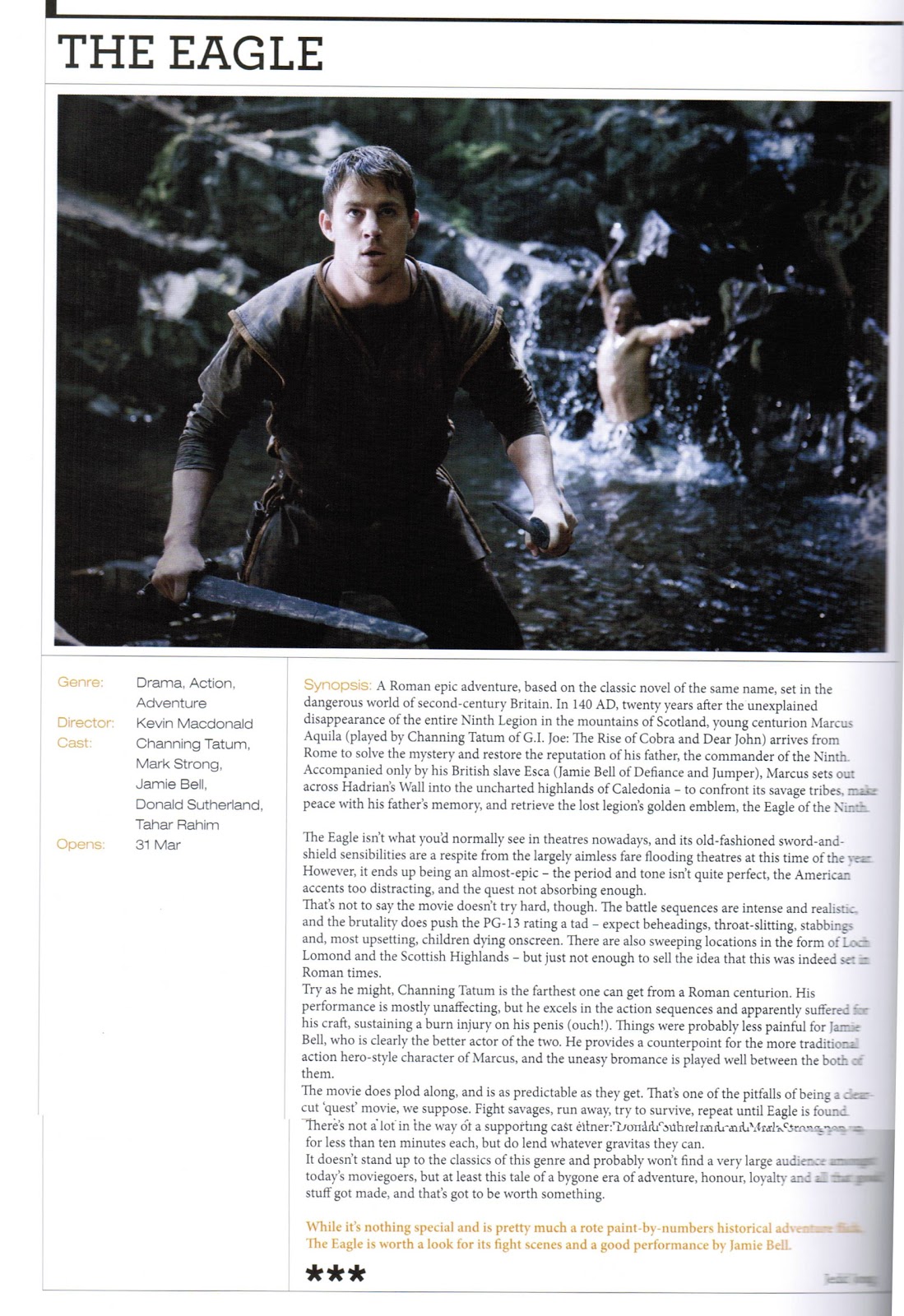
            Having played American soldiers in Dear John and GI Joe: the Rise of Cobra, Channing Tatum now adds Roman centurion to his résumé. In this adaptation of Rosemary Sutcliff’s classic young adult novel The Eagle of the Ninth, Tatum plays Marcus Aquila, a young centurion whose father mysteriously disappeared in battle, along with 5000 men and the titular Eagle standard. With his servant Esca (Bell), Marcus sets off to reclaim the Eagle and restore honour to his family’s name.

            The Eagle isn’t what you’d normally see in theatres nowadays, and its old-fashioned sword-and-shield sensibilities are respite from the largely aimless fare flooding theatres at this time of the year. However, it ends up being an almost-epic – the period and tone isn’t quite perfect, the American accents too distracting, and the quest not absorbing enough.

            That’s not to say the movie doesn’t try hard, though. The battle sequences are intense and realistic, and the brutality does push the PG-13 rating a tad – expect beheadings, throat-slitting, stabbings and most upsetting, children dying onscreen. There are also sweeping locations in the form of Loch Lomond and the Scottish Highlands – but just not enough to sell the idea that this was indeed set in Roman times.

Try as he might, Channing Tatum is the farthest one can get from a Roman centurion. His performance is mostly unaffecting, but he excels in the action sequences and apparently suffered for his craft, sustaining a burn injury on his penis. Things were probably less painful for Jamie Bell, who is clearly the better actor of the two. As the slave rescued from the gladiatorial arena by Marcus, he provides a counterpoint for the more traditional action hero-style character of Marcus, and the uneasy bromance is played well between them both.

The movie does plod along, and is as predictable as they get. That’s one of the pitfalls of being a clear-cut “quest” movie, I suppose. Fight savages, run away, try to survive, repeat until Eagle is found. There’s not a lot in the way of a supporting cast either: Donald Sutherland and Mark Strong pop up for less than ten minutes respectively, but do lend whatever gravitas they can.

It doesn’t stand up to the classics of this genre and probably won’t find a very large audience amongst today’s moviegoers, but at least this tale of a bygone era of adventure, honour, loyalty and all that good stuff got made, and that’s got to be worth something.

RATING: 3/5 STARS

Jedd Jong