A-CROSS THE UNIVERSE
John Woo, Zhang Ziyi and Tong Dawei in Singapore for The Crossing – Part 1
By Jedd Jong
Five years after the release of Red Cliff – Part 2, director John Woo
returns with the two-part romantic epic The
Crossing. The film, which focuses on three central romances that converge
aboard the ill-fated steamer Taiping
during the Chinese Civil War in 1949, has been chosen as a special presentation
for the opening night of the 25th Singapore International Film Festival
(SGIFF).
Woo, along with stars Zhang Ziyi,
Tong Dawei and his daughter Angeles, are in Singapore to kick off the SGIFF
festivities. F*** was at the press conference held at the ArtScience Museum in
Marina Bay Sands Singapore.
Woo, known for his “heroic
bloodshed” Hong Kong action films such as A
Better Tomorrow and Hard Boiled
and his Hollywood efforts including Face/Off
and Mission: Impossible 2, isn’t
necessarily a director one would associate with the romance genre. “I believe
in love, I believe that love can bring strength and warmth,” he enthuses.
“Seeing as this is a romance that takes place in tumultuous times, it is very
moving. Making the film was a challenge because of the upheaval that took place
during this period in history, making it a very painful chapter in time.” He
goes on to explain that the two-parter looks at how the three central romances
go through a trial by fire in the face of war and disaster.

Star Zhang
Ziyi says that while making the film was far from a walk in the park, it was
worth it for the chance to work with the famed director. “Everyone endured the
hardships of making this film for the opportunity to work with John Woo. I was
very moved after reading the script because the characters within are all drawn
very vividly. Everyone hopes to be able to work with John Woo. He is a good
person, he cares for us all very much.”

It is Tong
Dawei’s first time in Singapore and he wonders aloud what sweet treats he
should take back home for his kid. Zhang suggests he get some pandan cake from
the airport. Tong last worked with director Woo on Red Cliff. Regarding The
Crossing, Tong says “I feel that this is the most challenging film I’ve
worked on to date. We were filming for nearly a whole year and be it for the
actors or filmmakers, there were many firsts that we encountered. It was
physically demanding and there were a lot of special effects involved.” The
major set piece in Part 2 of the film
is the dramatic sinking of the Taiping
and shooting that required the actors to spend hours shooting in a water tank.

On the
subject of working with Zhang Ziyi, Tong reveals “Ziyi and I have been good
friends for a while but this is the first time we are working on a film
together. On the first day, it was a little awkward because under normal
circumstances, we don’t really discuss work. All of a sudden, we were working
together and it was a little weird. Furthermore, we had to film a pretty heavy
scene on the first day, the farewell scene.”
However,
Woo confirms that the actors were able to get into the swing of things quickly,
saying he was moved by their performances. “They are both very skilled actors
and brought real emotion to the roles, there was genuine feeling to it. While I
was watching them, I started tearing up.”

The Crossing is something of a family affair for Woo. His
wife Annie Woo Ngau Chun-lung has a cameo in the film and his daughter Angeles
Woo, also present at the press conference, has a supporting part as the
sister-in-law of Takeshi Kaneshiro’s character. “It’s my first time working
with my dad on a feature film. It’s my first time in Singapore too so I’m very
excited,” Angeles says. “It’s something I never thought would happen and I’m
very fortunate to be able to experience it in this film and it’s something that
I’ve learned a lot from as an actress.” She adds that having grown up mostly in
Los Angeles, it was challenging to play a character from a very different place
and time. The role required her to brush up on her Mandarin and also learn Min
Nan, the Taiwanese dialect. Host Danny Yeo jests that a scene in which Angeles
tucks Takeshi Kaneshiro into bed must make her the envy of many of the
heartthrob’s fans.
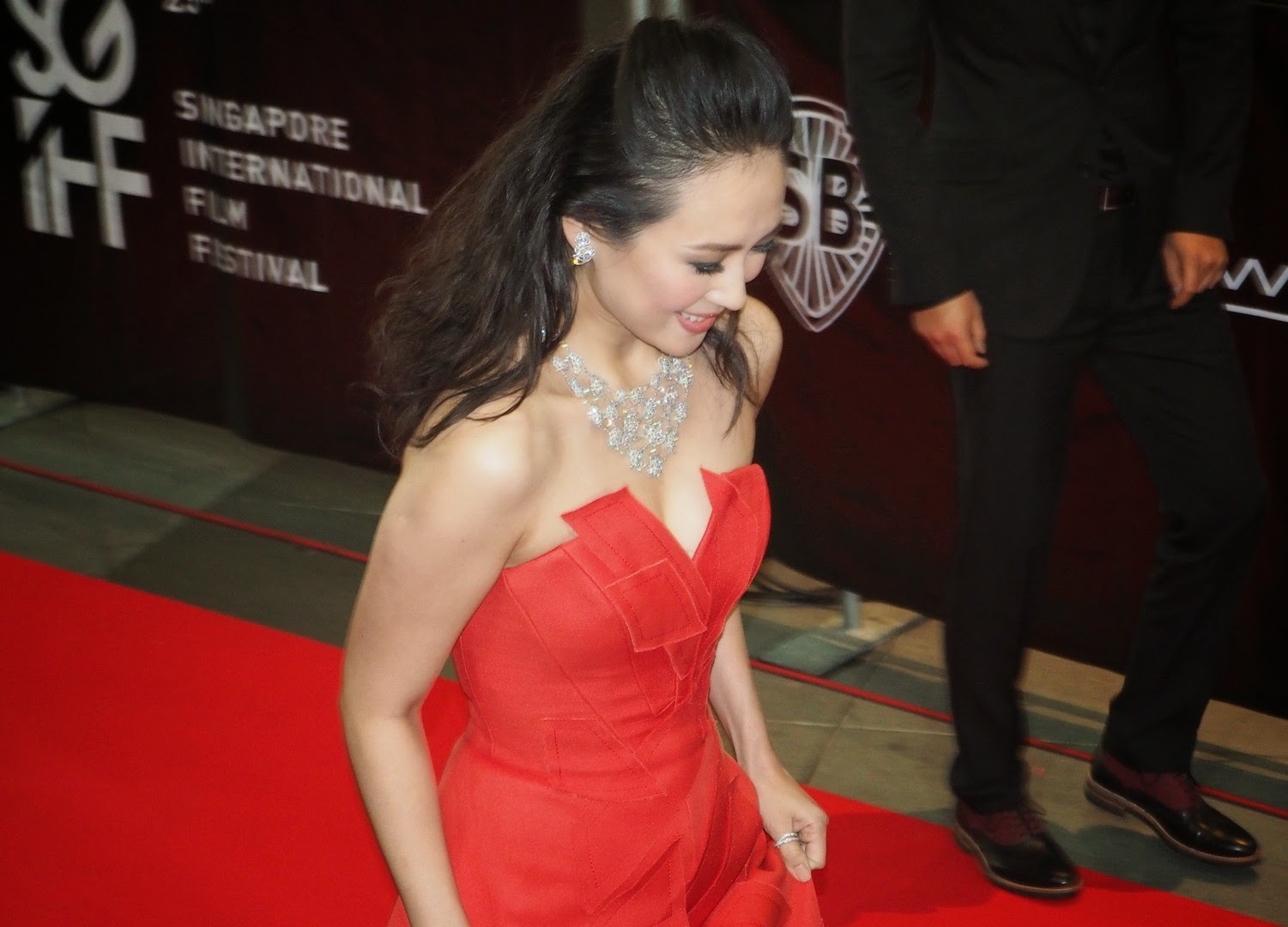
Zhang Ziyi
states that she is not a believer in over-preparing for a role. “Acting is an
emotional process and a lot of these emotions manifest themselves on the day as
you play opposite the other actors. It’s also influenced by the environment;
the costumes and the sets. If you’re in a special environment, it will draw out
emotions that you cannot prepare for. A lot of it is in the moment…if you spend
too much time worrying about every last technical detail of your performance,
it becomes rote. I don’t think that’s what performing is about.”

Touching on
the myriad struggles that her character in The
Crossing must endure, Zhang says “both Dawei and I portray characters of
the lowest social strata. They’re like wild grass, even though they grow in a
rough environment, they are very resilient. After the war, she goes to Shanghai
and has to become a prostitute. To a person this low on the social ladder, the
challenges in her life are great. She has a resilience, an ability to
persevere. This resilience is something that all successful people, be they men
or women, have to possess.”

A reporter
bravely broaches a personal question, asking Zhang about starting a family with
her boyfriend, rocker Wang Feng.” It’s actually not me pushing him to get
married, it’s the media,” she says with a chuckle. “I have never given him any
actual pressure. I feel that marriage has to happen naturally. There’s no way
to rush it, we never know what tomorrow may bring. In the meantime, we have to
care for each other.” Zhang gets her own back at the reporter, who asked the
question in English, with a dash of condescension. “Do you understand? You
won’t misquote me, right?”
The film
was post-converted into 3D and is being released in IMAX 3D. Woo explains his
personal attitudes towards the stereoscopic format, saying “there are battle
scenes and a disaster at sea, there were large-scale sequences that justify the
use of 3D effects so the decision was made to convert it. It was more
challenging while I was making the film because I had to pay special attention
to angles and focus. That was a challenge because I still look at films as a 2D
medium.” He admits that 3D doesn’t really excite him because of the limitations
in making a film in that format. “I still think it’s better to make movies in
2D because I look at making movies as like painting, composing a frame. I feel
that sometimes, 3D movies feel fake. There’s a sense of artifice, a house can
look like a doll’s house and cars and buildings look like toys. However, there
are advantages to the format but I still prefer traditional 2D movies. “

The
director famous for stylishly violent action movies reveals his softer side
when discussing the romantic elements of the film. “Normally, I’m more of a shy
person. I have to find ways to express my romantic side. Sometimes, on my way
back, I’ll pick a flower from the yard to give as a present to my wife.” Woo
and his wife have been married for 38 years. In the film, there is a waltz
sequence shared by Huang Xiaoming and Song Hye-kyo. Woo shares that when he was
younger, he enjoyed dancing with his wife, dedicating the scene to her. He also
believes in leaving his work on the movie set, saying “the general in the film
doesn’t bring the war home and spares his wife from the ugly side of war.
Similarly, I don’t bring my work home, I just want to support and care for my
wife. That’s how I express ‘romance’.”
Angeles
corroborates this, saying “At home he’s very caring and he doesn’t bring the
work home and he likes to make dinner for everyone, that’s just another way of
showing his affection. In this film, he used some memories past to really
illustrate the love story happening and that’s a very nice touch. “
“Even
though there are tragic elements to the romances in this film, I don’t want it
to be a depressing experience for the audience and I hope for audiences to
ultimately find it hopeful and uplifting,” the director concludes.
The Crossing – Part 1 opens on 4 December. Part 2 is due in May 2015.
 The second and final part of John Woo’s historical disaster epic washes ashore. Picking up where the first film left off, we continue following the three central romances as all parties are swept up in the aftermath of the Chinese Revolution in 1949. Taiwanese Doctor Yan Zekun (Kaneshiro) is caught in a bind, his mother intending that he marry Meifang (Angeles Woo), the widow of his brother. Zekun’s heart still belongs to Masako (Nagasawa), who has been writing letters to him, letters that Mrs. Yan has burned in the hopes of putting an end to that relationship. Yuzhen (Ziyi) is desperate to get on a boat out of Shanghai, believing that her fiancé is waiting for her in Taiwan. At the hospital where she volunteers, she is briefly reunited with a severely wounded Tong Daqing (Tong). Yunfen (Song), the pregnant wife of General Lei Yifang (Huang), boards the steamer Taiping with her family. The Taiping, overladen with passengers and cargo, embarks on its fateful voyage for Taiwan, a voyage the vessel will not complete.


