Text:
A LEGACY OF ACTION:
Remembering Tony Scott
By Jedd Jong 21/8/12
On 19 August 2012, Hollywood and the film-going public at large lost one of its best contemporary action movie directors: Tony Scott. While many may not know his face or even his name, his films are widely held by fans as shining examples of the modern-day action thriller, movies that were exciting to watch yet not silly, throwaway pieces of junk food. His films Top Gun, True Romance and Crimson Tide have pretty much cemented their position as classics of sorts, and some could say he is the man at least partially responsible for turning big-name stars such as Tom Cruise, Will Smith, Denzel Washington and Brad Pitt into fully-fledged action heroes. Many readers of F*** Magazine are surely lovers of these films, films that many action movie junkies have some kind of an attachment to. “Boy’s movies” that we cling to as reminders of our childhood, just like matchbox cars and model airplanes, and that followed us into adulthood with the more serious and dramatic Man on Fire, Domino and Spy Game.
Who was the man who created all these memories? Almost never seen without his trademark faded red baseball cap, Tony Scott was an adrenaline junkie in real life with a penchant for fast cars and motorbikes and who often relaxed by going rock-climbing. Anthony David Scott was born in North Shields England in 1944, the youngest of three boys. His father Colonel Francis P Scott was an officer in the Royal Engineers and his older brother was, of course, fellow director Ridley Scott (Alien, Blade Runner, Gladiator). Tony acted in his brother’s student film Boy and Bicycle and followed closely in his footsteps, graduating from the Royal College of Art just as Ridley did. However, Tony had originally wanted to be a painter, and it was his brother’s early success producing television commercials that sparked an interest in film. Tony wanted to make documentaries, and Ridley advised him to join his production company and promised his younger brother that he’d make enough money to get himself a Ferrari within a year, which he did. Over the next 20 years, Tony Scott directed thousands of television commercials working alongside his brother, looking after Ridley Scott Associates while its namesake was busy fostering a feature film career. On a sadder note, 1980 saw the passing of Tony and Ridley’s older brother Frank, who had succumbed to cancer.
The late 1970s and 80s saw something of an exodus of British directors who had experienced success directing television commercials over to Hollywood, including Alan Parker (Evita, Mississippi Burning), Adrian Lyne (Flashdance, Fatal Attraction), Hugh Hudson (Chariots of Fire, Revolution) and Ridley Scott himself . Many British directors who make it big in Hollywood these days are lauded, however during that time these directors were treated with a fair amount of hostility. In an interview with Cinema Blend, Tony Scott recalls the experience – “That period in the 80s was a period when I was constantly being criticized, and my press was horrible. I never read any press after The Hunger.” The Hunger was his first feature film, not an action flick like those he would become known for, but a horror film starring David Bowie, Catherine Deneuve and Susan Sarandon, about a vampire couple caught in a love triangle with a researcher interested in sleep and aging science. Oh, and it was dripping with blood and sex. The critical reception was not warm; renowned film reviewer Roger Ebert panned The Hunger as “an agonizingly bad vampire movie” and it launched accusations that Tony was too focused on atmospherics and style as opposed to storytelling.
Downtrodden, Tony Scott returned to making television commercials and music videos, until he was approached by the super-producing team of Don Simpson and Jerry Bruckheimer to direct a wee little fighter plane flick called Top Gun. They liked a television commercial Tony had made for Saab, featuring a car taking on a fighter jet in a pulse-pounding race, and thought he would be the perfect fit for their film. The film made waves with its aerial dogfight sequences shot in cooperation with the US Navy, the likes of which audiences had never seen before. However, the authenticity of these scenes had its price, and famous aerobatic pilot Art Scholl tragically crashed his plane while filming a sequence and neither he nor the craft was recovered – Tony Scott dedicated the movie in his memory. Once again however, the critics were not at their kindest to Tony Scott, Ebert once again offering this remark on the film: “the good parts are so good and the bad parts are so relentless”.
Tony Scott himself remarked, “when it came out I got slaughtered. ‘It represented everything bad that had ever been done in cinema.’ David Puttnam said that…But with the material I had, you can’t do it in a serious way — it had to be pop. I think it is the ultimate piece of Americana from 1986.” And that it was. Audiences on the other hand felt the need for speed, and rocketed the action flick towards an estimated worldwide gross of $353,816,701. The film made a star out of its leading actor Tom Cruise, and quickly took its place in popular culture, equally admired and parodied. Quentin Tarantino offered a humourous monologue during his cameo appearance in the film Sleep with Me, in which he analyses the homoerotic undertones Top Gun supposedly possesses, and the film was the primary basis for the spoof film Hot Shots! starring Charlie Sheen.
After the commercial success of Top Gun, the sky was the limit for Tony Scott and he quickly found himself in high demand as an action director. Simpson and Bruckheimer promptly hired Tony Scott to direct the second installment of their Beverly Hills Cop action-comedy series, replacing director Martin Brest from the first film. The film got mixed reviews, with Roger Ebert (him again) commenting, “What is comedy? That's a pretty basic question, I know, but Beverly Hills Cop II never thought to ask it.” Nevertheless, the box office take was once again sizable. Tony Scott ditched the comedy altogether for his next film, the romantic crime drama/thriller Revenge starring Kevin Costner, Anthony Quinn and Madeleine Stowe. Then, it was back to partnering with producers Simpson and Bruckheimer and re-teaming with Tom Cruise for the racing film Days of Thunder (essentially “Top Gun on wheels”)– which also introduced Cruise to future-ex-wife Nicole Kidman. Next up was The Last Boy Scout, which paired Bruce Willis and Damon Wayans as a former secret service agent and an ex-football star respectively, solving the murder of the latter’s girlfriend. There was friction between Scott, and Willis and Joel Silver (who had produced the actor’s Die Hard movies), plus the film was a slight disappointment at the box office, the Christmas-time release date of a brutal action flick often cited as a reason. However, The Last Boy Scout did singlehandedly rescue Bruce Willis’ reputation after the flop Hudson Hawk, and proved popular as a video rental title and Tony Scott counts it as one of his favourite of the films in his oeuvre.
The story goes that on the set of The Last Boy Scout, Scott had been ambushed by a pesky fan who asked endless questions about, among other things, the correct use of smoke. At the end of the shoot he learnt this cinema geek was none other than Quentin Tarantino, the same guy who read homosexual subtext into Top Gun. Tarantino then managed to get Scott to read a couple of scripts he had written, one of which became Scott’s next project: the romantic crime thriller True Romance, a sort of Bonnie and Clyde for the 90s. It starred Christian Slater and Patricia Arquette as the central couple, with actors such as Christopher Walken, Dennis Hopper, Gary Oldman, Tom Sizemore and Brad Pitt numbering among the supporting players. This time around, the critics loved it. Roger Ebert finally gave a Tony Scott film glowing praise, writing "the energy and style of the movie are exhilarating", and then up-and-comer Tarantino got a good deal of attention for his screenplay for the film. However, the edgy, violent and somewhat nihilistic nature of the film probably alienated some audiences, and the movie failed to make back its $13 million dollar budget.
The submarine thriller Crimson Tide would be something of a landmark for Tony Scott – not only is it considered one of his best and most successful movies, it was the first time he would work with Denzel Washington, who would become a frequent collaborator. Unlike on the gloriously exuberant Top Gun, Tony Scott didn’t receive government help for Crimson Tide. “The Navy didn’t give us any cooperation on that one,” Scott recalled. “They got cold feet about the plot — you know treason on a nuclear submarine!” He even had to rely on sneaky guerilla techniques to get some exterior shots of a Trident submarine. It did pay off; this time Roger Ebert’s praise was no longer faint. "This is the rare kind of war movie that not only thrills people while they're watching it, but invites them to leave the theater actually discussing the issues," he wrote. The star power of Denzel Washington and Gene Hackman was followed up with the star power of Robert DeNiro and Wesley Snipes in Scott’s next film, The Fan, showcasing the frightening extremes a sports fan might go to in his obsession with a sports star.
1998’s Enemy of the State saw Gene Hackman reunite with Tony Scott, alongside Will Smith. At the time, Smith was attempting to transition from a rap and TV career to becoming a big screen star, and this electrifying conspiracy techno-thriller surely helped his case. The film painted a frightening picture of a government with near-omnipotent surveillance abilities, able to trap and frame a man for a crime he didn’t commit. It also allowed Hackman, as a retired NSA agent who aids Smith’s character, to reference his earlier leading part in Francis Ford Coppola’s The Conversation, in which he played a similar if more sinister role. This was a film that was on the cutting edge at the time it was released, and actually does not feel dated when viewed now, almost 15 years later. Scott’s first movie of the new millennium was 2001’s Spy Game, an espionage thriller that also had an older, more established silver screen veteran paired with a younger, sexier action star – in the form of Robert Redford and Brad Pitt. Singapore’s own Adrian Pang also had a minor role in the film.
2004’s Man on Fire was the second Tony Scott-Denzel Washington joint effort Man on Fire, based on a novel of the same name (there was an earlier film adaptation in 1987, and then a Bollywood remake in 2005). In it, Washington portrayed an ex-CIA agent-turned bodyguard who goes to great lengths to rescue his 9-year-old charge (played by Dakota Fanning) when she is kidnapped. Location filming in Mexico City proved to be as dangerous and exciting as the situations depicted in the film, but Scott took it in his stride. “But I love the adventure and excitement,” he said offhandedly. “I mean, we had four bulletproof cars stolen. We had kids turning up shirtless at 3am on crystal meth carrying Uzis. We just said, ‘F*** it — take the cars.’”
Tony Scott’s next film was something a little different – a biopic of sorts, based on the life of model/socialite-turned-bounty hunter Domino Harvey. This being Tony Scott and the subject being a tough-as-nails chick, it was also an action film. The film starred Keira Knightley in the title role, chopping off her hair and donning a bulletproof vest and ammo bandoliers. Tony Scott explained what drew him to the project: “I took it on because I’m always inspired by extraordinary people. I grew up in art school in the north of England and my life has been surrounded by life’s casualties... even when I was a teenager at art school I was attracted to those darker characters. She (Domino) was definitely that. Heads you live, tails you die. That was her motto.” Critics tore it to pieces though, most weren’t fans of the combination of heady, stylishly gritty camerawork and over-embellished storytelling.
Tony Scott returned to the more familiar territory of having Denzel Washington be his leading man yet again, in techno-thriller Déjà Vu. The film also had Val “Iceman” Kilmer reteam with his Top Gun director as an FBI Special Agent who calls on Washington’s character, an ATF Agent, to investigate a mysterious ferry bombing. It combined a domestic terrorism-based mystery with high-concept science-fiction elements and is also notable for having Jim Caviezel, most famous for playing Jesus Christ in The Passion of the Christ, as a villainous Timothy McVeigh-esque home-grown extremist. Reviews were mixed and the film’s writers themselves were particularly unhappy with the end result, blaming Tony Scott for shifting the focus from their science fiction and philosophical ideas to the action scenes. Co-writer Terry Rossio stated flatly, "Tony Scott added nothing to Déjà Vu and made several hundred small mistakes and about eight or nine deadly mistakes". Rossio’s co-writer Bill Marsili was slightly more forgiving of Tony Scott, saying “while I am quite critical of the mistakes made, and while I mourn the good stuff that was cut or lost along the way, ultimately I am proud of the finished product. I hope people see it, I want them to like it.”
Tony Scott turned his attention to TV for a while, co-executive producing forensics procedural Numb3rs and legal drama The Good Wife alongside his brother Ridley, under their production company Scott Free Productions. For his penultimate film The Taking of Pelham 123, Tony Scott had his pal Denzel Washington as the leading man once again, but this time he wasn’t the action hero, he was an out-of-shape train dispatcher who spent most of the film confined to the control room, engaging the film’s villain (played by John Travolta) over the radio. The film was similar to Man on Fire in that it was also a remake of a film based on a novel. Yes, this was an action film, but it was an action film that mostly consisted of the back-and-forth between Travolta on the train and Washington in the control room. Tony Scott explains that he found this intriguing, saying, “it was really appealing and terrifying, two guys on the phone for an hour. Travolta plays it beautifully, but it’s all from the real guy. He’s funny, he’s f***ed-up. He’s dangerous. Denzel liked it because in this he’s playing The Guy Next Door, which he’s never done in any other movie.” Reviews were, once again, mixed, with the general consensus being that the remake was not superior to the 1974 film.
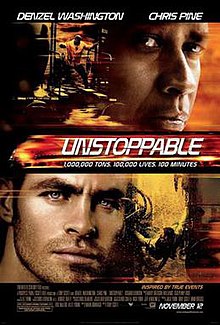
In 2010, the Scott brothers co-produced the big-screen adaptation of The A-Team, starring Liam Neeson, Bradley Cooper, Sharlto Copley, Quinton ‘Rampage’ Jackson and Jessica Biel. Later that year, Tony Scott’s final completed film, Unstoppable, was released. Like The Taking of Pelham 1 2 3, it starred Denzel Washington and was set on a train, and like Domino, it had its basis in real life. Continuing the Tony Scott tradition of pairing up a veteran and a rookie, Chris Pine joined Washington as a young train conductor. The heft of the trains barreling towards the screen at insane speeds was something Scott wanted to capture mostly in-camera, without an over-reliance on computer-generated imagery. “One of my strengths is putting the audience in the thick of it: in the seat of a racing car, the cockpit of a fighter plane, or the cab of a runaway train,” Scott said. “CGI doesn’t help with that…We’ve got freight trains going 80 mph, smashing into trucks, with helicopters buzzing overhead. You just can’t capture the intensity of that when you’re patching things together after the fact.”
There is no doubt that the filmmaker had many movies in him yet; at the time of his death he had multiple projects in various stages of production. Next year will see the release of the drama Out of the Furnace starring Christian Bale, which Scott was producing. Science fiction TV series The Sector and science-fiction drama Ion were also on Scott’s plate to produce. Reportedly, a sequel to Top Gun was in the works. As can be gathered from this article, Tony Scott did not receive the level of critical acclaim his brother did, nor did he ever win or get nominated for an Oscar, nor was he knighted. On the subject of his films being seen as more commercial and less meaty than Ridley’s, Scott commented “I always get criticized for style over content, unlike Ridley’s films like Alien or Blade Runner or Gladiator that go right into the classic box right away. Mine sort of hover. Maybe with time people will start saying they should be classics, but I think I’m always perceived as reaching too hard for difference, and difference doesn’t categorize you as the ‘classic’ category.”
However, ‘difference’ does get you remembered, and many of Tony’s Hollywood peers do hold him in high regard. The condolences poured in, and oft-collaborator Denzel Washington said in a statement to E! News, "Tony Scott was a great director, a genuine friend and it is unfathomable to think that he is now gone. He had a tremendous passion for life and for the art of filmmaking and was able to share this passion with all of us through his cinematic brilliance. My family sends their prayers and deepest condolences to the entire Scott family.” Ridley Scott has not issued a public statement at the time of this writing, but halted filming on his movie The Counselor in London to be with his family in L.A.
Tom Cruise, whom Tony Scott helped make the star he is today, said about his Top Gun and Days of Thunder director, "Tony was my dear friend and I will really miss him. He was a creative visionary whose mark on film is immeasurable. My deepest sorrow and thoughts are with his family at this time."
Joe Carnahan, who director the Scott-produced A-Team film, said on Twitter, “Tony Scott as a Director was Sui Generis. Tony Scott as a friend and mentor was irreplaceable. Tone, wherever you are, I love you man. RIP.”
Director Ron Howard put it sadly and laconically: "No more Tony Scott movies. Tragic day."
Tony Scott is survived by his wife Donna and his twin 12-year-old sons Frank and Max. Tony Scott also leaves behind a legacy of action, a filmography of a higher quality than he was ever given credit for. Samuel L Jackson said on Twitter that he was “Taking a moment to reflect on Tony Scott’s life & work!”, something we hope this article achieved. The actor continued, “My sympathies to his family. Feeling the loss!”
As do we all.