Showing posts with label toy designer. Show all posts

Friday, October 10, 2014

STGCC 2014: Frank Kozik Interview


STGCC 2014: Frank Kozik Interview by Jedd Jong


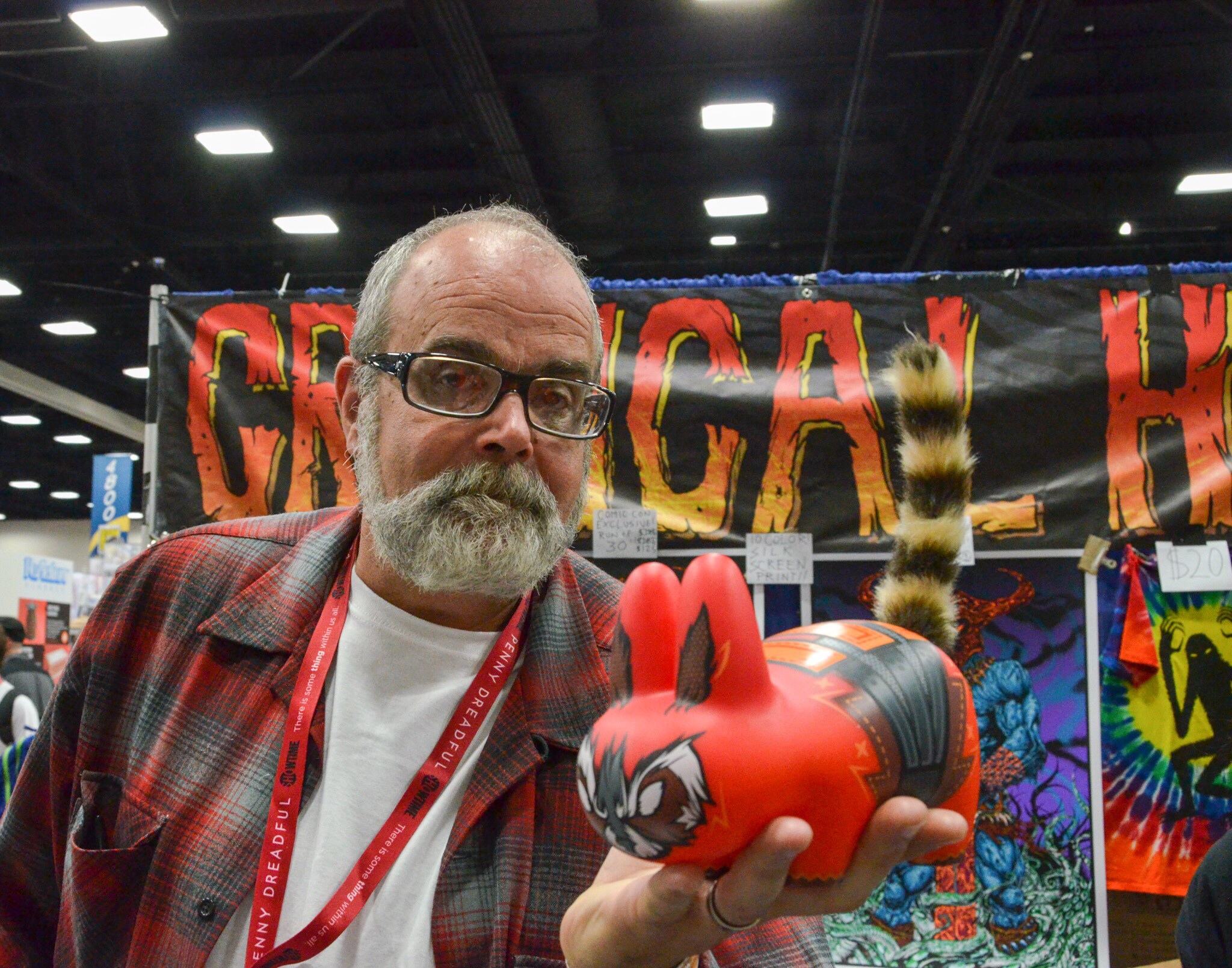
Frank Kozik with Marvel Labbit Rocket Raccoon – Image Credit: Vinyl Pulse
Artist and designer Frank Kozik is known in collectible art circles as the creator of the Labbit, but it also famous as a poster designer who created artwork for bands such as The White Stripes, Pearl Jam, The Beastie Boys and Nirvana. The commercial artwork he has done includes work for Nike, Swatch and MTV. Kozik was in Singapore as a guest of the Singapore Toys, Games and Comics Convention (STGCC) and I got to sit down with him to discuss his work. He was somewhat intimidating and frank and off-the-cuff, giving a detailed description of how Labbit came to be (it involves booty calls) and offering a surprising piece of advice to aspiring artists.
Jedd Jong: What was the genesis of Labbit; how did you conceptualise that?
Frank Kozik: That’s an interesting story. In the mid-90s, I was going to Japan quite a bit, I was working with the people there. When I went over there for the first time, I was really in Sanrio products, was really into like Hello Kitty and Keroppi and stuff, I thought it was very interesting, the stuff they were doing. I liked how they did the characters, it was like super-perfect. What’s interesting is in Japan then, it was just something for low-class people. These were are sort of like snotty Shinjuku fashion dudes, right? And they’re like “what do you want to do, do you want to do cocaine on top of a mountain?” and I’m like “no, I want to go to Kitty Land!” And they all just thought I was crazy, they were like “what?!” They couldn’t understand, it was such a low thing for them. And I tried to explain it, I said “look, there’s something really interesting here. It’s like super-perfect way to develop a character,” like you got to get beyond who buys it. In the US, it became a really big cult thing.
So they were all making fun of me, we were in a bar and they said “maybe you can make your own character,” like I was the idiot, right? So I said “okay” and I did this little…it was actually a rabbit but it looked like my cat and I showed it to them and they all sort of were like “oh…that’s actually pretty good, maybe that’s going to work” and they all got kind of bummed out. So what I’ve done in my small way, we never have any mainstream advertising but in the last ten years or so, we generated over $20 million in revenue, which is pretty good for an independent thing, to make all that money.
That was my sort of experience and the whole thing with the Labbit was I wanted to make a Hello Kitty-type of character, but I also wanted it to reflect a little bit of punk rock, so kind of like the Labbit is like…you guys have the term “booty call”, you know what a booty call is? It’s like 3 in the morning and you f***, right? The Labbit is who Hello Kitty booty calls and Dear Daniel doesn’t know anything about it. He’s just like the dirty guy at the bar who’s kind of sexy and she’s like “okay, let’s have some fun” and then won’t talk to him for a few months and he doesn’t care. That was the kind of idea, a cute character who’s a little dirty, so it has balance. He can be a nice character, he can be a dirty character, he can be you when you’re in a bad mood, that kind of idea is what I tried to develop and I think it’s worked really well. In the United States, it’s become a very popular character and the appeal is going to regular people, a mainstream appeal is starting to happen. So it out as an experiment and like I said, there’s never been big money behind it, never done any kind of advertising, it’s just been a word of mouth, self-generated thing.
You’ve just come out with the Rocket Raccoon Labbit with the flexible tail…
The Rocket Raccoon character, it’s kind of a cool thing with the flexible tail with the wire in it. It’s done real well, the movie’s really popular and it’s a cool character.
And Rocket Raccoon is a dirty character who’s also cute!
Yeah, that does make sense.
What message did you set out to send with your Ultraviolence Toys line?
Those are totally personal so all the Ultraviolence stuff, which is like the political thing, the big army men and the weird s***, that’s just stuff I want to have. Like that’s something I want for my office or whatever, and since they don’t exist, I have to make them. And it’s expensive, I like them being manufactured, I don’t like one-of-a-kind art sculptures, I really wanted it to exist and actually have the manufactured model. So basically, I market and sell those just so I can have them. They’re totally personal and I thought “nobody would ever buy any of them” but they ended up doing really well, so that was kind of a bonus. That was the one thing with the toys that was purely just a personal sort of artist’s statement thing that ended up being kind of profitable.
So it wasn’t like a political statement that you were trying to send out?
Well, it’s more like my riffing on combining ideas and values in politics and things and also, if you want to get really serious about it, I’m really fascinated with like 60s pop art and like bad public art. There was a phenomenon in the United States in the 70s where there was a lot of horrible public art that was really expensive, you’d go downtown and there’d be a statue of a giant foot or something and those things are still around, they’re all like decayed and s***ty. So I had a fantasy that if I had been approached to do like a giant piece of public art for the waterfront, that would be it. So all of those kinds of…thoughts about politics and society, like cultures meeting, the Mao is really about that. The Mao is like “okay, he became the last emperor of China, but it’s a China he didn’t want.” Like he’s the emperor of the capitalist future. Hence it’s Mao, very formal, but the mouse ears represent western capitalism and the cigarette was because he was a heavy smoker, they were covering that up, so it’s him in his natural statue. Plus it looks cool, right? It looks nice, it has some presence.
Have you kept in contact with any of the bands you did art for in the early days?
All of them. You have to understand like I’m old. All those bands always had a first tour in a small club and nobody watched the show. I worked in those clubs, so all those bands that became famous, I worked in the club where they had their first tour, I did the local poster. I lived in Austin, a city in the middle of the country which was the only local city [the bands would stop at]. So all of the underground culture, the bands would travel from coast to coast and Austin was the only place they could stop, do a show, make some gas money, so every band would stop to do a show there. It was a small college town with many small punk clubs and rock clubs. So all the bands that became super-famous, you have to understand, they all at one point were just like four guys in a van with no money. I was just there at the right place at the right time doing local posters, working in the club, met them, watched the show, made friends with them, maintained contact. Later, when they became bigger, they needed a tour poster so yes, I met and hung out with all the bands, all of them.
Will you go back to poster design?
I still do posters, it’s like a hobby now. Last year, I did a bunch of Eddie Vedder posters, so I still do posters for Pearl Jam. A lot of bands have a huge cult following. There’s this band called 311, they’re like okay, I did their posters years ago. They have a huge cult following and their posters sell very well. They all work with like these merchandising companies so there’s no pressure, I can do whatever I want. And it’s fun to do, I don’t care whether or not it’s good for them anymore, basically I just play and actually the posters sell very well. I do fine art prints all the time.
What kind of music do you listen to these days?
I listen to boring new metal. There’s a new band, relatively new band called Weep and it’s kind of slowed-down, weird faraway vocals. They have a couple of albums out, they’ve got stuff on YouTube. J Mascis did this crazy metal band called Witch. And there’s a new band in England called Uncle Acid and the Deadbeats, they’re really great, they sound like they were recorded in the 1960s-70s, evil biker Satan rock music. So that’s kind of what I listen to, like new metal-y kind of s***. I don’t listen to any like punk bands. I like ambient stuff that’s weird, I’ll just come across stuff.
We’ve seen hand-drawn poster art, particularly for movies, on the decline. What do you think it will take for a revival of that?
There’s an enormous one going on right now in the United States. If you look at a couple of websites like gigposters and the Alamo Drafthouse Mondo poster series, it’s all hand-done, it’s all super-amazing, it’s a huge thing. There are hundreds of poster artists doing thousands of posters every year, it’s just not mainstream. The Alamo Drafthouse series, all that is is they show old movies and then hire artists to do new posters for them and then they market and sell those posters. That s*** is like astounding. So there actually has been an enormous revival over the last 15 years. The s*** you see will blow your mind.
The studios wouldn’t use them as the A-poster though.
Well, that makes it kind of cool. You have to understand you know, I do commercial artwork and post people don’t have good taste. Most people, like if you a really elaborate, beautiful hand-drawn thing, they’re not going to understand why it’s cool. They have no context. They don’t collect stuff, they don’t know the history of movie posters, they’re just people who watch television. So the public wants the movie studios to put the movie stars’ face [on the poster] because that’s all they see in the magazines and on TV. They don’t care if the poster is artistic, they want to go and see the movie, right? They’re not collectors, they’re not into art, they want to go and be entertained and see a movie with their favourite actor, they don’t care about anything else. People who come here and collect are different, so at least there’s an alternative underground.
It’s okay that it’s not the mainstream version because the mainstream won’t appreciate the effort anyway. There’s two worlds, so there something for each of them, I’m not going to say one is right and one is wrong. Maybe we’re all abnormal. Being a collector is not really a mentally healthy thing, believe me. So I’m not saying one is better than the other, it’s good that both exist, because what it does is it allows really crazy superhero movies to be made. I’m 52, when I was 17 years old, movies f***ing sucked! Star Wars came out and things started to change, but I remember going to the movies before Star Wars, it was nothing that great, like for a kid. Sure, there were great movies, but you had to be mature to understand it, as a kid movies kinda sucked. It’s different now, you go see something like Guardians of the Galaxy, f***ing mind-blowing. But it’s dependent on like reaching the mainstream audience because it costs a lot of money to make, I’m just happy both things exist.
And I’m glad Guardians did so well because so many people were saying “this is going to be the first flop for Marvel Studios…”
It was funny dude, they had charismatic acting, there was no story, it was like a comic book come to life. They weren’t trying to make it be logical or realistic or anything, it was just cool.
What kind of toys do you collect, do you collect the mainstream mass-market stuff too?
No. It’s changed over the years, I mean originally like starting in the late-70s, I was heavily into Bandai die-cast toys, like all the crazy toys based on TV shows, where it would be like “it’s a talking stove!” or whatever, “an ape-man!” And then, as I had more money, I started collecting the more intricate Bandai stuff, like the big Tetsujins. Bandai made really, really nice stuff in the 80s, all die-cast, all articulated, all magnetic, they made some crazy s***. From the little goofy stuff to like the huge…I was really into that for a long time, and then it got really expensive and I stopped collecting that and I actually sold my collection. Then I got into vintage tin space toys for a while, collecting those for a long time and those got more expensive, sold that collection.
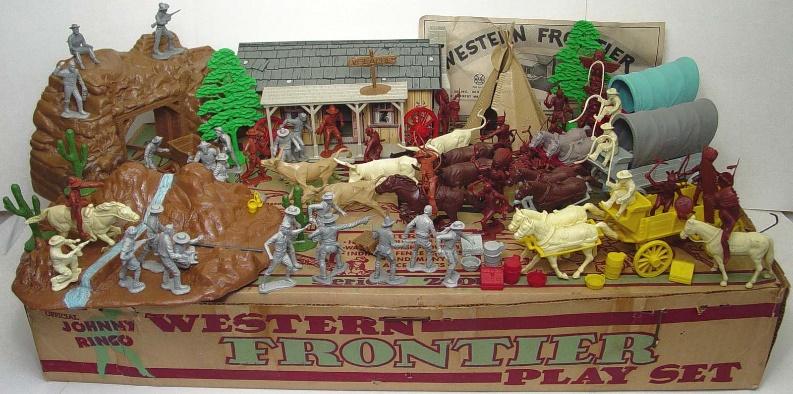
image01
I’m really into this company called Marx Toys, it was an American toy company from about 1920 to like the late ‘70s and they made some really amazing s*** over the years, like metal toys, plastic toys, all this kind of stuff, so I collected Marx playsets, they made these really great playsets. And then like I said in the 90s, in the late-80s, I started going to Japan to do stuff and I sort of got turned on to the Sanrio character thing. I got really into that. I never was into anime, I was never really into the Macross thing or Gundam stuff, too complicated. As time went on, I got more and more into simpler stuff, refined Japanese toys, simpler and simpler, sort of ultimate perfection stuff.
These days, I don’t really collect specifically anymore. Once in a while, I see something that [I like]. It’s got to be something really odd. My favourite toys are bizarre, generic toys, like it’s a weird s***ty toy from like Argentina, but it’s made in such a vacuum by like some weird dude in South America that it’s a super-perfect cartoon race car, it has no context whatsoever. Like the last 10 years, I really like collecting stuff that’s like entirely unknown, like some weird toy that some normal person made just to make money but somehow, it just came out really cool. They’re kind of hard to find, but I’ve got a nice collection of kind of weird [toys].
There was a small toy company in America in the 50s called the Erie Toy Company that was a normal place, a plastics and one year [they went] “we should make toys!” So they just made these bizarre, generic plastic toys out of hard plastic, but they’re like so generic it’s perfect. “It’s a truck,” “it’s a boat,” “it’s a race car.” They made this one thing, a clown car with an organ and a monkey playing it. And they’re like weird hallucination toys you’d see in a dream, because they didn’t know what they were doing. They sold them locally or some s*** like that or maybe they had some deal with a store. I’m not stuff like that these days, if that makes sense, where they’re just bizarre objects that don’t fit into any category. Lots of interesting like communist toys too, all the communist countries made toys, but it would be the weirdest design. It was like some dude in Poland going “I will make a toy for children”. Weird s*** like that, I’ll look on eBay and stuff like that. It’s not like there’s a whole bunch of them, they’re singles. They have to be weird and cheap. I have a really cool [bootleg] He-Man, that weird s***.
What is a day in the life of Frank Kozik like?
Really boring. I have a whole routine: I get up really early, I make a cup of coffee, I feed the cats, my wife is still asleep. I’m lucky my studio is the same neighbourhood as my house. I’ll walk to the park, go to work and just work 12 hours a day and then go home, have dinner and go to sleep.
Do you get artist’s block?
Never, never. I work every single day, 12 hours a day, I’m always productive. I’ve never had a day I didn’t work.
If you weren’t designing toys and posters, what would you be designing?
Everything. What I do is I have a large studio with different areas, so I can do digital work, sculpting, I can cast resins, I paint my own toys, I have a painting area for fine art, a drawing area and so I have a schedule. I have a production schedule, I’m always getting jobs, I’m always planning releases so I have a very elaborate schedule like 5 months in advance and it will be like “Monday I have to do these 5 things, Tuesday I have to do this, Wednesday I spend all day working on that” so there’s a schedule and I just go and work every single day. I do all my social media like in the morning usually, I do all my social media work for an hour a day, I have a lot of followers. I’m on Twitter, Instagram and have two Facebook pages and they all require a different approach, different kinds of people on different social media. I have to do all my business calls, every day is very, very full.
For those who want to turn their artistic hobby into a career, what advice do you have?
Don’t do it. No, seriously, become a doctor or a lawyer, something where there’s a health plan and a pension. There’s too much competition. I’m lucky I started before the internet, that was never a good situation but today, it’s a blessing and a curse. There is so much competition and everybody is really, really good, so it’s become noise. It’s like unless you’re very lucky or have a very good idea or have a rich family, it’s impossible. If you have to do it, do it. But my advice for someone who’s like “I don’t know what to do” is “no, no, go be an engineer.” You know what I’m saying?
Singaporean parents will agree.
image02The thing is, the odds are like getting struck by lightning. It’s like yes, there are a few hundred people who can make a living being creative, but that’s it man. There’s no room for it. And I’m talking like both America and Europe, there’s only 2-300 of us. Every year, it’s very heart-breaking because in North America, going to art school is very expensive. It costs hundreds of thousands of dollars, so many families will do that and the schools don’t teach you anything, it’s totally f***ing bulls***. So the kids come out of art school, there are no jobs for them, they’re in debt, it’s idiotic. I go to give lectures in schools and the first thing I say is “drop out of the school. Tell your parents to rent you a work space and buy you tools and just start making s*** because your chances of having a career will be better if you do that than if you spend four years in school doing nothing and then getting out with debt. No one’s going to hire you. There are no jobs.”
If you want to be a real creative, like “I want to be like a guy in an advertising firm that specializes in some bulls***” then yes, you can go to school and you can do that, but if you want to be an artist, the only way to do it is you have to just work a lot. Sitting in a class is not going to do it for you, no one cares about your portfolio, no one cares that you’ve got good grades because who are you? When you get out of school, you are nobody. You have no access to work space or materials or anything, so why do you waste the money? If your parents are willing to pay for school, they should be willing to go “f*** it, here’s the money, start a business”. This is my experience, because a lot of people want to do it. It’s like [how] everybody wants to be in a band but there can only be like 20 top bands. Time goes by fast and there’s a lot of competition. But by all means, if you really want to do it, do it. Dude, I’m 52 and I still have to work all day. It’s not like you get to retire or something. You’ve got money in the bank and everything but you’ve got no pension, every day I have to make something fresh.
Like Bill Mantlo, the writer who co-created Rocket Raccoon, said “don’t be a creative, become the people who are the exploiters because the creatives get exploited.”
Yeah. Over the years, I’ve learnt to exploit myself. It works okay.

Monday, September 9, 2013

STGCC 2013: Nathan Hamill interview

NATHAN HAMILL INTERVIEW
STGCC 2013 – 31/8/13
For ActionFigurePics.com

I got to sit down with toy designer and illustrator Nathan Hamill at STGCC - it ended up being my only one-to-one interview and I enjoyed it; he's very cool. And of course, he comes from cool stock. Let's start this party with a bang! 

Jedd: Welcome to Singapore!

Nathan: Thank you!

Jedd: Are you having a good time so far?

Nathan: Excellent. First time here and it's stunning, it's incredible. The weather was perfect yesterday; it's great so far. 

Jedd: I had a look at your Twitter feed, really cool stuff. Beneath your handle, it says "I makes what I likes". What do you think has been the most rewarding thing of living by that maxim? 

Nathan: Yeah, "I makes what I likes" is just...first of all, I think it's funny because it's using improper English, which makes me laugh. Like "I makes what I likes", yeah...I try to keep it as simple as that. So yeah, my motto, "I makes what I likes", at the end of the day it should come down to whether or not it's something that you enjoy, not to be too convuluted about what your themes and what your concepts are. Yeah, that stuff is good and fine but I guess I'm trying to...you know, take things less seriously. 

Jedd: So, inevitable question: was Star Wars a big part of your childhood and did the early Kenner toys inspire you to pursue toy design?

Nathan: Well, that's the thing, it took...when I finally figured out that I wanted to do this, I kind of thought "why hadn't I thought of this earlier?" It was a marriage of two things I've always loved: I've always drawn as a kid and always collected toys, so why not combine the two? My Dad jokes that my first word was "Kenner". Not true, just a joke. 

Jedd: Was there a lot of "I'm feeling a little bit mad at Dad so I'm gonna take it out vicariously 

on Bespin Luke here"?

Nathan: Not that I remember, you know, but maybe a few chew marks. 

Jedd: So you've worked with Bongo Comics; do you feel more of an affinity with The Simpsons or Futurama?

Nathan: Simpsons. I mean it's been around longer, it's just...I grew up on The Simpsons. Futurama came later, I still like Futurama but The Simpsons are...can't top that.

Jedd: Who's your favourite Simpsons character to draw? 

Nathan: Oh, to draw...I would be the Life in Hell character, the one-eared rabbit Bongo. Other than that, probably Homer. 

Jedd: There's the Matt Groening signature hidden in Homer's hair...is that like something that all the artists are briefed on before they work on the Simpsons comics? Like "you have to keep the Matt Groening signature" in there...

Nathan: Oh, actually I'm a colorist so I don't draw them, I draw them for fun but...I knew that before working there, because I was just so obsessed with the Simpsons like...I started working for Bongo; I was the go-to guy for questions. They go, "we need uh, JFK" and I go "Season 4, Duffless" And they would go "okay!" and they would go get the model sheets, so...I'm like the Rain Man of Simpsons.

Jedd: Nice, "Rain Man of Simpsons." If you could do a project involving a comics supehero/villain, one of those Marvel or DC characters, who would you like to put your spin on?

Nathan: Uh...Lobo. My favourite.

Jedd: Nice. Have you seen what they've to him in the New 52?

Nathan: No.

Jedd: They made him skinny, sensitive Lobo.

Nathan: Emo Lobo? 

Jedd: Yeah, with the little beautiful facial hair...

Nathan: Emo? Well that's...no, I like "Lobo's Back", that's my favourite. 

Jedd: I was talking to the Army of Snipers the other day and J*RYU had some very interesting things to say about hte label "desinger toys". So what do you think about the line between a toy and a piece of art, and what do you view your creations as? 

Nathan: Um...that's a good question. We were talking about that last night and whether like "designer toy" maybe makes it seem...too stuffy, maybe something you'd find at like an architecture show...you yeah, I don't...that's a tough one. I almost...that one I might leave up in the air because I love to say...talking about art is like dancing about architecture. There's a certain point where you kinda just leave it... leave it up to other peoples' interpretation. Yeah I guess I'll refer you back to "I makes what I likes" and just keep it...that's an ongoing question, that's a question that I'll have an answer to maybe next year, if I'm invited back.

Jedd: Sure, I look forward to it! Did you do customization when you were starting out; did you take existing toys and modify them? 

Nathan: Yeah...I mean it was actually...I sorta did it in an odd way which is I started customizing Boris, the first toy that I did. So we released the toy and had like 50 artists customize it. I think it was about 50, so um yeah, I customize from time to time.

Jedd: What's your view on the big commercial toy scene, the Mattels and the Hasbros? 

Nathan: I think there's...I collect lots of different types of toys, I think there can be a little bit of a...snobbery involved in toy collecting, where people will look down on you if you buy this or that or the other...and it's like "if the quality is there". For example there was a...Toma did a Godzilla toy in...it was in Toys 'R Us and it was mass produced but it was very well-made. It was a really high-quality toy, and just because it was in Toys 'R Us and it was sold for $18 vs. if the exact same toy was sold for $60, people would snap it off the shelves and they wouldn't look down on it...it all has to do with quality. So...as Kozac said, "make multiple". If you can make more and the quality's there, I feel like that's good.

Jedd: J*RYU said that he preferred the term "commoditized art pieces" to "designer toys", and he was talking about how the guy who did Dunny? I think his son was saying "Dad, my friends would like to have one of your monsters" and he was like "these are art pieces, these are $150 each" and when he was manufacturing it, people could have a hold of one for $10. 

Nathan: Is that Tristan Eaton and the Dunny? 

Jedd: I think it was Ryniak.

Nathan: They were limited edition ones? 

Jedd: I think it was a partnership they did with like Urban Outfitters...that the toys would be available at those stores.

Nathan: At KidRobot through Chris Ryniak? Not even stuffy and no...listen. J*RYU...when he was on Toy Break, he was so insightful, he knew a lot of stuff. I like to play around with it, I say like at the end of the day, they're just words. But it's good to have a dialogue, so I just...I'll say "that J*RYU's a snob!" Just kidding. 

Jedd: (Laughs) This is going to be the headline. 

Nathan: (Laughs) Fight! Fight! 


Jedd: The headline on the tabloid that I write for (laughs). I think you've been asked this a lot, but what was your experience like hanging around on the sets of the Star Wars films? In Episode I you had your cameo and before that...


Nathan: Well before that...well, I was so young that it was just a vague memory...like I kind of remember tall trees and little bears...you know...

Jedd: (Laughs) That should have been the tagline for Episode VI. "Tall trees and little bears".

Nathan: So for those I was...I mean I was probably two, two and half when they were shooting the third one (Return of the Jedi), you know, so...I don't...I wasn't making memories yet. And for Episode I, yeah, that was very cool to go over there and see the sets...it's just...there's a certain smell you get when you're on a physical set, it's a lot of fun. But the first one I just have photos, I don't have first-hand knowledge of that, so...

Jedd: Can I ask how you feel about Hasbro's Black Series? Now they've finally done Star Wars figures in six inch scale and everyone is going nuts and is like "ahh, why didn't you do this 20 years ago?!" 

Nathan: The Boba Fett is like...not only one of the best...it's coming out in Series 2. Boba Fett is where the focus is; Han Solo is an okay sculpt...it's great, I have that and the Artoo one and they're fantastic. It's gotten me collecting them again, so...I'd stopped for a while. 

Jedd: Is there a particular piece of your collection that holds a certain sentimental value for you, something that was hard to find or hard to get...

Nathan: Oh, that's a good...let me think about that...yeah, it's not a toy, there's an Empire Strikes Back tote bag, it's like a mini bowling bag thing that was something I got to...something George Lucas gave me when I was (little)...I carried all my figures in it.

Jedd: Like a carrying case...so cool. Do you have any insight, any views on Number 7? 

Nathan: I can tell you but as the saying goes, I'll have to kill you (laughs). I…yeah, I don't know much, and what I know I can't say. 

Jedd: Are you excited for it? 

Nathan: Yeah...yeah! I'll be there, I'll be there first in line, so yeah. 

Jedd: Thank you very much, I think I'm about done and it was great talking to you! 

Nathan:  Yeah, thank you! That was good, that was good. 

Here's the interview over on Red Dot Diva.

Tuesday, September 11, 2012

Mark Nagata Interview at STGCC 2012: Part 2

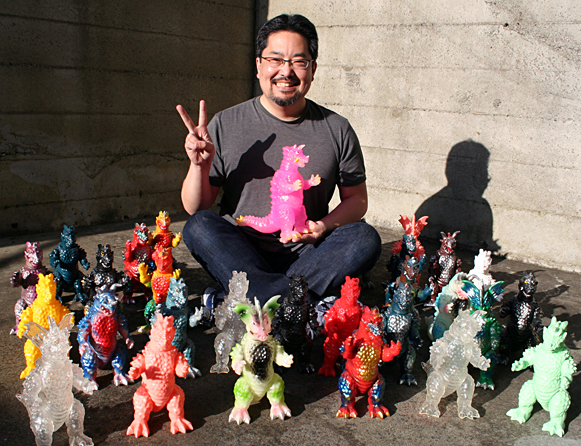
Hey everyone, here is part 2 of my interview with toy designer/collector and illustrator Mark Nagata of Max Toys Co.

For ActionFigurePics.com

STGCC 2012: Interview with Max Toy Co’s Mark Nagata – Part Two

Mark Nagata

Source: Max Toy Co

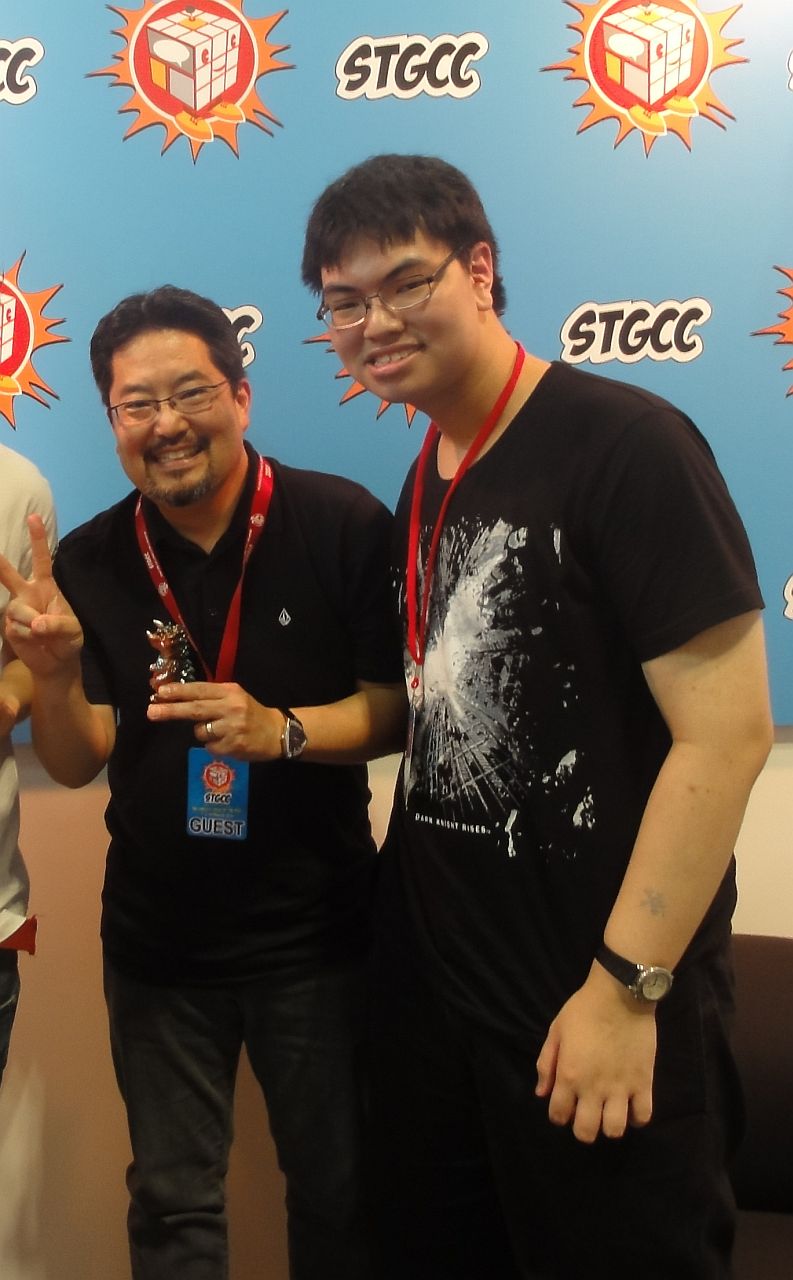
Mark Nagata of Max Toy Co was kind enough to speak with Jedd-the-Jedi at STGCC. If you missed it, click here to check out the first part of the Mark Nagata interview. In the conclusion to the interview, Mark tells Jedd about finding his toy Holy Grail, his top five toys, and more!

Do you have a special story of a collectible toy of any kind that you obtained through extraordinary circumstances? Have you gotten a hold of something you never dreamed you’d be able to own in a million years, something so extremely special?

(Laughs) Yes, I do! Yes, I do have a story about that. So, there’s a Bullmark figure, which is a Japanese company from the 1960s and 70s, and they issued, in very small numbers, a standard size Ultraman figure in red vinyl. Now the reason why they released it in red vinyl is they were hoping the colour red would appeal to girls, instead of the grey or like silver colour of what Ultraman is supposed to be. But Ultraman never was red in the series, and then the girls hated the figure anyways, so it never sold, it was a flop for them.
So going forward when I started collecting the figures in the late 80s-early 90s, and I’m doing research about all the different types of figures I had to find, when I found out about the red Ultraman that was always at the top of my list, like if I go back to Japan I’ve gotta look for this, or if I’m looking at eBay or Yahoo Japan or something I gotta find this. So on one trip to Japan, we were in the Nakano mall, which is a very famous mall with like different shops, like Mendorake and toy stores.

One of my friends said “Hey, go look over in the case; I think that’s something you’re looking for!” So I walk over there and there’s a red Ultraman sitting there right, so I was like “oh my God”, and I had to find out, I had to go over and ask how much, right? So I went over and in my very, very poor Japanese asked “Ikura desuka?” – you know, “How much?” And the guy goes “$5,000” – USD $5,000. I just thought… ”I can’t, I can’t. My wife’s gonna kill me!” And I only had $2,000, that’s all I had – for the whole trip, so no way, and I don’t wanna use credit card or anything. So all my friends said “Oh, you know, I’ll loan you a couple of hundred dollars, maybe you’ll get enough to make a big pool or something,” and I said “No no no, I don’t want to have to owe you guys!” So, I left.


So about a week later, I come home to San Francisco, and I’m still thinking about that figure. I can’t believe I couldn’t get it, right? So I’m looking around my room and I’m like “okay”, I have maybe $1,000 saved for toys, but maybe can I sell $4,000 worth of things to get the $5,000? So over the next three weeks, I gather up all kinds of figures and I sell them. And I raised the $4,000, plus the $1,000 I had saved, so I had $5,000 ready to go.

I have to email another friend to run down to the store to make sure the figure is still there, and luckily, it’s still there. So I PayPal the money to my friend, he goes down a second time, buys the figure, and so I tell him “Look, you send it to me EMS. Full insurance, please $5,000 insurance. Put it in a secure box, lots of tape, lots of bubble wrap, this is… this is it, this is my Holy Grail. I’ll pay whatever it costs to get it to me!” He was like “No problem, no problem.”
So a week later, the mailman comes and, you know, EMS box, and I’m looking at the box. It’s a shoebox, a Nike shoebox. It’s crushed. So, it goes like this (an indentation) right in the middle. EMS, it’s from my friend, so I’m thinking “I hope my figure’s not in there.” So I sign for it, I open up the box and the figure’s in there, with two pieces of newspaper. And it’s crushed right, but luckily the figure is fine. So I’m like “good, I got my figure now, I put it in my case, everything is great, right?” I’m looking at the label – he insured it for $5! ¥500. So I just… you know I just thought it got crushed, he didn’t even pack it well, but it got to me alright so… it was meant to be! (Laughs).

Thank you, that’s a great story!

Well, not at the time. I was so mad! I was like “What’s wrong with you?!” and he was like “I forgot… ”

It would probably be hard to ask you to pick a favourite out of the thousands of figures you own, maybe that Red Ultraman would be one, but if you had to – a desert island sort of question – what five figures would you rescue if your house burned down – knock on wood. 


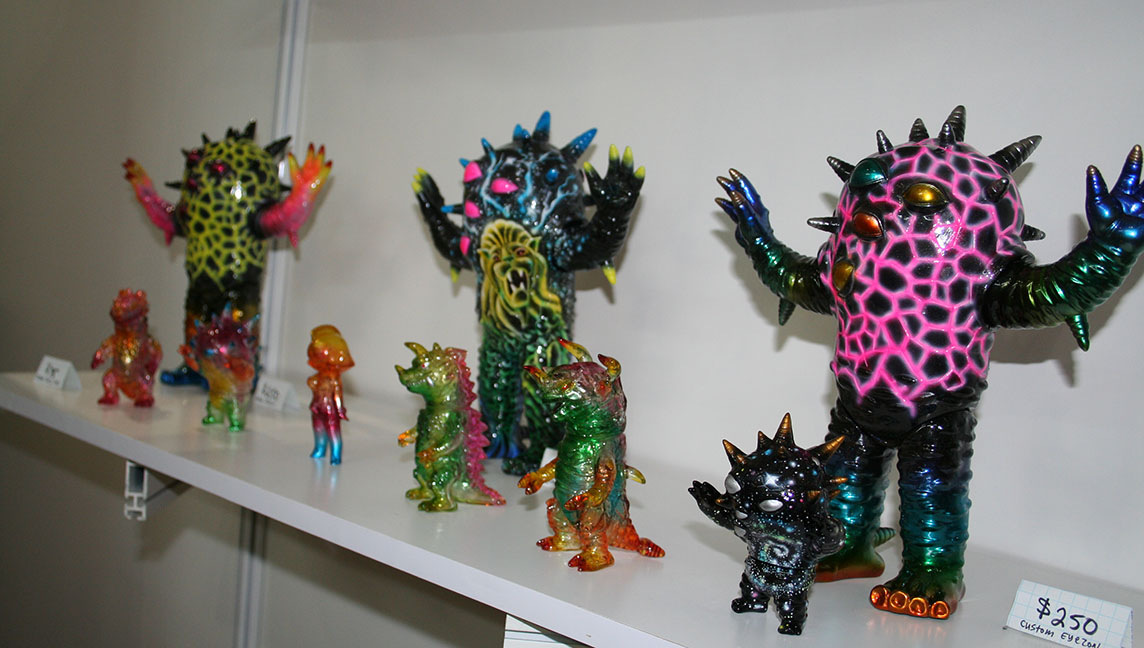
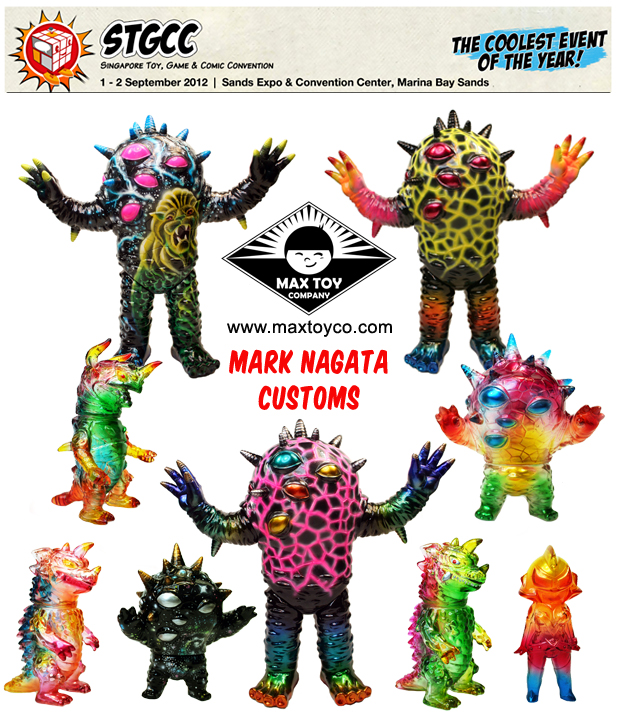
Eyezons at STGCC
Source: Toy Karma

Oh wow. Number one has to be – well one of the five, I can’t rank it – has to be the Red Ultraman. I actually have a wax sculpture of the most kaiju that I sell called Eyezon. Even though that’s not really a figure, for me it’s very special because that’s like the original sculpt (master sculpt). See, I’m trying to think of… ohh… these are tough questions! What do we got… three more… there’s a… about a 20 inch tall Marusan Talking Ultraman that I have… that… that was actually very hard to get too so I gotta put it on there. I think I’ve got to get a couple of kaiju in there, so, there’s a giant-sized Kitty Fire – it’s a kaiju from the Mirror Man show. And then, um, probably last one…

Wouldn’t Godzilla be somewhere in there?

You know, actually, I’m not a big Godzilla fan. Yeah. I mean I watch the movies, but in terms of collecting, um, you only have so much money, so all my focus went into Ultraman. Whereas my other friends it was Godzilla or Toho figures. So you know, if I want to see a Toho figure, I just go to my friend’s house and he has all the Godzilla figures (chuckles).

When I was younger, my Dad would always say “Don’t start a new collection, don’t start a new collection!”

Oh yeah, yeah of course! Yeah, it’s, uh, it can be bad.

You’ve said that handpainting toys preserves a tradition. Do you think mass market toys lose too much of the personal feel given to them by sculptors and painters in mass production, or does modern day toy technology adequately duplicate, to a certain degree, the handcrafted original product? 

You know, I actually visited a factory in China, for some of my early toys, and the thing that I realised is even though you don’t know the people’s names in the room, they’re all humans. They’re all hand-painting the toys! So even if one woman is just doing the eye, it’s by hand. And she just passes it to the next person, and then maybe they just do the chest, and then the next person but in the end, humans are all touching the toy! Even like a Star Wars figure, you know, they make two hundred thousand of them, it’s still hand-processed. For the actual painting they use a mask, they spray, they put another mask and it goes down the line, so you know, sometimes I don’t understand why people get so down on Chinese-made toys, because what I used to tell them is, well, “Maybe you don’t know their names, but these are people that are still doing the same; similar techniques – just on a bigger scale than what’s happening here, but you should still appreciate the effort that’s going into it,” so…

I guess people have this misconception that mass-market toys come off a production line like cars, you know, where it’s all robots… 

Right right, with the robots… well exactly, I understand. If you look at the room and there’s like a hundred people all dressed alike, and you don’t see their faces then you don’t have a connection, a human connection, but even with like, you know, the Hot Toys, they’re sewing all the clothes, sewing the pockets and putting the buttons on… it’s all handwork, it’s amazing.

So, how much of the handiwork do you think most collectors will appreciate? How much of what you do ends up in the collector’s hearts and minds? 

Well I would hope that because I like to talk about the process and I videotape them pulling the vinyl, and the guys painting it, I hope that in a little way people will realise that there is that human element in all of these toys and even thought it’s a collectible to just realise that, you know, even if I do twenty of these, really no two are the same. If you line them all up, they look the same, but you start looking and go “oh, maybe this eye is a little this way or this tooth is a little like that” – so actually each one is unique.

My last question is: are you optimistic about a possible kaiju movie revival in the States? With Godzilla and with Pacific Rim and films like that? 

Yeah, I am more excited about Pacific Rim (laughs) than I am about Godzilla, only because, uh, I think you know Godzilla has such a long history, that it’ll be very difficult for anybody to come up with something fresh or new… ah… without going so far away from the original Godzilla look?

It’s kinda like how people said “You can’t tell a new Joker story” before The Dark Knight with Heath Ledger came out. 

(Laughs) Right!

So there is that concern.

Yeah, there is.

Do you think Guillermo del Toro will handle the heritage well, with Pacific Rim?

You know, I’ve barely heard any, uh, reports on it. So um, let’s hope! I love his um… I love Pan’s Labyrinth, and Hellboy, yeah so I think he’ll do a good job.

Thank you so much!

Big thanks to Mark for the interview, and to Jedd for providing some awesome coverage of the Singapore Toy, Game & Comic Convention. For more of Mark Nagata, check out: Max Toy Co, Toy Karma, and mark nagata illustration.

Click here for more of Jedd’s STGCC updates.

Friday, September 7, 2012

Interview With Mark Nagata - Part 1

I was sent by Ron Mirasol, publisher of TheFwoosh.com and ActionFigurePics.com, to cover the Singapore Toy Games and Comics Convention for the website. One of the personalities I was able to interview was multi-talented toy designer, illustrator and toy collector, owner of Max Toy Co. Mr Mark Nagata. Here's Part 1 of my interview with him. Part 2 includes a little talk about upcoming Hollywood kaiju movies, so there's your movie connection! :D

For ActionFigurePics.com

STGCC 2012: Interview with Max Toy Co’s Mark Nagata – Part One


Mark Nagata and Jedd-the-Jedi

Mark Nagata is a Renaissance man. He just might have the largest Ultraman collection in the world. As a designer and artist, he’s worked for the likes of DC Comics, LucasArts, and Hasbro. For several years, he published Super 7, a magazine focused on Japanese vinyl toys, before going on to start the Max Toy Company, designing and manufacturing vinyl art toys. On top of all this, he’s a tremendously nice guy!
Jedd-the-Jedi had a chance to sit down with Mark at STGCC. In the first part of their conversation, they spanned toy collecting, the differences between working for the big guys vs. running your own show, and if it’s alright to play with your art toys. It’s really a fantastic interview. Read on!

Jedd: Hi Mark, great to be talking to a fellow lover of toys. First off, what got you into collecting toys? You wrote on your site “I think it’s safe to say that most of us collect because of our childhoods,” so do you have any childhood memories of a particular toy or action figure that you want to share?

Mark Nagata: Oh boy, for sure. Well I think the first impression I had for Japanese toys is when I was about 9 years old, and I had an aunt who was living in Japan, and for Christmas she sent a very big box to me, and inside were about 20 different Japanese toys. So Henshen cyborgs, Bullmark figures, kaiju toys… but at the time, I didn’t know that’s what they were called. To sort of back up a little, I’m third generation Japanese American, so my parents were born in America and my grandparents came from Japan to America, but me being third generation, actually I don’t understand Japanese and I don’t speak Japanese, so when I got this box of toys, I couldn’t read anything except for the company name Bullmark, ‘cause it was printed in English. I didn’t know the names of the characters, I didn’t know that they had TV shows; I just thought they were toys.

So, from that point, it was really… I fell in love with the visual part of the toys. The way it looked, the packaging, because all the packaging had like very dynamic artwork and colours, very crazy colours, and all the kaiju for me… were just… I couldn’t even put into words what it did to my imagination. Because at that point, my toys in America were GI JOE 12 inch, Major Matt Mason, so very… 60s, 70s types of toys, but um very plain, based on like a real astronaut, or an army man. No imagination, right?

So when I opened that box, and I saw these crazy colours, and these kaiju and these spacemen, I was like… you know, what is this? I haven’t seen this before. So when I look back all these years, that’s the point that started me on this journey to this day, which is being able to make actual kaiju toys in Japan.


Do you feel that there’s a strict dichotomy between Western and Asian popular culture, and to a certain extent the toys? Because many Americans and Europeans have been embracing manga and anime over the last two-three decades, and some western artists have been influenced by it. As an illustrator, toy collector, and toy designer, what do you feel is different or distinct between Asian and Western toys and comics, to put them under those umbrellas?

Wow, that’s a very hard question! I guess my simple answer is, ah, for sure Asian culture has a much longer history than America, than Western, and it’s much more diverse in terms of its mythology. So, Western culture for the most part is based on Christianity, but not ‘gods’ and ‘demons’ and… I mean, they have the devil but, you know, it’s very much rooted in human types of characters, whereas Asian cultures at least as far as I understand, you could have a tree demon, you could have a water creature, it’s very much based on nature. Wind, air, fire… so I think that’s also a reflection on kaiju toys, is they’re much more free to create creatures that are not confined by human structure, so it’s not just Frankenstein (‘s monster), it can be an arm that has flame, a body that has ice and you know a leg that’s metal and it all makes sense, it’s no problem. Whereas if you try to that in America, (laughs), I think it really throws people off, right? They don’t quite get it; it’s like “I don’t understand, why is this arm like that.” But as you were saying, the influence of manga and anime, now, the younger generation, they’re more acceptant of this type of toy.

How different is it working for huge toy companies such as Hasbro and Mattel, compared to working for yourself at Max Toys? What did you glean from your experiences at the two big toy giants? 

Well, when I did work for Hasbro and Mattel, I was a freelance illustrator; so basically, they would contact me to do a specific job. So if it’s packaging, box art, or backing cards for action figures, they would tell me exactly what to do. Exactly what pose, it needs to be this colour, the arm has to go two inches this way… so there is really not much freedom for myself to do much with the job – basically, it’s a job. But at the time, I was not designing toys, so it was strictly just artwork that I was doing for them. You know, they’re big companies, so the bottom line for them is they need to make money, and I understand that, you know. That’s just the way it is with big companies. But in terms of my company now, I have much more freedom to create whatever image I want… you know, paint the artwork the way I want… it’s perfect, it’s perfect.

It seems that toy companies, like the two I mentioned, are recognising the pull and power of adult collectors more and more. So, should there be a big distinction between kids’ market toys and “adult collector” toys? There are some instances where they cross over, but now there are less collector-aimed toys with action features, where there once were. It seems to be that some kids actually prefer highly-articulated figures, rather than those with five points of articulation and giant guns stuck to their arms. 

Sure, sure. Um, I think, maybe about six or seven years ago, Hasbro and Mattel and a lot of the toy companies, they started recognising art toys, or urban toys, as something coming up, something that might be very popular. Designer toys, all under the same category. But I think the flaw in their execution was one of the appeals of these types of toys is you can actually meet the maker, or you know the artist. So if it’s The Beast Brothers and so on, it’s not a company, it’s two guys, right? And you can actually go and meet them and they’re the creators. Whereas Hasbro and Mattel, no matter what, they’re big companies, so you’re kind of detached from becoming… having a personal involvement with them. So, I know they try to move some of their toys in that direction, but um I think really they will not be that successful, because collectors will realise it’s not that honest. It’s the nature of the companies, and the amount they have to make – they have to make a hundred thousand figures, whereas a lot of us are making them in a couple of hundred pieces or less, very limited.

Can toys be art, and is it then alright to play with art? 

As far as I’m concerned, if you buy one of my toys, you can do whatever you want with it! (Laughs). But I think toys can be art, and you can still interact with it – it’s not a problem.

What is your defense when people say collecting toys is “childish?” – that if you collect toys, then that automatically makes a silly, basement-dwelling man-child? 

(Laughs) Wow! Those are very… very strong words! As far I’m concerned, if you’re a very positive person and you’re not harming anybody, then really, it should be nobody’s business what you want to do. So, I try to be positive about what I produce, but I don’t want to tell people that, you know, “don’t open it,” you know, “keep it in the bag” or “keep it in a case”… it’s really up to the person to just enjoy it how they want to enjoy it.

Collecting toys seems to be about the passion. So how do you reconcile the “passion” part of the toys and comics business with the “money-making” part? Because one doesn’t want to be a starving artist but one doesn’t want to be a sell-out either. Huge toy companies get a lot of flak for occasionally poor quality control, reusing parts and molds, endless repaints and generally not giving fans not what they want – so it does less of a problem in smaller, more collector-oriented toy companies such as your own? 

It’s… the one thing that is similar with the bigger companies is that I do have to produce multiple runs from the same mould. And that’s an economic decision, because I have to invest a certain amount of money to have the toy made, and it take me at least three runs to just break even. So by the time I get to #4 or #5 or #6, then I can start making a little bit of a profit (chuckles)… it’s really not that much. I mean, I think many collectors would be surprised, um… I tell people “don’t go into the toy business if you want to be rich”. (Laughs) It’s tough, it’s tough. And that’s why the bigger companies have to make a hundred thousand or a million of something, because that’s the only way they can make money.

Is it safe to assume that your interests in toys and in drawing went hand in hand? 

Oh yes, for sure. And again, that goes back to when I opened that box of toys from Japan, because the toy was sitting right on top of a piece of artwork, you know, the packaging. So as soon as I removed the toy, didn’t know which was better right, the artwork or the toy!

Lots of kids draw pictures of their action figures, and some artists use action figures as reference material. Are you one of those artists?

Sometimes I do, yes. It’s cheaper than getting your friends to pose. (Laughs)

Stay tuned for part two of Jedd’s conversation with Mark Nagata, coming up on Monday. Mark talks about the toy manufacturing process, his five favorite toys, finding his action figure Holy Grail, and more!
- Ron Mirasol


Thanks for reading guys and yes, do stay tuned! Hopefully, several mega-posts pertaining to my experience at STGCC are on their way. The cool cosplayers, fantastic displays, talented artist alley denizens...stay tuned for that too!