Showing posts with label western. Show all posts

Wednesday, February 17, 2016

Jane Got a Gun

For F*** Magazine

JANE GOT A GUN


Director : Gavin O'Connor
Cast : Natalie Portman, Joel Edgerton, Ewan McGregor, Rodrigo Santoro, Noah Emmerich, Boyd Holbrook, Alex Manette, Todd Stashwick, James Burnett, Sam Quinn
Genre : Action/Drama/Western
Run Time : 98 mins
Opens : 18 February 2016
Rating : NC-16 (Violence and Some Coarse Language)
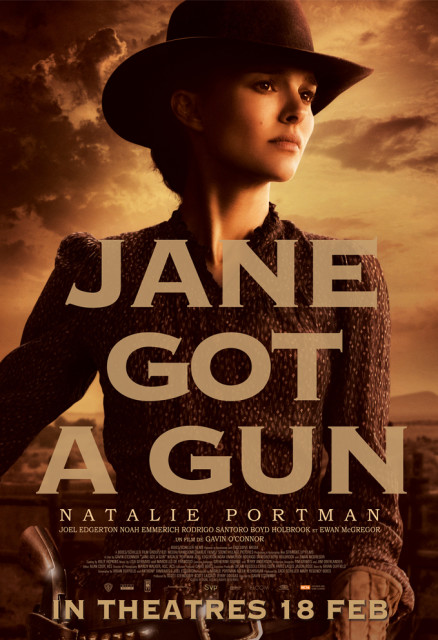
In Marvel’s ongoing Thor comics series, Jane Foster is the current wielder of Mjolnir. In this western, Jane Hammond (Portman) wields more conventional weapons. It is 1871 in New Mexico territory and Jane lives with her husband Bill “Ham” Hammond (Emmerich) and their daughter Kate. When Ham rides home seriously wounded after a gun battle with the Bishop Boys gang, Jane has no choice but to turn to her ex-fiancée Dan Frost (Edgerton) for protection. John Bishop (McGregor), a notorious outlaw from Jane’s past, has returned to torment her. Dan is still broken after losing Jane to another man, but he resolves to help Jane protect her family and her home as the Bishop Boys come a-knocking.


            Jane Got a Gun was plagued by numerous production problems, and it will be remembered more for its behind-the-scenes tumult than on its own merit as a film. The original screenplay by Brian Duffield was a hot property, landing on the Black List of best-liked screenplays in Hollywood back in 2011. Natalie Portman was attached to star and produce, with Lynne Ramsay of We Need to Talk About Kevin fame directing. Severe disagreements led to Ramsay dropping out on the first day of principal photography, with a bitter legal battle ensuing. Warrior director Gavin O’Connor was roped in to replace her, but the film’s troubles were just beginning. Michael Fassbender, Jude Law and Bradley Cooper were all attached at different points and Edgerton ended up switching roles from the villain John Bishop to the ex-fiancée Dan Frost. The release date was shifted back multiple times, with distributor Relativity Media dropping the film and The Weinstein Company later acquiring it.


            For all the drama involved in getting the film made, one would expect it to, at the very least, be bad in an interesting way. No such luck. Jane Got a Gun is soporific and dreary, sorely lacking in a key element of any revenge story: passion. It looks, feels and sounds like a western, but there’s so little energy and momentum behind it. The title suggests a fun genre piece with a feminist twist, perhaps something akin to Kill Bill in the American frontier. Some of the expected ingredients are there, including a tragic back-story and a score to settle with an old enemy, but it’s so plodding and self-serious that getting invested in Jane’s tale is quite the task. It’s sometimes a pretty movie to look at, but most of the time it’s visually dull: the picture is sepia-tinted, then the flashbacks appear to have another layer of sepia tinting on top of that and this stylistic touch ends up creating even more distance between the audience and the story.


            Portman may be playing the titular protagonist and has championed the film through the myriad obstacles it faced in getting made, but Jane Hammond will not go down as one of the great ass-kicking female characters in cinema history. There’s some emotional impact to Jane’s tortured past, but her supposed transformation into a gun-toting damsel no longer in distress is underwhelming. The love triangle between Jane, Ham and Dan bogs the movie down in melodramatics instead of creating any fireworks and nothing unconventional comes of the dynamics between the three characters. The villain in a revenge western should get to chew a good deal of scenery, but McGregor has too little screen time and too little material to work with, unable to create a particularly intimidating or striking villain. With Padmé, Obi-Wan and Owen Lars in the same movie, it’s a mini Attack of the Clones reunion.


            Jane Got a Gun has a round or two in the chamber: the climactic standoff brims with tension and the sombre atmosphere is sometimes effective. It is morbidly fascinating to read about how a straight-forward western got mired in so many production troubles and it is admirable that last-minute replacement director O’Connor was able to salvage it all. However, in the aftermath of this hullabaloo, all Jane Got a Gun has to show for it is mediocrity.


Summary: Dour and slow, Jane Got a Gun fails to make good on its promise of a fun genre piece starring a dynamic female lead.

RATING: 2 out of 5 Stars

Jedd Jong 

Tuesday, January 19, 2016

The Hateful Eight

For F*** Magazine

THE HATEFUL EIGHT


Director : Quentin Tarantino
Cast : Samuel L. Jackson, Kurt Russell, Jennifer Jason Leigh, Walton Goggins, Demián Bichir, Tim Roth, Michael Madsen, Bruce Dern, Channing Tatum
Genre : Western/Thriller
Run Time : 167 mins
Opens : 21 January 2016
Rating : R21

Hang on to them reins, boys and girls, because Quentin Tarantino’s wrangled up his eighth motion picture and is coming at you guns a-blazin’, all shot in glorious 65mm. It is some time after the Civil War in wintry Wyoming and bounty hunter Major Marquis Warren (Jackson) hitches a ride on a stagecoach occupied by fellow bounty hunter John “Hangman” Ruth (Russell) and his captive, Daisy Domergue (Leigh). Ruth is delivering Domergue to the town of Red Rock, and the trio comes across Chris Mannix (Goggins), apparently the new sheriff of Red Rock. The four arrive at Minnie’s Haberdashery, a stagecoach lodge, which is being looked after by Bob the Mexican (Bichir) in Minnie’s absence. They meet the other lodgers: English hangman Oswaldo Mobray (Roth), ranch hand Joe Gage (Madsen) and former Confederate general Sanford Smithers (Dern). Trapped in the middle of a fierce blizzard, this motley crew aren’t going to sit all quiet-like and wait for the storm to blow over, with mysteries unravelling, tensions mounting and lots of blood being spilled.

            As can be expected with any new Tarantino project, there was a great deal of pomp and circumstance surrounding the development of The Hateful Eight. The script surfaced online in January 2014, inciting Tarantino’s rage and a degree of finger-pointing as to who exactly leaked the screenplay. Tarantino briefly considered scrapping the film entirely and publishing The Hateful Eight as a novel instead. A live reading was staged before the film eventually went into production. Legendary composer Ennio Morricone came on board to score his first Western in 34 years and provide the first original score for a Tarantino film, the soundtracks of which customarily comprise existing songs. Then, the film was released in an old-fashioned roadshow presentation projected in 70 mm format, this version containing an extra 20 minutes of footage compared to the regular theatrical release.


            After all of this build-up, The Hateful Eight emerges as a film that is Tarantino’s through and through, but is not one of the director’s stronger efforts. With all the accolades he has amassed and with the impact his films have made on the pop cultural landscape, it makes sense that Tarantino would be given carte blanche to create the film he wants to. This is a spectacularly self-indulgent piece, and while Tarantino has made self-indulgence work in his favour in previous films, The Hateful Eight will test audiences who aren’t already converts to his style. Near the beginning of the film, Ruth orders Warren to put aside his pistol “molasses-like”, which is exactly the pacing of the movie. The 167-minute-long theatrical cut is already a challenge to endure, let alone the 187-minute roadshow cut. The cast is peppered with actors who have worked with Tarantino before and the director’s penchant for bombastic monologues and excessive, gory violence is in full force here. He has always planted his flag at the intersection of artfulness and vulgarity, and that flag is definitely still standing.


            At its core, this is a mystery, with Tarantino citing the Agatha Christie classic And Then There Were None as a reference point. It seems like it would work better as a stage play, and Tarantino does indeed have intentions of writing and directing a Broadway adaptation of the film. There are twists, turns and reveals, but this is a more straight-forward story than it is presented as, with the feeling of a tense, intimate drama being bloated to epic proportions, stuffed with over-the-top posturing and drenched in mostly unnecessary blood. Our characters arrive at a locale, are stuck there and a whodunit unfolds. The sometimes ridiculous heights that this reaches detract from the overall impact and suspense.

There are ingeniously staged moments of ratcheting tension that are immediately undercut by fountains of arterial splatter. One can imagine Tarantino rubbing his hands with glee, setting special effects makeup artists Greg Nicotero and Howard Berger loose on set, armed with assorted viscera. When Tarantino was paying homage to genres like the gangster movie, Blaxploitation or the martial arts film in the past, bloody violence makes more sense than it does in association with westerns, even given revisionist works by the likes of Sam Peckinpah. The violence crosses past the point of being shocking into being pointlessly numbing.


            Watching the cast at play is fun and thankfully, there’s a great deal of that going on here. This is an ensemble piece, but Tarantino’s oft-collaborator Jackson takes the lead as Major Marquis Warren. We initially lean into rooting for Warren because, as the lone black character for the bulk of the film, Warren is the target of strong racial slurs, but his own volatility and detestable actions soon come to light, making him at once fascinating and repulsive. Russell’s more understated approach is the ideal counterpoint to Jackson’s style, and for the most part, it’s clear this is a cast who knows full well what they’re doing.

Leigh is remarkably believable as the scuzzy Domergue, bad teeth, black eye, stringy hair and all, perhaps the most authentic of the bunch in mannerisms and appearance. Jennifer Lawrence was reported under consideration to play Domergue. Dern has a quietly commanding presence and carries one of the film’s most powerful moments, a conversation between Warren and Smithers about the fate of Smithers’ son. Goggins is entertaining though often bothering on annoying as he enthusiastically bounces about the set. Madsen puts in the least effort, though perhaps there’s a charm in that stemming from the Reservoir Dogs connection. In addition to Mr. Blonde, Mr. Orange, a.k.a. Tim Roth, is also present.


            Tatum’s appearance, however brief, completely pulled this reviewer out of the film. The actor has stumbled awkwardly through many a dramatic role and the ruthless badass Tatum plays in The Hateful Eight doesn’t capitalise on any of his comedic strengths. Stunt performer and actress Zoë Bell, a Tarantino mainstay, also has a minor supporting role. Bell’s New Zealand accent is acknowledged, but that doesn’t make it any less out of place in the setting.

            For fans of Tarantino’s technique and style and those who have enjoyed dissecting his back-catalogue and devising theories about how the events of all his films are connected, The Hateful Eight will be a largely fulfilling experience. However, if the wanton violence and odes to specific pop culture ephemera in his previous movies were alienating, The Hateful Eight is all the more so. It is generally true that a director making a film for himself is better than a hired gun just cashing a check, but The Hateful Eight feels like it was made primarily for Tarantino’s own amusement, and that if the general audience happens to like it, it’s mostly because they’ve been conditioned by the director’s own oeuvre.


Summary: The Hateful Eight is packed with its director’s signature flair, but it often feels saturated and overwhelmingly self-indulgent, a cloud of “you’re supposed to like this because it’s Tarantino” hanging over it.

RATING: 2.5 out of 5 Stars

Jedd Jong


Wednesday, December 9, 2015

Bone Tomahawk

For F*** Magazine

BONE TOMAHAWK

Director : S. Craig Zahler
Cast : Kurt Russell, Patrick Wilson, Matthew Fox, Richard Jenkins, Lili Simmons, David Arquette, Sid Haig
Genre : Horror/Western
Run Time : 133 mins
Opens : 10 December 2015
Rating : R21 (Violence)

Gun-slinging outlaws are far from the only terrors a small town sheriff needs to fend off in this horror western. Sheriff Franklin Hunt (Russell) of the frontier town Bright Hope leads a party in search of Samantha O’Dwyer (Simmons) and young Deputy Nick (Evan Jonigkeit). Samantha and Nick have been kidnapped by savage troglodytes, cave-dwelling humanoid creatures who feed on people. The party comprises Arthur O’Dwyer (Wilson), Samantha’s husband who is nursing a broken leg, the dapper sharpshooter John Brooder (Fox) and elderly “back-up Deputy” Chicory (Jenkins). It turns out that bandits Purvis (Arquette) and Buddy (Haig) have incurred the wrath of the brutal troglodytes by desecrating their burial grounds. With one member of their group already wounded and two of them elderly men, it seems the odds are stacked against Sheriff Hunt and his gang.


            Bone Tomahawk is the directorial debut of multi-hyphenate S. Craig Zahler, a novelist, screenwriter, musician and cinematographer. Zahler’s noir western novels have garnered him considerable acclaim, and it is clear from Bone Tomahawk that he has an affinity for the genre. The film is an old-fashioned western that segues into graphic, gory horror and it’s quite clear that this is intended to become a cult classic, to be screened mostly at film festivals to discerning audiences. As such, its appeal is very limited and this is obviously intended for a niche market, at the risk of alienating anyone else. The film has been described as a “slow burn”, but one man’s slow burn is another man’s slog. Indeed, Bone Tomahawk meanders and dawdles, with not very much happening until its final half hour. We get non-sequitur conversations about how one would read a book in the bath without getting the pages wet and the minutiae of flea circuses, which are intended to provide texture but come off as pointless instead.


            Thankfully, Zahler has wrangled an excellent cast and the characters embody familiar genre tropes without being one-note caricatures, which is difficult to do in a genre piece. Russell, as expected, seems perfectly at home in the setting and brings an authority to his sheriff role without overplaying the macho man aspect. He gets to kick ass, but the film wisely avoids indulging in cheeky references to Russell’s iconic past roles. For an actor of his iconic status, this is quite a small project to headline and Russell was drawn to the part as an early supporter of Zahler’s novels. We’ll next see Russell in a western again really soon, in the form of Quentin Tarantino’s Hateful Eight.


            Wilson can sometimes be bland, but he fits the everyman O’Dwyer and while the character seems set up as a bit of a milksop, he comes into his own and has us rooting for him to rescue his wife and survive this ordeal. Jenkins is on hand to provide most of the comic relief as the doddering old Chicory, but he is careful not to play the part too broad. Fox rocks a beautifully-tailored turn-of-the-century suit as the dashing, boastful rogue, though there are times when he doesn’t convincingly seem like someone from that time period. The same goes for Simmons, who comes off as a little too modern for a frontierswoman. She gets to perform a somewhat gratuitous sex scene with Wilson but is ultimately little more than the stock damsel in distress whom the valiant men have to venture into the unknown to rescue. She’s a doctor, so that counts for something, we suppose.


            Bone Tomahawk is somewhat hampered by its limited budget, the town of Bright Hope obviously standing on a backlot that’s been used in countless westerns before. While the film presents us with well-drawn characters portrayed by some talented actors, it lacks a crucial forward momentum and the flabby midsection is almost entirely devoid of urgency. The ending in particular packs in grisly scenes designed for maximum stomach-turning effect, but more impatient viewers are wont to grow restless before then. The smaller production gives Zahler the freedom to try many things which big studios would’ve forbidden him from doing and the most positive thing that can be said about the enterprise is that well, it’s different.


Summary: Kurt Russell’s strong performance gives this hybrid western/slasher flick some weight and gore-hounds might be pleased with the gruesome third act, but Bone Tomahawk is ultimately too slow and too spare to be a truly riveting genre offering.

RATING: 2.5 out of 5 Stars


Jedd Jong 

Friday, June 13, 2014

A Million Ways to Die in the West

For F*** Magazine

A MILLION WAYS TO DIE IN THE WEST

Director : Seth MacFarlane
Cast : Seth MacFarlane, Charlize Theron, Amanda Seyfried, Neil Patrick Harris, Liam Neeson
Genre : Comedy, Western
Opens : 12 June 2014
Rating : NC16 (Coarse Language and Sexual References) / 116 mins

Directed by, starring and co-written by Seth MacFarlane, here’s the film that details why life in the American frontier was hard, no matter what your station. MacFarlane plays Albert, an unassuming sheep farmer in the town of Old Stump, Arizona whose girlfriend Louise (Seyfried) leaves him for Foy (Harris), a dashing, arrogant moustache tonic salesman. Anna (Theron), the wife of notorious outlaw Clinch Leatherwood (Neeson), arrives in Old Stump, hoping to lie low while her husband continues tearing up the region. She befriends and soon falls in love with Albert, the sheep farmer unaware that his new paramour is in fact married to the most dangerous man in the land.

            The marketing for this film includes an online flash game that is a funny, entertaining spoof of the classic educational video game The Oregon Trail. Alas, nothing in the film itself quite matches the creativity of that tie-in. A fair number of the jokes in A Million Ways to Die in the West land, but the film is overly reliant on lowbrow bodily-function gags and “shocking”, cartoony violence. The movie’s biggest laughs are provided by the surprise celebrity cameos and a joke involving an offensively-themed shooting gallery gets a satisfying payoff during the end credits. However, one of the best of these was completely spoiled in a TV spot, making this yet another example of a comedy where the laughs are run into the ground by the trailers.


            The film hinges on its main character, Albert the sheep-farmer, being likeable enough that audiences will want to root for him to survive all those million possible methods of death. Seth MacFarlane is not likeable. This is not a controversial statement. A Million Ways to Die in the West would have benefitted from a different lead actor but this being the vanity project it is, that was unlikely to happen. With Ted, he was able to hide behind a computer-generated stuffed toy but here, his shortcomings as a leading man are all too apparent. One adjective often used to describe the Family Guy creator is “smug”. “Smug” is pretty much on the opposite end of the spectrum from “hapless, sweet, unassuming and well-meaning”.


            MacFarlane has surrounded himself with an excellent supporting cast, but because he is positioned as the film’s focal point, their presence seems merely perfunctory. Charlize Theron makes for a fun, watchable Annie Oakley-type but as her on-screen husband, Liam Neeson gets the short shrift. While he has slightly more screen time than in Battleship, one can’t help but feel sorry for the actor who has redefined the term “badass” when he’s forced to bare, well, ass. Family Guy fans will be tickled by the casting, since one cutaway gag featured Liam Neeson struggling with his accent in a cowboy film (he retains his Northern Irish brogue here). Neil Patrick Harris relishes the chance to gnaw at the scenery and he certainly rocks that well-coiffed handlebar moustache, in addition to dancing to the Stephen Foster folk ditty “If You’ve Only Got a Moustache”. Giovanni Ribisi and Sarah Silverman are amusing as Albert’s best friend Edward and Edward’s prostitute girlfriend Ruth respectively, if you don’t mind hearing Sarah Silverman graphically describe sex acts.


            A comedic Western in this day and age is a fairly ambitious prospect and something of a gear change from Ted, but MacFarlane fails to mine the opportunities presented by the premise, this outing proving yet again to be too self-indulgent. At 116 minutes long, this does meander and there’s the threat of tumbleweeds, but it would be too harsh to say A Million Ways to Die in the West is completely laugh-free. Co-writers Alec Sulkin and Wellesley Wild, who also worked on Ted and Family Guy with MacFarlane, retain a somewhat mean-spirited sense of humour (the poster has a cactus resembling a hand flipping the viewer off) but once in a while do offer inspired gags. Just not quite often enough.

Summary: Doesn’t quite set our saddles ablaze.

RATING: 2.5 out of 5 Stars

Jedd Jong

Tuesday, July 2, 2013

The Lone Ranger

For F*** Magazine

THE LONE RANGER

Director: Gore Verbinski
Cast:  Johnny Depp, Armie Hammer, Tom Wilkinson, William Fichtner, James Badge Dale, Ruth Wilson, Helena Bonham Carter
Genre: Action, Adventure
Run Time: 149 mins
Opens: 4 July 2013
Rating: PG13 (Some Violence)

The Lone Ranger - ReviewLong before Chuck Norris swaggered across the small screen as Texas Ranger Sgt. Cordell Walker, another had paved the dusty path and worn that silver badge. The Lone Ranger first appeared in radio dramas 80 years ago and has endured as a pop culture icon, astride his noble steed Silver and with his trusty friend and partner Tonto ever by his side. For the first time since 1981, the Lone Ranger rides onto the silver (heh) screen again.

This film is an origin story, portraying the circumstances under which the Lone Ranger and Tonto first met and ‘pardnered’ up. John Reid (Hammer), the new District Attorney of Colby, Texas, happens to be on a train which is also transporting two criminals: notorious outlaw Butch Cavendish (Fichtner) and Native American spirit warrior Tonto (Depp). Cavendish’s crew of bandits break him out as John and Tonto have to save themselves from the train crash. John’s brother Dan (James Badge Dale) deputises him as a Texas Ranger and as advised by Tonto, John dons a domino mask to become The Lone Ranger. The newly-formed pair go about tracking down Cavendish and his fellow crooks as they find themselves in the middle of an explosive dispute over the construction of a trans-continental railway.


The film has been plagued by well-publicised production troubles, including budget problems, rain and snowstorms, wildfires and the tragic drowning of a stuntman. When your western hits a reported budget of around $250 million, maybe something isn’t going right. Some have even predicted this as the “John Carter of 2013”, in reference to Disney’s notorious box office flop from last year.

The thing is, John Carter didn’t have a marquee name like Johnny Depp starring in it. Indeed, director Gore Verbinski and co. seem to be fully aware that Depp is the movie’s best asset. This is a Lone Ranger movie in which the actor playing Tonto gets top billing – it’s like if everyone was making a bigger deal of Robin than Batman. The Pirates of the Caribbean film franchise cemented Depp’s position as a big box office draw and his Jack Sparrow quickly became this generation’s Han Solo. It appears that everyone involved in this film was fully aware of that appeal and tried to milk it for all it’s worth.


Depp has previously portrayed a Native American character in The Brave, which he also directed. Depp’s casting as Tonto has attracted controversy and yes, while stereotypes like “spirit animals” and shamanistic rituals are invoked, the film’s portrayal of the Comanche people is not derogatory. Depp clearly had a ball inhabiting the iconic role, imbuing the character with the eccentricity we’ve come to expect of the actor. For example, Tonto wears a dead bird as a headdress (apparently inspired by Kirby Sattler’s painting I Am Crow). Even if the film’s focus is clearly weighted towards the character who’s ostensibly a sidekick, Depp’s dedication to the part is still enjoyable to watch. It’s hard to imagine the guy’s already 50 years of age.

This means the film doesn’t actually have a lot of faith in its title character, portrayed by Armie Hammer. It’s a less embarrassing role than that of Prince Andrew in last year’s Mirror Mirror, but John Reid has his share of indignities to endure. These include but are not limited to being dragged through horse manure and then having said horse lick scorpions off his face later on. The filmmakers are clearly worried that the Lone Ranger might come off as a boring, generic hero, but Hammer makes him likeable enough and strikes up a decent odd couple chemistry with Depp. Perhaps Reid’s incompetence in this one can be attributed to his rookie status (though it’s more likely a result of Depp exercising his clout as executive producer).


William Fichtner is a gnarly, mangy, frightening presence as the outlaw Butch Cavendish, a ruthless fiend with a disturbing taste for human flesh – there’s just not very much to the character. Similarly, Helena Bonham Carter seems a perfect fit for the role of a gutsy brothel madam with a weaponised prosthetic leg – it’s just that the character is very underused. Tom Wilkinson is not bad as the railroad tycoon who won’t let anything get in the way of his business and Ruth Wilson is believable as frontierswoman Rebecca Reid. The standout supporting player is probably Silver the horse though, who is equal parts gallant and endearing.


Ever since the first Pirates flick became a runaway success, Disney has tried to recapture that with the action-adventure flicks Prince of Persia: The Sands of Time and the afore-mentioned John Carter, both times not with much success. The Lone Ranger possesses enough of that matinee serial spirit of excitement and adventure to be considered entertaining, featuring several fun action set pieces; the one on a train that kicks off the action reminiscent of the opening of Indiana Jones and the Last Crusade. There are some pretty cool stunts, but there’s also just as much conspicuous computer-generated imagery, including ropey digital caribou and rabbits.


However, at 149 minutes, the film certainly feels bloated at times. While there are several moments of levity, most provided by Depp, the film has a surprisingly high body count and for something that’s meant as a nostalgic throwback to old-timey oaters, it’s unnecessarily over-violent. This has been marketed as a family flick from Disney, so it’s a little jarring to see the villain carve out someone’s heart and bite into it. While the film is probably as historically dubious as the Pirates movies, it doesn’t quite have that authenticity or verisimilitude that those films did.


The Lone Ranger himself might be a gifted marksman, but his latest big screen outing is very much hit and miss. Johnny Depp fans will certainly lap up their idol’s portrayal of Tonto and it is the most worthwhile thing in the film. There’s relatively satisfying action and a good number of homages to the classic hallmarks associated with the character (including Rossini’s William Tell Overture as his theme tune) but it probably isn’t “fun for the whole family” as advertised.


SUMMARY: The Lone Ranger attempts to keep the character’s legacy alive and doesn’t do a particularly bad job at it, but this is clearly Johnny Depp’s show and that’s not necessarily an entirely good thing. It’s also weighed down by gratuitous violence and an overlong running time.

RATING: 3 out of 5 STARS 

Jedd Jong