Tuesday, October 13, 2015

Crimson Peak

For F*** Magazine

CRIMSON PEAK

Director : Guillermo del Toro
Cast : Mia Wasikowska, Jessica Chastain, Tom Hiddleston, Charlie Hunnam, Jim Beaver, Doug Jones, Leslie Hope, Burn Gorman
Genre : Supernatural/Mystery
Run Time : 119 mins
Opens : 15 October 2015
Rating : NC16 (Some Violence)

Guillermo del Toro beckons you to enter Allerdale Hall. Dare you step through its foreboding gates? In this period horror flick, Mia Wasikowska plays Edith Cushing, a young author who falls headlong in love with the mysterious stranger Sir Thomas Sharpe (Hiddleston). Sir Thomas comes from Cumberland, England to Buffalo, New York, accompanied by his sister Lady Lucille Sharpe (Chastain). After the tragic and sudden death of her father Carter (Beaver), Edith marries Thomas, while her childhood friend Dr. Alan McMichael (Hunnam) continues to harbour feelings for her. Alan begins to suspect that there is more to the siblings than meets the eye, as Edith is spirited away to Allerdale Hall, the ancestral home of Thomas and Lucille. Situated atop a clay mine, the mansion has fallen into disrepair, its walls hiding restless spirits and arcane secrets. Our heroine must unearth the mysteries buried in Allerdale Hall before it devours her whole. 


Director Guillermo del Toro has said that following the rough time he had making Mimic, he reserves his lyrical macabre fantasy horrors for his Spanish-language films, with most of his English-language movies being more accessible blockbusters. After cultivating a good working relationship with Legendary Pictures’ head honchos on Pacific Rim, del Toro was allowed to unleash his dark imagination in a big Hollywood movie with Crimson Peak. These days, horror movies seem to be predominantly low-budget affairs; found-footage movies proving especially popular with studios. Blumhouse has cornered the market with the Paranormal Activity franchise and its ilk. There is nothing inherently wrong with low-budget horror and there have been several excellent small movies in this genre. However, there is no denying that aficionados of classic horror have been hankering for a grand, lavish fright flick, and Crimson Peak should go a good way towards sating that appetite. 


Crimson Peak is a wholehearted throwback, with del Toro and screenwriter Matthew Robbins citing 1963’s The Haunting and 1961’s The Innocents as primary influences. It also owes a great debt to Edgar Allan Poe’s classic Gothic short story The Fall of the House of the Usher. Clockwork contraptions and dead insects, which the director has a particular fondness for, figure into the plot. The central setting of Allerdale Hall was constructed from scratch at Pinewood Toronto Studios in all its eerily dilapidated glory. Del Toro, production designer Thomas E. Sanders, art director Brandt Gordon and the rest of the film’s creative team can take a bow knowing that they have crafted such a sumptuous, spooky world. Placing the house atop a red clay mine is an inspired touch, allowing for the haunting imagery of the blood-red clay seeping into the snow above, hence the name “Crimson Peak”. The ghosts, rotting carcasses enrobed in wispy, black ether, are suitably grotesque and benefit from the physicality of performer Doug Jones, an oft-collaborator of del Toro’s.


The film is essentially a blood-drenched soap opera, theatrical, highly mannered and often quite arch. As such, del Toro runs the risk of the audience feeling like they are being held at arm’s length, unable to fully sink their teeth into the proceedings. There is very little subtlety to be had – for example, Edith announces upfront that in the story she’s writing, “The ghost is more a metaphor – for the past.” It is possible to step a little too far back and leave the realm of the story. Not entirely dissimilar from American Horror Story or Penny Dreadful, then. One does need to be in the right frame of mind to take in Crimson Peak and this reviewer did appreciate the theatricality; the lurid, saturated palette echoing Italian giallo horror films. In the cut that we watched, a sex scene was truncated, presumably to get an NC-16 instead of an M-18 rating. 


“We have scary ghosts, but even scarier people,” del Toro proclaimed while promoting the film at Comic-Con. A gorgeous set means nothing without a talented cast to inhabit it, so it’s a good thing then that this cast is very talented indeed. Wasikowska, who has played the “ethereal waif” fairly often in her career, is the ideal leading lady for this project. Emma Stone was originally cast, and Wasikowska does seem better-suited to the Edith part. This is a determined woman who would rather be Mary Shelley than Jane Austen, and the balance between strength and vulnerability is one that Wasikowska absolutely nails. She is the outsider who finds herself plunged into an unfamiliar, frightening world – it’s not a new character type in this genre, but Wasikowska does breathe new life into it. 

Hiddleston can play “enigmatically charming” in his sleep, and Sir Thomas Sharpe is enigmatically charming to the hilt. Replacing the initially-cast Benedict Cumberbatch, Hiddleston looks right at home in the period costumes and sets. There’s an immediately appealing warmth that he brings to the part while ensuring we’re still questioning his motives every step of the way. Chastain’s turn could have used a little more ambiguity, but her icily sinister Lady Lucille is threatening and beguiling all the same. Pacific Rim star Hunnam fares a little worse, playing the “nice guy” who lacks the edginess Hiddleston has and whom convention dictates won’t get the girl. He also doesn’t fit into the late-Victorian/early-Edwardian setting as well as his co-stars do. It is pretty fun to see Burn Gorman, also from Pacific Rim, pop up in a cameo.

Crimson Peak is the work of a director who is right in his element, given free rein to indulge his dark imagination and reaping rewarding results while at it. It does veer dangerously close to pastiche at times: Fernando Velázquez’s musical score is very on-the-nose, the climactic confrontation involves somewhat brandishing a giant shovel and there might be one too many uses of the iris wipe transition, which most audiences know best from Bugs Bunny going “th-th-that’s all folks!” However, more than enough of del Toro’s earnestness and adoration for classic horror comes through and the splendid production values are a treat amidst the sea of cheaply-made, grainy, shaky contemporary fright flicks. 


Summary: Guillermo del Toro delivers a handsome, stately horror film that is a throwback to the heyday of the haunted house subgenre, with no shortage of gruesome wince-inducing brutality for good measure.

RATING: 4 out of 5 Stars
Jedd Jong 

Bridge of Spies

For F*** Magazine

BRIDGE OF SPIES

Director : Steven Spielberg
Cast : Tom Hanks, Mark Rylance, Amy Ryan, Alan Alda, Austin Stowell, Will Rogers, Sebastian Koch
Genre : Drama
Run Time : 142 mins
Opens : 15 October 2015
Rating : PG13 (Some Coarse Language)

We’ve had our late-summer fun with The Man From U.N.C.L.E., but with fall awards movie season upon us, it’s time to revisit the Cold War in a far more serious manner. It is 1957 and Soviet spy Rudolf Abel (Rylance) is captured by the FBI in Brooklyn. The Brooklyn Bar Association elects for insurance attorney James Donovan (Hanks) to serve as Abel’s counsel. Three years later, after U-2 spy plane pilot Francis Gary Powers (Stowell) is captured by the Soviets, Donovan is tasked with negotiating his release. The deal is an exchange of Abel for Powers. Naturally, things aren’t that clear-cut, and the East Germans have American student Frederic Pryor (Rogers) in custody. With the odds stacked high against him, Donovan flies to East Berlin to bargain for the safe return of both Americans as the threat of nuclear war between the two superpowers looms ever greater. 


Bridge of Spies is based on the 1960 U-2 incident, an actual event, with a screenplay by Matt Charman and rewritten by Joel and Ethan Coen. The title refers to Glienicke Bridge, which was the site for several prisoner exchanges between the Americans and Soviets. The film has been described as a “Cold War thriller”, but it’s more of a courtroom drama and not an action-driven spies vs. spies affair. Director Spielberg’s follow-up to 2012’s Lincoln is another sombre awards contender, but this is more accessible to the average filmgoer, less dense and scholarly. Bridge of Spies is an old-fashioned drama, with the bleakness of a rubble-strewn East Germany evoking the gloomy vision of Vienna as seen in the classic spy film The Third Man. There is a stillness about the film, which is very much a slow burn. Spielberg’s films are seen by many as varying degrees of schmaltzy. While Bridge of Spies certainly has its emotionally impactful moments, it is largely restrained and the feeling of frigid detachedness effectively captures the atmosphere of the Cold War.


If the film that surrounds him is cold, Hanks is Bridge of Spies’ warm, beating heart. In this, his fourth collaboration with Spielberg, Hanks is called upon to embody the archetype of a decent man in an indecent time. If there’s anything Hanks can play, it’s “decent” – he does that and so much more here. James Donovan is a consummate professional who is flung into unfamiliar territory but who always stands his ground, his attentiveness and upstanding nature recalling To Kill a Mockingbird’s Atticus Finch. It turns out that Gregory Peck almost played Donovan in 1965, with Alec Guinness set to play Abel opposite him, but the film was ultimately called off as the era was too fraught with political tension for it to be made. When Donovan arrives in East Germany, construction has just begun on the Berlin Wall, and the angle of a relatively ordinary man caught up in extraordinary circumstances is the audience’s way in. As Donovan is accosted by gang members, catches a cold and has to deal with Soviet and East German officials, he remains admirably steadfast, clinging to his principles, the ideal unassuming hero. 


Rylance, a veteran of the London stage, is coolly compelling as Rudolf Abel. Abel is a Russian spy, ostensibly the bad guy, but the film doesn’t demonise him, taking the stance that the Soviets had their spies and the Americans had theirs. Rylance’s Abel is unflappable and inscrutable, and the unlikely bond that Abel forms with Donovan makes for a fascinating and subtly moving dynamic. While audiences are very familiar with Hanks, Rylance isn’t as recognisable a name, and perhaps that unfamiliarity adds to Abel’s mystique. Spielberg apparently enjoyed working with the actor and Rylance will play the title character in Spielberg’s next film, The B.F.G. Defending Abel makes Donovan a very unpopular man indeed, and this takes its toll on his family, especially his wife Mary (Ryan). The scenes involving Donovan’s family and Pryor’s arrest at the border are the closest Spielberg comes to indulging his more sentimental sensibilities, but these moments are necessary to establish the personal stakes involved. 


Spielberg’s usual cinematographer Janusz Kaminski and editor Michael Kahn bring the technical polish that we’ve come to expect from his films, but one key collaborator is missing: composer John Williams. Owing to a minor health issue which has now been resolved, Williams was replaced by Thomas Newman. Newman’s score is appropriately dignified, containing his own trademark instrumentation while not sounding a million miles away from what Williams might have written. 


Spielberg has always been an idealist, and along with lead actor Hanks, he brings a reassuring, old-fashioned moral certainty to this tale set in one of the murkiest eras in modern history. Even so, Bridge of Spies avoids being naïve and manipulative in its account of the U-2 incident negotiation process. Perhaps this reviewer just isn’t that much of an intellectual, but the one action sequence in which Powers’ U-2 spy plane is shot out of the sky did make him hanker for another Spielberg-directed straight-up action adventure. Of course, that’s not the kind of film Bridge of Spies is, and it lives up to the pedigree before and behind the camera, succeeding at being a sturdy, well-made historical drama. 

Summary: As prestigious as prestige pictures get, Bridge of Spies is a restrained, quiet drama anchored by Tom Hanks’ reassuring presence, with thespian Mark Rylance stealing the show from him at times. 

RATING: 4 out of 5 Stars

Jedd Jong  

Thursday, October 8, 2015

Pan

From F*** Magazine

PAN


Director : Joe Wright
Cast : Levi Miller, Garrett Hedlund, Hugh Jackman, Rooney Mara, Amanda Seyfried, Leni Zieglmeier, Adeel Akhtar, Cara Delevingne, Jack Charles, Na Tae Joo, Nonso Anozie, Kathy Burke, Kurt Egyiawan, Lewis MacDougall
Genre : Adventure/Fantasy
Run Time : 112 mins
Opens : 8 October 2015
Rating : PG (Some Frightening Scenes and Violence)

The boy who would never grow old is also apparently the well that would never run dry, as here we are with yet another return to Neverland, this time to see how Peter Pan began. Peter (Miller) is an orphan in World War II-era England, who alongside his best friend Nibs (Lewis McDougall) bedevils the strict nuns who run the orphanage, holding out hope that his mother will one day return for him. One night, Peter gets spirited away via flying pirate ship to the magical realm of Neverland, where he is forced to work in the mines run by the flamboyant, tyrannical Blackbeard (Jackman). Peter befriends fellow miner James Hook (Hedlund) and along with Smee (Akhtar), they escape the mines. They run into Tiger Lily (Mara), princess of the Piccaninny tribe, who helps Peter discover his destiny and unveils the mysterious truth about Peter’s mother. With Blackbeard closing in, Peter must overcome his doubts and embrace his place as Neverland’s saviour.


Since Peter Pan’s creation by author J.M. Barrie in 1902, the character and the mythos has been adapted and reinterpreted innumerable times for the stage and screen. Pan hops aboard the “revisionist fairy-tale” bandwagon, recounting Peter’s secret origins. “This isn’t the story you’ve heard before,” the opening voiceover by Peter’s mother Mary (Seyfried) proudly proclaims. The thing is, the embellishments add very little to the story as we know it, with allusions to events that will unfold later on coming off less as knowing winks and more as on-the-nose insertions. Peter Pan’s early days as an orphan give the story a Dickensian spin and the visual of a flying pirate ship taking on RAF and Luftwaffe fighter planes during the Blitz is fun, but ultimately relatively pointless. That’s a good way to sum up Pan – “fun, but ultimately relatively pointless.”


Director Joe Wright set out to craft a family-friendly live-action fantasy adventure, and it turns out there aren’t that many of those in theatres these days. It is a positive sign that Pan avoids being dark and grim and embraces the joy that has become associated with Peter Pan. Visually, it is pretty to look at, production designer Aline Bonetto crafting some dazzling mini-worlds. However, it isn’t anything radically inventive, the look of Neverland’s various environs owing a lot to previous versions of the story and other fantasy films. Complaining about computer-generated imagery has become tiresome in and of itself, but the synthetic feel of the settings and creatures undercuts the whimsy and wonder the film is aiming for. There is a frustrating lack of soul behind the visuals, and this reviewer found himself switching off at times because there wasn’t anything to, pardon the pun, hook on to. The most egregious offenders are the skeletal Neverbirds, which look like rejects from The Nightmare Before Christmas and are straight-up cartoony in appearance, never seeming like they convincingly inhabit the landscape.


There are things about the film that work, chief of which is the title character. Australian child actor Miller is a revelation as Peter, fearlessly holding his own opposite Jackman and the other adult cast-members. There’s a fine blend of confidence, impishness and vulnerability in his performance which made this reviewer never question that he was the right choice to play Peter Pan. Miller also has enough personality such that he doesn’t come across as a too-cutesy production line Disney Channel moppet. There’s a messiah element to this interpretation of Peter – his mother is even named “Mary” – but that symbolism isn’t very meaningfully explored. Wait, Mary Darling was the mother of Wendy, John and Michael…it can’t be the same Mary, can it? This is confusing.


Jackman appears to have been paid in scenery, which he wolfs down with gusto, going the full Tim Curry as Blackbeard. He’s clearly having the time of his life, rocking the over-the-top Jacqueline Durran-designed costumes. He even gets to lead a chorus of miners in singing Nirvana’s Smells Like Teen Spirit - a delightfully bizarre anachronism that effectively highlights the “outside of time” nature of Neverland. There was never any question as to whether or not he would be entertaining and Jackman’s sinister glee papers over some of the cracks in the well-worn story.


Captain Hook is reimagined as a charming rogue very firmly in the Han Solo mould, with Hedlund drawling and smirking his way through the part. Hedlund is pretty bland, lacking the dangerous charisma that should hint at Hook’s destiny as Peter’s arch-nemesis. The “friend-turned-enemies” plot device is kind of tired and is yet another example of an attempt to put a spin on things that is only semi-successful at best.


Mara is also quite stiff as Tiger Lily, the Princess Leia to Hook’s Han, even though she does get to partake in the action. There was a degree of controversy surrounding the casting of a, well, lily-white actress in the part, seeing as the Piccaninny Tribe are analogous to Native Americans. In the film, the tribe is composed of various ethnicities and we even get Korean actor Na Tae-joo as martial arts fighter Kwahu, who seems awfully reminiscent of Hook’s iconic Rufio. It’s a shame that the role was whitewashed, since there really is no justification for Tiger Lily not being played by a person of colour, especially given the dearth of roles in Hollywood for actors of Native American origin. On the other hand, the typically-white Mr. Smee is played by Adeel Akhtar, a British actor of Pakistani origin. Akhtar displays solid comedic chops, his Smee doing a fair amount of the expected bumbling about.


Under the guise of reinventing the story of Peter Pan, Pan walks a well-trodden path, presenting a bog-standard hero’s journey/chosen one plot that just happens to be set in a fantastical location. There are entertaining sequences, a few genuinely creative sparks and good performances, but the CGI-heavy visuals are insufficiently enchanting and screenwriter Jason Fuchs doesn’t make many worthwhile additions to the mythology. “To live will be an awfully big adventure,” Barrie famously wrote. We guess a medium-sized adventure will have to suffice.


Summary: A middling fantasy adventure that never quite takes flight, Pan is another revisionist fairy-tale that doesn’t fully justify its existence, but should be fun enough for the tykes in the audience.

RATING: 3 out of 5 Stars

Jedd Jong

Friday, October 2, 2015

Infinity Times Three: Disney Infinity 3.0 Launch

Oops, just realised this is pretty late. Anyway, here's my coverage of the launch of the Disney Infinity 3.0 video-game:

As published in Issue #68 of F*** Magazine


---
Text:

INFINITY TIMES THREE
F*** leaps into the toy box and emerges in a galaxy far, far away at the Disney Infinity 3.0 Edition launch
By Jedd Jong


F*** was at the Sandcrawler Building, Lucasfilm’s Singapore headquarters, for the launch of Disney Infinity 3.0. Disney Infinity, which had its first version released in 2013, is a “toys-to-life” video game which utilises collectible figurines that can be synchronised with the game, unlocking new characters from various Disney properties that can interact and go on missions. The characters in Versions 1.0 and 2.0 have included Disney and Pixar characters such as the Incredibles, Elsa and Anna and Captain Jack Sparrow. Disney Infinity 2.0 Edition introduced Marvel characters such as Spider-Man, the Avengers and the Guardians of the Galaxy. 3.0 marks the much-anticipated arrival of Star Wars characters into the Infinity toy box.


“We wanted people to play much like Andy and Woody played in Toy Story,” Disney Interactive producer Jason Moffitt says of the Disney Infinity concept. “The brand, that’s what’s strong with us – having Olaf sitting on an AT-AT leg and getting taken away because he wants to hug it, this is the only place that can happen,” Moffitt continues, referring to a trailer we were shown that depicted just that – Frozen’s loveable snowman, feeling right at home on the snow planet Hoth, embracing the foot of the Imperial Walker from Empire Strikes Back.


Disney Infinity encompasses various styles of gameplay, with open world sandbox elements alongside platforming, top-down dungeon crawl and cart racing modes. Developed by Avalanche Software, other developers were brought on for 3.0 to enhance the gameplay. Ninja Theory of Devil May Cry fame were enlisted to devise the lightsaber mechanics and Sumo Digital, known for Sonic Racers, helped build out the cart racing mode.


The game has been touted as offering the “complete Star Wars experience”, with the Twilight of the Republic playset which covers the prequel trilogy and the Clone Wars, as well as the Rise Against the Empire playset, which covers the original trilogy. The Twilight of the Republic playset comes with Anakin Skywalker and Ahsoka Tano figurines, while the Rise Against the Empire playset is packaged with Luke Skywalker and Princess Leia figurines. Players will get to relive iconic moments from the films, including the Death Star trench run and the Endor speederbike chase and battle villains such as Darth Maul and General Grievous. Fan-favourite Boba Fett is available as an exclusive figurine with the PlayStation bundle.


There will also be a playset for the new Star Wars film, The Force Awakens. Finn and Rey were revealed as Disney Infinity characters at the recent D23 expo. There will also be more characters to be announced further down the line. Moffitt revealed that while Star Wars Battlefront will incorporate elements from The Force Awakens, Disney Infinity 3.0 will be the only video game that features the story of the film, at least for the time being.

The Playset Mode can only be occupied by the characters appropriate for their worlds, but in 3.0, any Star Wars character can inhabit any Star Wars world, which means Luke can go back to the Clone Wars. Toy Box Mode is an open world playground where players can create whatever they imagine. Moffitt described a “Lion King challenge”, in which a contestant was able to re-create the famous opening scene to the Lion King using Toy Box elements.


The other main draw of 3.0 is the Inside Out playset, based on the Pixar film. The Inside Out playset is designed as a platformer where players control Joy, Sadness, Disgust, Fear and Anger as they traverse various areas inside Riley’s mind. The Inside Out playset was designed with cooperative gameplay in mind. “It’s an easier game to play when you play co-op,” Moffitt says. “You can be running on top of the level and your friend can be running below the level doing different things.” A Marvel playset called “Battlegrounds” is in the works.

The “Toy Box Takeover” is Moffitt’s favourite mode in the game. The rough storyline features Incredibles villain Syndrome snatching away the player’s magic wand, enlisting the help of other Disney Infinity villains such as Davy Jones and Loki. The player will have to go into each villain’s world to fight them and eventually reclaim the wand. Any character from 1.0, 2.0 and 3.0 is fair game to jump right in and play.

Lead character designer Jeff Bunker Inset: Han Solo
During the Q&A session, this writer asks Moffitt if Han Solo was intentionally designed to resemble Flynn from Tangled, since he’s even got the smoulder. Moffitt replies that the development team believes lead character designer Jeff Bunker made Han a little bit of a self-portrait. Another reporter asks Moffitt about his views on Disney Infinity’s competitors in the toys-to-life video game category, such as Skylanders and Lego Dimensions. “They’re all great games, I have nothing bad to say about Skylanders, I hope everybody buys every toys-to-life game but if you’re gonna buy one, buy ours,” Moffitt replies diplomatically. “I think what sets us apart, honestly, is Toy Box. The Toy Box mode, when we were first selling it, we had to say ‘this game is Little Big Planet mixed with Minecraft mixed with Skylanders’…and it’s like that, the logic connections, we just continually grow what you can do.” Referring to the Toy Box mode, Moffitt claims “no other game has that and no other game’s going to have that because it’s just such a huge undertaking for someone to do and I think that’s what sets us apart.”  On the future of the series, Moffitt states “we hope to make a hundred of these [versions] and maybe by then we’ll run out of Disney characters.”


Exasperated parents should prepare their wallets come 1 September 2015, when Disney Infinity 3.0 is released. The Starter Pack includes 1 Disney Infinity 3.0 video game disc, 2 Star Wars figures – Ahsoka Tano and Anakin Skywalker, 1 Disney Infinity 3.0 Edition base, 1 Star Wars: Twilight of the Republic playset piece and 1 web code card that unlocks content for PC/mobile. The standard retail price of the Starter Pack is SGD $99.90. Additional Disney Infinity 3.0 playsets, Toy Box expansion games and character figurines are sold separately. The game is available for the PlayStation 4, PlayStation 3, Xbox One, Xbox 360, Wii U, PC, iOS and Android platforms. 

Wednesday, September 30, 2015

Pawn Sacrifice

For F*** Magazine

PAWN SACRIFICE

Director : Edward Zwick
Cast : Tobey Maguire, Peter Sarsgaard, Liev Schreiber, Lily Rabe, Michael Stuhlbarg, Robin Weigert
Genre : Drama/Biography
Run Time : 114 mins
Opens : 1 October 2015
Rating : PG13 (Brief Coarse Language)

Awards movie season has officially begun with this prestige biopic focusing on chess champion Bobby Fischer, often considered the greatest player of all time. Fischer (Aiden Lovecamp as a child, Seamus Davey-Fitzpatrick as a teen and Maguire as an adult) is a chess prodigy from Brooklyn, developing a love for the game at an early at age. At 15, Fischer becomes the youngest player to earn the title of grandmaster. In the meantime, the Cold War heats up and Fischer is adamant on taking on and beating the Russians, considered the best players in the world. Represented by manager and attorney Paul Marshall (Stuhlbarg) and backed up by fellow grandmaster William Lombardy (Sarsgaard), Fischer works his way up to the 1972 world championship match in Reykjavik, Iceland. His opponent: world no. 1 Borris Spassky (Schreiber) of the USSR. As Fischer’s fame and ambition grows, so does his mental instability and paranoia, leaving his sister Joan (Rabe) worried for his well-being as the eyes of the world are fixed upon him, his opponent Spassky, and the chessboard.


            Bobby Fischer has been a magnet for fascination both within and outside the world of chess and has been the basis for several documentaries and narrative films. Pawn Sacrifice combines two subgenres that have proven popular with Academy voters – the “tormented genius” biopic and the historical sports drama. The screenplay by Steven Knight landed on the 2009 Black List of best-liked scripts making the rounds in Hollywood. Stephen J. Rivele and Christopher Wilkinson, who have a “story by” credit, also penned the biopics Ali and Nixon.  

Director Edward Zwick knows audiences in general might walk into this with the preconceived notion that chess is boring and inaccessible. As such, he drums up the stakes and the thrills, establishing the background political intrigue. “We’re at war – only it’s not being fought with guns and missiles, not yet – it’s a war of perception: the poor kid from Brooklyn taking on the whole of the Soviet Union,” Marshall tells Fischer. Quite the opposite of “this is not the start of World War Three/ No political ploys,” as the lyric in the musical Chess goes. Pawn Sacrifice has inevitably drawn comparisons to the likes of A Beautiful Mind and The Imitation Game and it is certainly in that mould. There is the feeling that the events have been embellished for dramatic purposes, but then again, what biopic hasn’t done that?


            Thanks to the production design by Isabelle Guay, the costume design by Renée April and art direction by Lisa Clark and Jean-Pierre Paquet, Pawn Sacrifice authentically captures the feel of the era in which it is set; all of it bathed in cinematographer Bradford Young’s warm hues. Zwick is gunning for mass appeal and seems determined for the film not to get stuck in the “arthouse” pigeonhole, even as it clearly primed to compete at the Oscars. To establish the period, flashes of news footage showing John F. Kennedy, Martin Luther King, the Vietnam War and Richard Nixon are spliced into the montage of Fischer climbing the ranks. It can come off as clumsy and on-the-nose, but it’s not egregious enough to pull one out of the movie entirely.

            This is squarely star and co-producer Maguire’s film to carry, and a role like Bobby Fischer is one many actors would kill to sink their teeth into. Fischer is portrayed as petulant, arrogant and socially inept; Maguire gamely tackling the challenge of playing a protagonist who is inherently difficult to sympathise with, but whom we have to root for. Maguire puts a great deal of effort into capturing the real-life Fischer’s mannerisms and Brooklyn accent, resulting in a performance that is good but not transcendent. Maguire is sometimes too hysterical, Fischer’s paranoia and instability manifesting on the surface level without enough nods at what’s festering deeper within his mind. Fischer’s involvement with the Worldwide Church of God sect is given passing attention – exploring his religious affiliation would have made for rich if risky material. Fischer’s anti-Semitic rants, in spite of his own Jewish roots, are touched on – a crucial element that makes his fall from grace all the more tragic.


            Schreiber is a commanding presence as Boris Spassky. We don’t get to spend a great deal of time with the Soviet chess team, but there is an effort made to characterise them beyond being Ivan Drago-esque “I must break you” types. Schreiber’s Russian line delivery is convincing and his equally-driven but more composed Spassky is a pitch-perfect dramatic counterpoint to the zealous Fischer. Sarsgaard, as the level-headed priest/semi-retired player who becomes Fischer’s coach, is subtly comic while being the reserved straight man. Michael Stuhlbarg has a tendency to play up the stereotype of the harried manager seen in many a rock star biopic, closer to a caricature of someone from the era rather than an authentic portrayal, but given Fischer’s varied antics, it is very easy to empathize with the man who had to keep everything under control.


            While it isn’t the deep portrait of all-consuming obsession and the thin line between genius and madness it is pitched as being, Pawn Sacrifice is a gripping and entertaining biopic. For those unfamiliar with the Bobby Fischer story, it is a straightforward, coherent account of the events and serves up an intriguing slice of history. And yes, it’s Spider-Man taking on Sabretooth in chess, a game that is typically the domain of Professor Xavier and Magneto. So much for getting through the review without making that joke.

Summary: Pawn Sacrifice falls shy of greatness, but there’s no faulting Zwick’s play of couching the biopic as a thrilling high-stakes historical tale.

RATING: 3.5 out of 5 Stars

Jedd Jong

Tuesday, September 29, 2015

The Martian

For F*** Magazine

THE MARTIAN


Director : Ridley Scott
Cast : Matt Damon, Jeff Daniels, Jessica Chastain, Kristen Wiig, Michael Peña, Kate Mara, Sean Bean, Sebastian Stan, Aksel Hennie, Chiwetel Ejiofor, Donald Glover, Benedict Wong
Genre : Sci-Fi/Adventure
Run Time : 142 mins
Opens : 1 October 2015
Rating : PG13 (Some Coarse Language and Disturbing Scenes)


Someone alert David Bowie – there is life on Mars after all. It comes in the form of astronaut Mark Watney (Damon), who is stranded on the planet after being presumed dead when a sandstorm strikes his crew. The rest of the Ares III astronauts, Lewis (Chastain), Martinez (Peña), Johanssen (Mara), Beck (Stan) and Vogel (Hennie) are bound for home, unaware that Watney is still alive. Watney is left to fend for himself, drawing on every ounce of resourcefulness as he makes the most out of extremely limited supplies, eking out an existence on Mars. Back on earth, NASA director Teddy Sanders (Daniels), Mars missions director Vincent Kapoor (Ejiofor), public relations manager Annie Montrose (Wiig), Jet Propulsion Lab director Bruce Ng (Wong) and others labour over devising a rescue plan once they discover Watney did not die as they had believed. In the face of sheer adversity, the “Martian” must survive and work towards finally coming home. 


The Martian is based on Andy Weir’s 2011 novel of the same name, which was lauded for being thoroughly researched. There exists a scale, albeit a subjective one, of science fiction “hardness”, with something like Guardians of the Galaxy on the “soft” side and 2001: A Space Odyssey on the “hard” side. The Martian is a rare big-budget Hollywood hard sci-fi film and it emerges triumphant. Director Ridley Scott hasn’t had a spotless track record, coming off last year’s below-average Biblical epic Exodus: Gods and Kings. His previous sci-fi film, 2012’s Prometheus, proved hugely divisive. With most of the key crew from Prometheus including director of photography Dariusz Wolski, editor Pietro Scalia, production designer Arthur Max and costume designer Janty Yates returning, Scott has managed to more than redeem himself. 


The Martian boasts a sweeping, epic majesty juxtaposed with the intimate tale of one man’s survival. Jordan’s Wadi Rum seems to have made a steady career doubling for the fourth planet from the sun in films like Mission to Mars, Red Planet, The Last Days on Mars and this one. While everything does look a little too slick and Hollywood-ised, there’s still a sense of authenticity, the harsh environs and the sheer remoteness of the Martian landscape driving home how slim Watney’s chances of making it out alive are. Real-life NASA staffers must be drooling at seeing manned Mars missions depicted so gloriously on the big screen, given how bureaucracy, a lack of funds and myriad other obstacles stand in the way of this actually being realized. The 3D effects are superb, most noticeably when we get to see astronauts floating through the long hallways of their spacecraft and in the exterior shots of the detailed and realistic Hermes ship drifting through space. 


Screenwriter Drew Goddard adapted Weir’s novel for the screen, and on paper, The Martian certainly sounds like it could be boring, with too many finicky technical details potentially holding the viewer at arm’s length. A good portion of the story unfolds in voice-overs that are packed with scientific exposition, but there is just as much showing as there is telling and the script is light enough on its feet, not getting weighed down by the “boring stuff”. This is a film that celebrates and champions science, all of its characters being the best and brightest. It’s also an extremely human survival story that almost defiantly refuses to spiral into mawkish sentimentality, while still hitting many emotional beats. Perhaps most surprisingly, The Martian is extremely funny. There are stakes and dire straits, but the tone is pleasantly upbeat and optimistic throughout. Sean Bean even gets to make a Lord of the Rings reference, sending many audience members in this reviewer’s screening howling with laughter. 


The Martian has been described as Apollo 13 meets Cast Away, and both films happen to star Tom Hanks. Here, Damon exudes an irresistible likeability that gives even Hanks a run for his money. Watney’s indomitable spirit and how he keeps his sense of humour intact throughout his ordeal keep us keen in seeing him alive. We cheer each instance in which his MacGyvering succeeds and wince whenever he’s hit by another setback. “Mars will come to fear my botany powers,” Watney jokingly proclaims as he sets about growing potatoes. Naturally, there are moments of introspection in which Watney considers the magnitude of his plight, and Damon is able to play those moments earnestly and compellingly. 


While the film is squarely Damon’s to carry, Scott has assembled a robust supporting cast to back him up. Cheesy as it sounds, there is something inspiring about seeing so many people put their heads together in working towards a common goal. Chastain proudly carries on the tradition of capable female characters in Ridley Scott movies, her Commander Melissa Lewis steely yet calm, a natural leader with an amusing penchant for 70s disco music. As NASA director Teddy Sanders, Daniels is the hard-nosed, pragmatic bureaucrat, but in his hands, the character does not become the stereotypical authority figure who’s standing in everyone’s way. Ejiofor does his share of hand-wringing, but it makes sense given the immense pressure on his character. Wiig is fine in a role that is not overtly comedic, though her presence at Mission Control might be distracting to those familiar with her prolific comedic exploits. 


There are places where the film falls back on formulaic genre trappings: the pilot Martinez tells engineer Johanssen to explain something “in English”; there are many scenes where characters take objects like pens and salt shakers and use them as stand-ins for spacecraft and planets in demonstrating manoeuvres and Donald Glover shows up as a hyperactive genius prone to Eureka moments. That said, it is remarkable just how refreshing The Martian is. In this day and age, it seems everything has been done before, especially in big sci-fi blockbusters. That The Martian manages to be so unique and engaging is certainly commendable. In telling the story of the efforts to bring Mark Watney home, Scott has hit a home run. 


Summary: A thrilling, surprisingly funny survival film with a grounding in actual science, The Martian features one of Matt Damon’s most charming performances to date and is a joyous ode to the merits of ingenuity and perseverance. 

RATING: 4.5 out of 5 Stars

Jedd Jong 

Wednesday, September 23, 2015

Everest

For F*** Magazine

EVEREST

Director : Baltasar Kormákur
Cast : Jason Clarke, Jake Gyllenhaal, John Hawkes, Josh Brolin, Keira Knightley, Robin Wright, Sam Worthington, Emily Watson, Martin Henderson
Genre : Adventure/Thriller
Run Time : 122 mins
Opens : 24 September 2015
Rating : PG (Some Intense Sequences)

There is a Chinese proverb that warns of the dangers of the oceans, which roughly translates to “bully the mountain but never bully the water”. It turns out that mountains aren’t to be trifled with either. It is 1996 and Rob Hall (Clarke), founder of expedition guide agency Adventure Consultants, is leading a group of climbers up Mount Everest. His clients for this season include Doug Hansen (Hawkes), a mailman who has made two failed attempts to ascend Everest; Beck Weathers (Brolin), a Texan doctor; Yasuko Namba (Naoko Mori), a Japanese woman who has climbed six of the world’s seven tallest peaks and is hoping to complete that list by reaching the top of Everest; and journalist Jon Krakauer (Kelly). Rob’s wife Jan (Knightley) is pregnant with their first child and is awaiting his safe return. It is a crowded climbing season at Everest base camp, with expeditions from various countries and Scott Fischer (Gyllenhaal), founder of the rival expedition agency Mountain Madness, also with their eyes on the prize. When disaster strikes at the roof of the world, every last ounce of determination and endurance will be required to stay alive in the most inhospitable of conditions. 


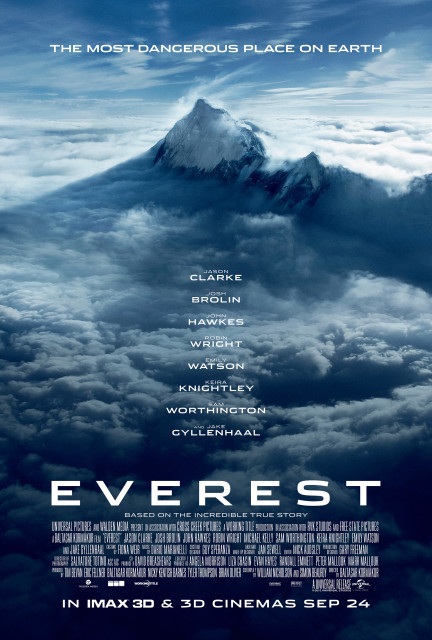
The 1996 Mount Everest disaster is a well-documented tragedy, covered by multiple books, documentaries and a TV movie. Jon Krakauer’s book Into Thin Air is probably the best-known account, though some have called the veracity of his version of events into question. The poster claims Everest is “the most dangerous place on earth”, though mountains like Annapurna, K2 and the Eiger have claimed a larger ratio of lives. Still, that’s not to diminish the obvious risk inherent in climbing Everest. Director Baltasar Kormákur is clearly striving for a depiction that is as accurate, objective and respectful as possible, lending the movie the vibe of a National Geographic docu-drama re-enactment, but with a much larger budget and better actors. Movies allow audiences a glimpse into worlds they would never step into otherwise, and Everest achieves a sufficient degree of authenticity, thanks to location shooting in Italy’s Ötztal Alps, Iceland and Nepal itself. This is a film that was made for the IMAX 3D format and while there is an actual IMAX 3D Everest documentary, this film offers a more immersive and thrilling experience because of its narrative. 


The movie makes it crystal clear that ascending Mount Everest is a behemoth undertaking, involving training and acclimatisation, complex logistics, the harshest of elements and coming at a high monetary cost as well. The screenplay, credited to Simon Beaufoy and William Nicholson, tidily explains the rules and technicalities in layman’s terms while not dropping exposition into the audience’s lap wholesale. The film, via Michael Kelly’s portrayal of Krakauer, directly addresses the question most viewers would have on their minds – “why climb Everest at all?” The famous words of pioneering mountaineer George Mallory, “because it’s there”, are invoked, but the answer – if there is a singular one - seems far more ineffable and we are able to see just how much conquering the famous peak means to the various people in the story. 


Everest boasts an impressive cast by any standards, so there is the danger of it becoming “famous people on a mountain” and losing the verisimilitude of the true story. Thankfully, this is largely averted. Jason Clarke is excellent, portraying Rob Hall as diligent and attentive, while also aiming to turn a profit/make a living. Josh Brolin’s rugged charm is on full display, but it is John Hawkes who turns out to be the emotional core of the film. Hawkes’ portrayal of Doug, whose passion for mountaineering has rendered him near-penniless and has driven a wedge in his relationship with his wife and family, is quietly, painfully sympathetic. Jake Gyllenhaal’s Scott Fischer is the laid-back, free-spirited counterpoint to the by-the-book Rob, and the film benefits from never sensationalising the rivalry to cartoony proportions. 


We do wish Naoko Mori’s Yasuko Namba got more screen time – this is a woman who has successfully conquered six of the seven tallest mountains in the world by the age of 47, and is clearly a fascinating person. However, we concede that giving everyone their moment to shine in an ensemble picture is tricky, let alone when set against the staggering backdrop of a mountaineering disaster. The film also falls back on the “anxious wife back home” cliché, with Keira Knightley and Robin Wright as Rob’s wife Jan and Beck’s wife Peach respectively. The fact that Jan was pregnant at the time might come off as emotionally manipulative – but then again, that is what actually took place and while it’s a formula we’ve seen many times before, we can’t think of a viable alternative to portray what the climbers’ families were going through. 


While there is not a huge amount of room to establish the climbers as fully-developed characters, they are several notches up from being faceless victims and it easy to get invested in their plight. There are certain points where it might be difficult to tell the characters apart, since they are all clad in heavy-duty winter gear, are wearing goggles and mostly bearded. 


Many films are pitched as “celebrating the triumph of the human spirit”. There is an element of that in Everest, to be sure, but it is tempered with the idea of Mother Nature as a harsh mistress. As the line in the film goes, “the last word always belongs to the mountain.” There’s no sugar-coating, no manufactured “Hollywood ending”, with the conclusion bittersweet in that it’s 80% bitter and 20% sweet. Everest gets off to a slow start and because the tragedy it’s based on was so well-publicised, many viewers will know how it ends, but this is a journey that is largely worth the while. 


Summary: A respectful, credible account of the 1996 Everest disaster that overcomes the bits of survival drama formula it must include with some terrific performances and harrowing spectacle. 

RATING: 3.5 out of 5 Stars

Jedd Jong