Showing posts with label Pamelyn Chee. Show all posts

Thursday, May 12, 2016

The Faith Of Anna Waters (a.k.a The Offering)

For F*** Magazine

THE FAITH OF ANNA WATERS

Director : Kelvin Tong
Cast : Elizabeth Rice, Matthew Settle, Adina Herz, Colin Borgonon, Adrian Pang, Jaymee Ong, Pamelyn Chee, Paul Lucas, Victoria Mintey, Gus Donald
Genre : Horror/Thriller
Run Time : 95 mins
Opens : 12 May 2016
Rating : NC16 (Horror)

Singaporean filmmaker Kelvin Tong takes a dip in the waters of Hollywood with this horror thriller. Chicagoan journalist Jamie Waters (Rice) travels to Singapore when she learns that her sister Anna (Condy) has died in an apparent suicide. Sam Harris (Settle), Anna’s ex-husband, is staying in an old bungalow inherited from his parents. Sam and Anna’s daughter Katie (Herz) insists that her mother is not really dead and senses ghostly activity that indicates so. Jamie discovers a mysterious symbol, and her research points towards an ancient demonic entity linking a spate of seemingly unrelated suicides in Singapore. Meanwhile, Father Matthew Goh (Pang) is tracking down the source of cyber-attacks on multiple church websites. He brings this to the attention of Father James De Silva (Borgonon), a priest haunted by a failed exorcism years ago. Rather than a mere hacker, Father Goh believes the same ancient evil linking the suicides is perpetrating the cyber-attacks. Jamie, Sam and the two priests must face a powerful other-worldly force to stop this cycle of death.


            The Faith of Anna Waters is touted as “Singapore’s first Hollywood horror movie”. What that actually means is this is a Singaporean film that managed to secure financial backing from American investors, with a couple of American actors leading the cast. An English-language genre piece has the potential to travel, and the producers of the film hope The Faith of Anna Waters will find an audience in the States and elsewhere beyond Singapore.


Director Tong also wrote the screenplay and the film is something of a mashup of the supernatural horror and techno-thriller subgenres. The premise of a tech-savvy demon can easily become ridiculous and certain aspects of this story seem a little dated. The project was originally entitled “Email”, and haunted email movies are past their sell-by date by about 15 years. There are so many disparate ingredients flung into the pot, from cyber threats to incurable diseases to allusions to the Biblical Tower of Babel to a family mystery rooted in Singapore’s colonial past, that this reviewer was less spooked by the film and more curious to see where it all leads. Unfortunately, Tong fails to satisfyingly tie these plot threads together, with the film often falling back on genre clichés and cribbing liberally from The Exorcist and supernatural horror movies of that ilk.  


Twilight’s Nikki Reed was originally attached to star, but was replaced by Mad Men’s Elizabeth Rice due to scheduling conflicts. Jamie Waters is the stock “intrepid journalist” character through and through, snooping around abandoned basements and thumbing through archival newspaper clippings in search of the truth. As proactive a protagonist as Jamie is, she’s just not a terribly interesting character. Similarly, Band of Brothers and Gossip Girls actor Settle is bland and unremarkable as Jamie’s former brother in law. Nothing really dynamic comes of the conflict between the two, with Jamie blaming Sam for leaving her sister and niece.


Herz, formerly a contestant on The Voice Kids Australia, makes her acting debut in the film. Unfortunately, her inexperience shows through, as she turns in an awkward and stiff performance. Australian actor Borgonon brings enough dignity to bear as Father De Silva in a performance that’s clearly patterned after Max von Sydow’s role in the afore-mentioned The Exorcist. Pang turns the earnestness up to eleven as priest/cyber-sleuth Father Goh, but there’s the sense that a considerably younger actor might be better-suited to the role as written.

The film’s production values are decent, with cinematographer Wade Muller establishing an appropriately spooky mood. The film employs digital visual effects sparingly, Tong wisely avoiding an overuse of CGI. There are also some effectively-staged gory moments showcasing competent special effects makeup work by Thai studio QFX Workshop. The film does rely too heavily on Joe Ng and Ting Si Hao’s score to announce to the audience that they should be afraid. Music and sound effects should enhance or accompany an inherently scary moment instead of merely serving to startle viewers. There are some potentially fascinating ideas at work in The Faith of Anna Waters, but these are muddled in an unnecessarily convoluted story with a lack of focus.


Summary: The bubbling cauldron of ideas in The Faith of Anna Waters hides a fairly conventional supernatural horror film, the intriguing fragments failing to cohere into an engrossing whole.

RATING: 2.5 out of 5 Stars


Jedd Jong 

Thursday, October 16, 2014

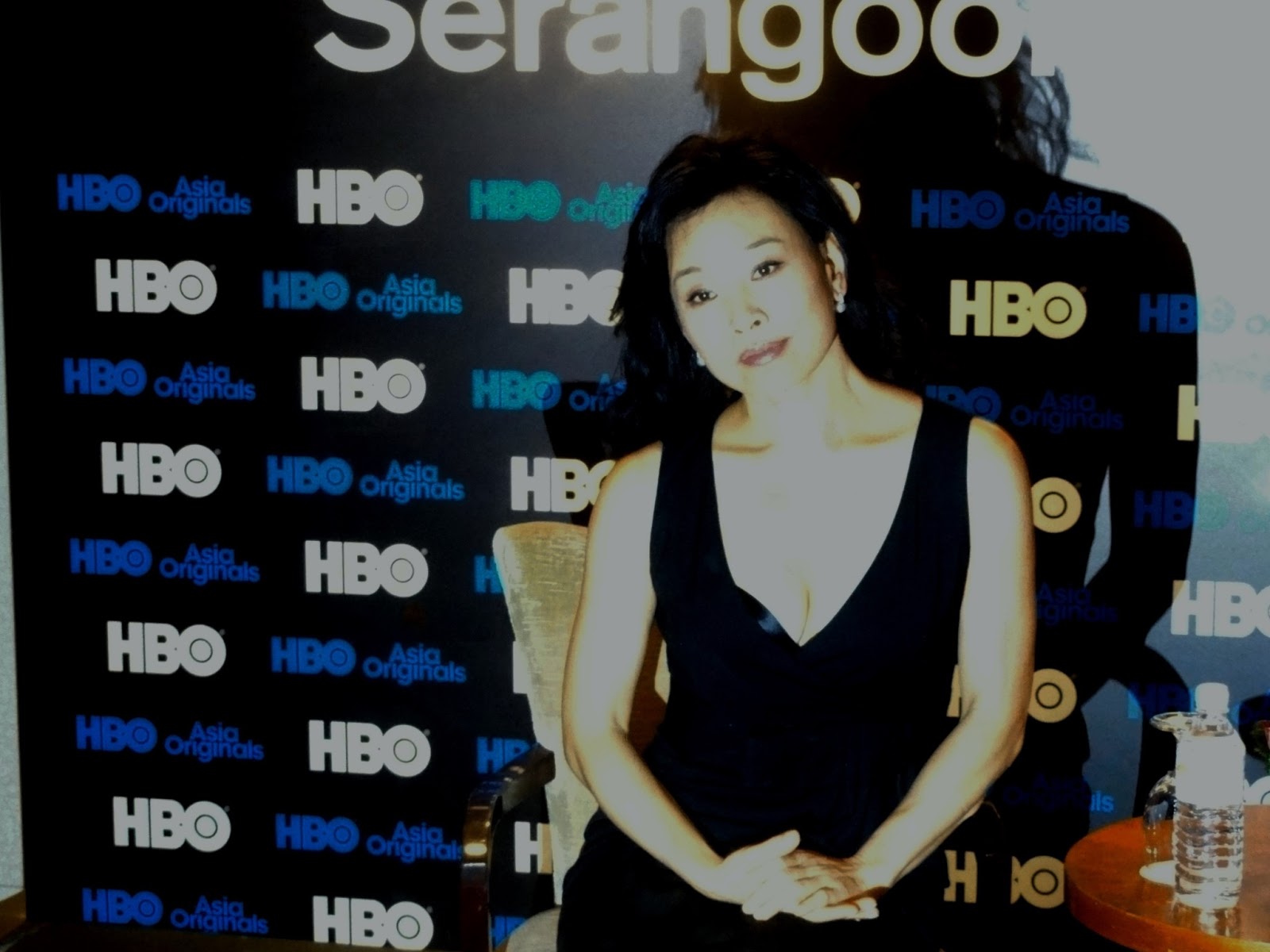
Grace Interviews: Russell Wong and Pamelyn Chee

GRACE: RUSSELL WONG AND PAMELYN CHEE INTERVIEWS


Russell Wong and Pamelyn Chee, stars of HBO Asia’s horror drama mini-series Grace, sat down with F*** to talk the opportunities presented by Asian content in English, stereotyping in Hollywood, how actors sometimes “worry too much” and how Russell Wong is pretty much a cross between a human and an alien. Pamelyn Chee’s words, not ours!

Russell, you were very memorably drawn and quartered at the beginning of The Mummy: Tomb of the Dragon Emperor. Is there anything particularly painful, without giving too much away, that happens to anyone in Grace?

Wong: Yes. [Everyone laughs]

Okay, cool!
You were in Serangoon Road earlier, what drew you back to HBO Asia and to Singapore as well?

Wong: What drew me back is the Asian content in English. The production’s shot in English with Asian stories; that appealed to me, more authentic Asian stories.

Is the horror element new to you?

Wong: It is new, having not done any horror before this. There are a couple of horror films that I like, The Ring, there’s also American Horror Story with Jessica Lange.

Were you aware of just how popular horror movies are in Asia?

Wong: I am aware of it, more aware of it.

How will Grace meet the expectations of viewers who love horror?

Wong: I think Grace will meet a lot of the expectations, especially at the finish of the story because you’ve got to watch all four parts. The first two build it up at a slow pace, quiet with a lot of information, but it finishes a little stronger. Pamelyn’s character and mine go through a little bit more.

Pamelyn, we have some indication that your character is a femme fatale. What preparation did you undertake for the role and were there any reference points?

Chee: You mean, besides being myself? [Laughs] I think the clothes make you look like a femme fatale, the makeup does, the role does, the lines do and I don’t I feel like I have to do much work but just trust in the material and I think maybe, sometimes actors worry too much. They’re like “oh, I can’t do this, I can’t do that, this role is not for me,” but I think if you just trust in yourselves…Russell and I always have this conversation, right? It’s about trusting and being in the moment. It will be an authentic experience if you let it.

Russell, how would you compare working in Singapore with a Singaporean crew to working on a Hollywood film?

Wong: There are a lot of similarities, basically you’re making a film or a TV show. A lot of times, the difference is the budget, or maybe the personalities or whatever, but pretty much, you’re making a movie. Everyone was very professional, very efficient in their work.

Did you get to create some back-story for your character beyond what was in the script?

Wong: I came up with some of my own back-story, some dynamics in our relationship, added a few lines here or some adjustments there.

You play a guy whose mistake brings a curse upon his family. What is it about this character that you like?

Wong: That I like…even though he does…steps outside of his marriage, he’s staying truthful to himself, he knows what he did is wrong. His humanity, I like his humanity. He’s trying to make it right, or he wants to make it right, but things just spiral out of his control.

You described the series as being “Fatal Attraction meets The Shining”, which makes me really want to watch it. In The Shining, the hotel is very much a character. What was it like working on the set of the Egress Hotel in this series?

Wong: We shot a lot in the studio and we built a set that looks like part of the Egress Hotel. I think [director] Tony [Tilse] and the art department, they really achieved kind of a nice, creepy fourth floor…we were kind of limited in the budget with what we could do and I think they did a great job with what they had.

What was it like working with Tony?

Wong: It was good. He knows what he wants, he knows what he needs. Because he has experience, it makes it feel safe, he makes you feel comfortable. “Okay, you’re in good hands.” If he wants a certain shot or a certain emotion, he won’t hit you over the head with it but he’ll let you suggest it.

Were there any challenging scenes for you in this series?

Wong: In the beginning for me, it was just kind of finding the character. You come in and play with the other actors and actresses and you have your idea of where you want to come from with the character but when you actually get on set, we didn’t have time to rehearse, a little bit of time, then it’s usually trying to get to the relationships, what you hope it will be. The initial part was the challenging part, making a connection with the other actors and finding your character through your relationships with them.

Pamelyn, you’re playing the mistress and Constance Song is playing the wife. What was the dynamic like?

Chee: You mean besides the fact that I hate her? [Laughs] You know, we don’t actually meet in the show. So it’s always this big looming cloud at the back of my head that she’s married to him and he’s still married to this woman and that really drives me crazy! We’re friends off-camera, but we don’t ever meet as characters in the show.

How did you build the conflict between those two characters?

Chee: I think it’s not really hard if the person you love the most is married to somebody else! Imagine that! Mine, always! [Laughs]

To come back to the Fatal Attraction comparison, is there anything like the bunny boiling scene in Grace?

Chee: Bunny boiling? There’s things that are worse than the bunny boiling. We don’t boil animals [laughs].

There are supernatural elements and Asian traditions explored in the show. Are you familiar with these traditions?

Wong: I’m from the US, so obviously not as familiar as Pamelyn, but coming to Hong Kong years ago I was introduced to the traditions and festivals, things like that, and you hear stories about the ancestors, superstitions.

What are your personal beliefs with regards to the supernatural?

Wong: My impression is that there are spirits, different realms. We’re all in transition, we’re vibrational beings, we go to a different vibration, maybe some spirits are attached to the earth, some of them had tragic deaths and they want to hang on, to what end, I don’t know. But I definitely believe that are spirits that are happy and that are not happy and you can’t take it likely because there is energy, vibration.

After Grace, are you interested in doing further work in the horror genre?

Wong: I’m interested in good writing. It doesn’t matter what genre it is, if the writing is good, the material is good, I’m all in! I’d love to be a part of it, good writing is basically where it’s at and the horror genre’s fun, it’s interesting, what you can do visually, with the camera and with makeup.

Would you like to play supernatural beings, be it vampires, ghosts, witches or demons in future projects?

Wong: That’ll be interesting, yeah.

Chee: [to Wong] You’d make a good witch, I think!

Wong: Warlock. I’d like to be [a creature that’s] between an alien and a human or something.

Chee: A bit like yourself! [All laugh]

Wong: Thank you Pamelyn [laughs].

Besides the horror genre, I would think the action genre is one that crosses boundaries very well. Do you think there’s the potential for a home-grown action series on the level of Grace?

Wong: Yeah, I mean action and horror do travel and Asian horror is unique and also this is in English. With those elements, this is a great vehicle for HBO and for all of us to showcase Asian stories that can be told internationally. Because of the genre, it’s easier for people to digest and be entertained.

During the press conference, you said that you would want to do less martial arts-heavy roles now.  Is it something that you would still do if there’s a good story?

Wong: A good story, I would do it. When I started out as an actor, I was afraid of being stereotyped into just that, but fortunately when I was younger I was pretty athletic and I could handle the action but not like a world-class martial artist, a lot of the [other] guys are really good. I wanted to focus on just being an actor. But as far as well-written material, if it were something like Taken

You could be an Asian Liam Neeson.

Wong: [Laughs] That’s funny, Tony [Tilse] said the same thing!

What was the vibe like on the set? We heard that there were almost no outtakes, so was it a very intense vibe or did you guys get to chill out? How was it like in-between filming?

Wong: I loved the vibe on the set, it was just chill. I wouldn’t say it was intense, but it was focused.

Chee: Very focused, yeah.

Wong: Everyone was very focused on what they wanted to do, pretty enthusiastic, working with HBO on an original thing, it was a great opportunity for all of us and everyone came to work ready to go.

Chee: I actually made an effort not to hang around his [on-screen] family, the only person that I would talk to was Russell so I had only friend throughout the entire production [laughs].

So that was a little “method”.

Chee: Yeah. I think it helps both for them and for me.

You worked together on Serangoon Road. How was the experience making Grace compared to that of making Serangoon Road?

Wong: For me, I was coming in as kind of a guest star but the set was pretty focused and relaxed. For Grace, I was the lead male so I felt very welcome and kind of taken care of in that regard so I was very comfortable. Not much difference, really, but I guess it make work easy and was something to look forward to.

Chee: I think Grace is much edgier, don’t you think? The material and the style and the way Tony handled it, we’re not trapped by the whole “1960s Singapore” [setting] and the historical element of that genre. It was very liberating being on Grace, I have to say, it was a completely different experience.

This probably applies more to the writers and to Tony [Tilse], but was there some research you had to do into the traditions and customs to get into character?

Wong: Not for me.

Chee: I thought that the research writers at HBO did a wonderful job with the Asian customs in general because sometimes I feel like that gets lost in a western production. They put on what they think an Asian person should [act like]…but I think they made a very conscious effort to keep it very authentic.

Tony [Tilse] and Erika [North] were saying that Grace is set in a generic Asian city and not explicitly Singapore to try and make it accessible. What was that like knowing you could not overtly make reference to the city in which the story was set? Did it have a lot of bearing on playing the characters?

Wong: It didn’t have a lot of bearing on me, it could have been Hong Kong, originally we were talking about Hong Kong but spending time in Hong Kong, spending time in Singapore, obviously they have their similarities and their differences so given that, we focused more on the relationship of the family than the place per se, not a whole lot of emphasis placed on that.

What other projects can we look forward to from the both of you?

Chee: I’m doing a TV series for Channel 5 and also I’m doing Kelvin Tong’s film, so that’s what keeping me busy for the next month.

Wong: I’m meeting with a director in Beijing this week and there are a couple of projects I’m waiting to hear about back in the States.

What is the situation like in Hollywood with regards to stereotypes and the portrayal of Asians in media?

Wong: I think there’s some progress made in certain diverse casting and yet some kind of remain stereotypical. It honestly doesn’t excite me [chuckles]. I love the potential of where HBO can go or may go. I definitely love being a part of this because it’s unique in that it’s Asian content in English that’s done internationally. I just feel like it’s a good fit. I know they’re taking baby steps and that kind of thing.

What do you think it will take for American audiences to accept a TV series headlined by an Asian actor or actress, and do you think something like Grace would travel well to the States?

Wong: It could travel well to the States. What it will take is good writing, same as any film takes. Good writing, good performances, good scripts and good direction, just the whole production. And it doesn’t have to be a huge budget, the quality has to be there, the material has to be there. There are great stories here in Asia that need to be told that with a good writer, it will travel. This is a good story, you want to watch it, doesn’t matter where it’s from. A good story is a good story. We can execute this as well as anybody. The DPs (Directors of Photography), the sound, the lighting, everything. It’s good execution and content.

How do you think the mini-series format works for this story? Is four episodes enough?

Chee: If it’s bad material, four episodes is four episodes too many [laughs].

Wong: For my tastes, it’s a little slow, but for some people, they need to get all the information. I’m like “skip to it, skip to it!” But maybe people want to see all the details and Tony does that, all the details about this character and about that character, you pay attention to what’s happening here so there’s a build-up and it builds quite slowly but at the end there’s a strong finish.

Chee: But don’t you think it’s skewed because you are in the film so you know the story? [Laughs]

Wong: I’m not biased [laughs].

Chee: No you are, totally biased! [Laughs]

Wong: Yes I am. The whole time we shot this, I kept thinking to myself “this is going to be good!” It’s not just another job, I’m part of something that’s going to make some noise.

Chee: When was the last time you felt that?

Wong: Romeo Must Die.

The approach in this series seems to not be about the gore and the in-your-face horror elements but there’s the power of suggestion, atmospherics, nothing is scarier than what you can’t see. What was it like on the set and what are some of the techniques used to keep the tension at a slow burn?

Wong: I think that’s done with camera angles and what he’s shooting and how he’s shooting it, and the editing and the sound. There’s obviously a lot of parameters they have to work within, you can’t be too gory and there are different cultures, you don’t want to step on any toes, that kind of thing. There are a lot of parameters to work with and in doing that, it creates something that’s almost more disturbing, it messes with your mind a little bit which I think is great horror, like The Ring. Watching it, there’s cameras coming through the kitchen and you hear a sound and it’s like “this is disturbing!” [Laughs]. I think Tony was able to achieve some of that, it’s great.

It seems that the series has a contemporary Asian feel, but there’s been a strong tradition of domestic horror films in Hollywood, things like Poltergeist, Rosemary’s Baby and The Omen. Were those influences, whether consciously or subconsciously, on the family dynamics in Grace?

Chee: Definitely not. I think the sensibility is so different that to even borrow that would be wrong.

Are you also a very superstitious person?

Chee: Definitely very superstitious [laughs], like all Asian people, you guys must know!

Was there anyone in your family who told you “don’t do this because it’s a horror project”?

Chee: Yeah! But you know, I’m not the kind of person who listens to what everybody tells me [laughs]. 

Thursday, September 11, 2014

Coup de grâce: Grace Press Conference

COUP DE GRACE

The stars of Grace dish on HBO Asia’s horror drama mini-series
3/9/14 Jedd Jong


This October, HBO Asia is hoping to add its own dash of spookiness to the usual Halloween festivities with Grace, its original four-part mini-series. F*** was at the Conrad Centennial Hotel Singapore for Tuesday morning’s press conference.

Revolving around what could be any upper-middle class Asian family, Grace shows how one man’s indiscretions doom his family to a series of eerie happenings. Present at the press conference were leading man Russell Wong who plays Roy Chan, Pamelyn Chee who plays Roy’s mistress Ya Yi, Constance Song who plays Roy’s wife Angela and George Young who plays Roy’s son-in-law Charles.


Grace features several alumni from last year’s HBO Asia co-production Serangoon Road, including Wong, Chee and Australian director Tony Tilse. With deejay Maddy Barber moderating the proceedings and everyone seated on couches decorated with HBO throw pillows, Wong jokes that it feels like they’re in for family counselling. The Chinese-American Wong, known for films like The Joy Luck Club and Romeo Must Die, leads a cast that includes many Singapore-based artistes in addition to Taiwanese actress Teresa Daley and New Zealand-based actor Yoson An.

Wong’s reputation as the roguish charmer from The Joy Luck Club precedes him, but it seems he has mellowed somewhat. Mostly shy and laid-back, he says “I had a good time working on Serangoon Road. It’s Asian content in English. Sometimes in the States there’s still a little bit of stereotyping going on and trying to fit into the martial arts genre…at my age it’s not working so well. So this works great!”

Young was the enthusiastic jokester of the group, making a crack about how there was “a lot of sexual tension” between him and Wong. “I wanted to give him some watermelons, ‘xī guā!’” Young says, alluding to The Joy Luck Club. “I gave him a couple, not during the scene though.” He adds sincerely, “Russell being mixed Asian-Caucasian as well, kind of similar to me, I see him and I want to learn from him.” Young describes Grace as a “Greek tragedy with an Asian twist”, adding this is perfect for him given that he is half-Greek and half-Chinese. When the cast is asked if they are superstitious, Young says he practices “touching wood” (get your mind outta the gutter) to avoid jinxing anything.

Pamelyn Chee says her character has no qualms ripping Roy’s ideal family apart. “It could just be my real life,” she jokes. Chee was given the script without being told which actor would play Roy, but she guessed Russell Wong and she was right. When asked if the emotional nature of the role made it challenging, Chee responds “I think emotions are overrated. I don’t feel like it’s about being emotional, that’s an easy sell for an actor, I feel like it’s portraying the different levels and layers that the character has and it doesn’t always has to be emotional, it can be scary, it can be wild and there are so many other layers that are under-explored by actors in general.”

Constance Song, who made her television debut in 1998’s The Return of the Condor Heroes, is a familiar face to fans of Chinese-language drama series on Channel 8. Stepping outside her comfort zone to take on an English-language part, she says that she practised with English-speaking friends and that “actually it’s not so bad after a while”. She called the chance to act alongside Russell Wong “unbelievable”, saying “Russell is always making me so nervous. I think it’s just his presence.”

Ever the gentleman, he said of Song “she has a great restaurant,” referring to the actress’ other venture, a tapas bar.
Song admits that she couldn’t help but crack up when Wong had to deliver some dialogue in Mandarin. When Barber asks the actor how his command of the language is, he replies “mó mó hú hú”, meaning “vauge”. Our expert tells us this isn’t even the right term, but far be it from us to play Chinese grammar police.

When asked if the Singaporean cast members would travel to the States to visit Wong, Young quips “yup, I’m crashing at Russell’s place. Russell didn’t know this, but I’m borrowing his car, he’s got a few, I’ll borrow a couple…” Apparently, the cast has gotten close enough to go out for dinner that evening on their own accord.


A journalist asks about the significance of the series’ name. Director Tony Tilse, sitting in the front row, takes over the microphone to answer. “It all came out of the concept of the story,” he says. “Ultimately Grace is about forgiveness, mercy, elegance, all those things. I think the idea of Grace is that it’s all those things, so in a way it’s about, because of the story we chose, we saw grace as about wanting forgiveness, the whole idea behind it so that’s the whole meaning behind it.”


Grace premieres Friday, October 17 at 10 pm (9 pm Thailand/Jakarta) on HBO and HBO HD. 

Wednesday, February 26, 2014

Re:solve (决义案)

For F*** Magazine

Re:solve (决义案)

Director: Randy Ang
Cast:  Chris Lee Chih Cheng, Yuan Shuai, Mico Chang, Pamelyn Chee, Jimmy Wong, Sunny Pang, Zheng Ge Ping, Zhu Houren
Genre: Action, Thriller, Crime
Run Time: 100 mins
Opens: 27 February 2014
Rating: PG (Some Violence)

We’ve all heard the adage “actions speak louder than words” and fisticuffs and shootouts are indeed a universal language among film-goers. Ong Bak and Tom Yum Goong did a good deal for the visibility of Thai films around the world, as did The Raid: Redemption for Indonesian cinema, not to mention the scores of Hong Kong martial arts movies over the decades. Touted as “Singapore’s first action crime thriller”, director Randy Ang’s Re:solve hopes to pave the way for made-in-Singapore action movies to become a thing. These are baby steps though, and it shows.

Special Tactics Unit member Cheng Shaoqiang (Lee) is part of a raid that goes awry, resulting in the death of team leader Wu Tianle (Pang) and the dissolution of the unit. Shaoqiang’s girlfriend Wu Qizhen (Chang), who’s also Tianle’s sister, is understandably upset and the relationship falls apart. Seven years later, Shaoqiang, now an inspector with the Serious Crimes Unit, finds his past coming back to haunt him, as he investigates a series of attacks on financial firm BWB Capital. Qizhen and Wang Zheng-ming (Wong), Shaoqiang’s former teammate, now work at BWB Capital and the three reunite under less-than-ideal circumstances. As Shaoqiang and his new partner Yan Yongchen (Yuan) work to crack the case, all signs point to Tianle – the mentor and comrade who seemingly died in the line of duty – being the mastermind.


It is about time a made-in-Singapore crime thriller feature film saw the light of day, so the mere existence of Re:solve should be encouraging, but it also demonstrates how far the local movie industry has to go. It’s worth noting that the production values are solid and the look and feel of the picture is a marked improvement on that of amateurish home-grown TV “action dramas”. The action sequences here are decently choreographed, though they are few and far between.

But the film’s tone is constantly overwrought and melodramatic, emphasised by a maudlin score filled with swelling strings and lilting piano melodies. The film slips into unintentionally funny territory on a number of occasions, falling back on trite plot devices like Mission: Impossible-style “latex perfection” mask disguises. It’s also a pretty dull affair, sagging in the middle when it enters paint-by-numbers procedural mode.


The acting is just passable, Taiwanese actor Lee making for a handsome but bland lead. Chang is very much the same; at least her part is a little more than a bog-standard “girlfriend”. Zhu Houren hams it up, gesticulating wildly and wringing his hands in all of his scenes. Yuan Shuai’s turn as the sidekick borders on being whiny. Pamelyn Chee has poise to spare as the businesswoman who might know more than she’s letting on. Wong is pretty stiff and it turns out that he isn’t a professional actor and is in fact a Forex trader who executive-produced the film, so the fact that he plays an important secondary character does carry a slight “vanity project” aftertaste. TV veterans Richard Low and Xiang Yun show up and there’s also a cameo from Roger Koh, owner/CEO of the fried rice restaurant Chen Fu Ji and one of the movie’s financiers. Thankfully, the name-dropping of his restaurant, while silly, stops short of the cringe-worthy product placement that infests so many Singaporean films.

In the context of Singapore’s film landscape, Re:solve might seem like something of an achievement. Unfortunately, the reality is that this also-rans crime flick can barely compete with any of the dime-a-dozen cop movies that come out of Hong Kong. It’s a “points for effort” situation in that it’s clear what Ang was striving for, and the film does possess a degree of polish, the climactic infiltration of a hijacked cruise liner making for a decent denouement. Following that, however, the film ends with a “sothisiswhatreallyhappened” reveal, the logic-straining twist ending coming off as not quite preposterous but still really rushed, especially given Re:solve’s flabby midsection – not an ideal resolution.

Summary: Less of a milestone and more of a stepping stone, those hoping for a decent Singaporean action thriller will be at least a little disappointed by the frustratingly mediocre Re:solve.

RATING: 2.5 out of 5 Stars

Jedd Jong

Monday, March 18, 2013

On the Road: Serangoon Road Set Visit

I went on my first set visit assignment in January, and here's the resulting article!


ON THE ROAD
F*** Magazine is in Batam, on the set of Serangoon Road.

By Jedd Jong for F*** Magazine, Singapore

26/01/13

It’s a pleasant afternoon in Batam, Indonesia, and the weather is holding up nicely – a relief given it was raining for the past several days. After hopping aboard a ferry and braving choppy waters, our group is relieved to be on dry land, and is packed into a minibus headed on location for the shooting of a scene for Serangoon Road, HBO Asia’s first co-production (with Australia’s ABC TV).

A ten-part detective drama series, Serangoon Road is set in 1960s Singapore and tells the story of Australian-born Sam Callaghan (Don Hany), whose childhood was spent in Japanese internment camps in Singapore during the Second World War, and who returned to fight in the Malayan Emergency, both experiences causing him considerable trauma.

His neighbour Patricia Cheng (Joan Chen), a widow whose recently-deceased husband leaves behind a detective agency, seeks out Sam’s help to keep the agency on its feet, and to investigate her husband’s death. After he reluctantly agrees, Sam is plunged into a tangled web weaved by Chinese Secret Society gangs, foreign powers vying for control and information, and a city in the midst of political and racial unrest.
As he journeys through both the seedy underbelly and the realm of upper crust expat elites, Sam – along with his girlfriend (Maeve Dermody) and Patricia – is brought face to face with some of Singapore’s most brutal and powerful factions, who are not afraid to kill to keep their secrets.

The series takes its name from one of the earliest roads built in Singapore and a key thoroughfare that ran across the island when it was first constructed, bringing together denizens of every stripe. Scenes have been shot across various locations in Singapore, including Raffles Hotel and black-and-white bungalows in Mount Pleasant, but the bulk of filming was done at Infinite Studios’ brand new stages and backlot at its facility in Batam, which we would soon be headed to.


First on the agenda was a visit to a sleepy seaside town in Nongsa where, with just over a week until the end of principal photography, a flashback sequence was being shot. This scene depicts a young Sam Callaghan, played by child actor Julian Feder, wandering through the Sime Road Prisoner-of-War camp in World War II-era Singapore, searching for his father. Unfortunately, this would be a lost cause as Sam’s dad has been sent on the death march by Japanese soldiers.

“Keep the smoke up, that’s it, lots of smoke”, instructs director Tony Tilse as smoke from incense burners wafts onto the set, adding to the bleak atmosphere created by a reconstruction of the camp with its bamboo gate and thatched roof, and background actors playing prisoners of war. In the corner, there’s a family who is reunited after being separated during the war – but being extras on a TV series isn’t all fun and games.

“You cannot laugh or smile….keep your emotions and expressions from head to toe”, an assistant says sternly over a megaphone. The director calls action.
“Have you seen my dad?” the boy asks to the camera as it follows him forward, through the camp.

After the take is completed, camera operator Bruce Young watches his work on a playback monitor as the crew prepare for another take. This writer says a quick hello to the child actor before we’re whisked off to the studio facility proper.

We alight at the studio and are ushered into a reception room that is plushly carpeted, decorated with paintings and wood carvings with an Indonesian motif, as we await our “guides” to bring us through the set. They turn out to be no mere tour guides, but rather Paul Barron (who created the show along with Peter Andrikidis) and Erika North, executive producer with HBO Asia.

“The backlot is one of things that’s almost old-Hollywood type filmmaking where you get a backlot that’s a blank canvas and you get to create whatever you want with it,” Barron says. He states that re-creating Singapore as it was in the 60’s in modern-day Singapore itself would be difficult to say the least, “Especially if you want to have gunfire and set off explosions and do an action detective series – which is what this is at its heart. It’s a detective series, but it’s meant to be a detective series that at its heart is set in the reality of Singapore in the mid-1960s so this is something that we worked on from day one.”

Before we begin the tour, Barron describes the nature of the show. “This was meant to be a genuine creative co-production where we brought together creative talents across the board and the Asian characters are leads – they’re not the off-siders – where the stories came from Singapore and Malay and Indonesian stories and they didn’t get conceived of as somebody doing whatever. Every single story here was grounded in some fact, some reality of Singapore at the time.”

“I think what works and what attracted me at HBO Asia to this show is the fact that it’s a procedural – at its heart it’s a detective story, and detective stories, no matter where they’re from, they work, they travel,” North opines. “This is a home-grown, a truly kind of Pan-Asian detective story that we really think will travel, not only across the region but internationally, we hope.”


Barron comments that times have changed, and that 30 years ago it would have been impossible for a co-produced show set in an Asian locale to come to fruition. However, when he laid out that “this is a detective series set against this backdrop, in this place”, there was a strong immediate international interest, and Barron hopes that this could become something of a breakthrough because “it’s a primetime drama series that isn’t Vietnam.”

As we walk towards the backlot and spy scaffolding in the distance, Barron relates the effort that the art department went to in order to ensure the details were period-accurate – what he refers to as a “from the teacups up” approach. “In fact when we had the Indonesian minister here on set a couple of months ago, she actually went into the tea room and was remembering the teacups and saying things like “my God, I remember we used to have these when I was younger”. So we’d like to think we got it right,” he says.

It turns out that the very studio facility we were in, built by Singapore company Infinite Frameworks, was one of the keys to getting the project off the ground. Shooting in a controlled environment on a backlot gave the team the opportunity to not only recreate the world the series was set in, but to wreak some destruction as well. “On a backlot situation, we can explode the cars, we can explode the post office, we can have gunfire going off in the street because as a detective series – you need all that stuff.”

Oh yes, there’s some action in store. The series co-creator sets the record straight. “We’re not doing “Miss Marple”, where you can just talk about it all – we’re doing an action detective series.” The impressive Chinatown set we were walking onto would be a permanent fixture on the backlot, though it could be repurposed to represent Chinatown in any era. “What they were creating was a blank canvas of a Chinatown. You could recreate Chinatown in the 1890s, you could recreate Chinatown in the 1980s, you could, in this case, recreate Chinatown in the 1960s.”

And recreate Chinatown they did. An effective movie or TV series set should make one feel like they’ve turned the corner and walked into a different world, and that was exactly what the 60’s Chinatown – in Batam, no less, did. Storefronts and signs looked right out of period photographs, and carts, bicycles and stands were placed throughout the set. There were even live chickens in a corner, probably unaware that they were not actually in 1960s Chinatown.


When asked what the most difficult part was to get right, Barron answered, “I think the most difficult part is getting vehicles. Because trying to find cars that are accurate to the time, that are now 50-year-old cars, is hard.” He says that transforming the empty backlot into 1960s Singapore was the art department’s job, but it was a job that was done extremely well.

Barron has nothing but praise for the scenic artists. “Herbert Pinter is the production designer, and frankly he’s a genius. He has a whole team of people though, some days there’ll be 40-50 people in the art department building things, constructing, painting whatever. So there’s a huge logistics issue involved before we started to shoot here of turning those white walls and empty streets into something like what you’re seeing today. Now, when they fill this with 50 or 100 extras, and you’ve got the bicycles and the trishaws going, it is Singapore in the mid-60s.”


Barron has, as expected, kind things to say about the parties who made the production possible. “The co-production I think has helped everybody because we’ve been able to bring together two things: one is the creative resources – the creative resources of Singapore, and acting resources from across the region, and our creative resources and then we’re frankly able to bring together the money. And the money included MDA, it included ABC, it included HBO Asia, it included the West Australian government, it included the rest of our distributor content. And all those parties were necessary to make it happen. It’s fair to say that Singapore’s MDA were a great supporter of the project from the very early days, and without their support we wouldn’t be here –but it’s also fair to say that without the support of all those parties, we wouldn’t be here. “


When asked what inspired him to create Serangoon Road, Barron replies, “Well, I love reading history and I love detective stories. And so, how it came about was partly because I love detective stories but when I was reading more and more and spending more and more time in Singapore and getting more and more fascinated by the stories of Singapore and of the region, but frankly just one day I sat down and started to write Serangoon Road. The characters of Sam Callaghan and Patricia Cheng and all of those came from the very beginning. And it was less a bolt of lightning and more I guess a synthesis of a whole series of strands of ideas that I’ve been playing with for a while that found a home in mid-1960s Singapore.”

The series will have an overall story arc about the mystery of who killed Patricia’s husband, and comprise individual stories over the ten episodes.


As the co-creator of the series, Barron is understandably very excited to fill us in on the background of the show, describing how the individual stories were based on real events, and that “while we’re not doing a documentary and we’re not doing a history lesson”, he “wanted the stories and the characters to resonate.” He tells us the backstory of Kang, a former communist insurgent who came in from the cold during the amnesty and ends up working for Sam.

“This is the short version!” Erika interrupts with a laugh.

Barron talks more about Sam’s character: the scene we witnessed earlier on was essentially the beginning of his journey, as a child in the POW camps. He goes back to Australia, joins the army, and fights in the Malayan Emergency and ends up back in Singapore, “running a kind of quasi-import/export business because he doesn’t want to go back to Australia, and the only place he feels strangely at home, is here.”

When asked if he faced any restrictions that affected the storytelling of Serangoon Road, Barron says “I wouldn’t say “restrictions”, but whenever you’re doing co-productions you’re aware of the sensitivities. You know, it’s just a fact of life. And it never got in the way of the storytellers. So there are sequences that touch on potentially touchy subjects at the time because the politics was a part of life here, you can’t not refer to it in any way, shape or form. . But we weren’t telling a story about any particular political party or any particular individual and, you know, the Americans were here and so we have the CIA, but we don’t touch on this that the Americans might have done in real life as much as the fact was that the CIA was here, and American soldiers were on their way to Vietnam and that provided the source of stories.”

With a TV series set in 1960s Singapore and intended to travel, there’s always the danger that it might come off as tacky or cheaply exotic, but Barron is quick to allay our fears. “HBO Asia have been instrumental in making sure that this has an identifiable and real Asian tone, Asian characters – they constantly went up the Asian characters to make sure we didn’t fall into the western clichés, and so they’ve been truly integral to that process.”

This writer asks Barron if an effort was made to not exoticise the series. “Well, beauty is in the eye of the beholder and you know, so when you look at it you’ll be the one to tell me,” he says. “But certainly that was the intention, was not to exoticise…it was to say “real and authentic”. Always the catch-words were “real and authentic”. Now, the thing though – the trick in your question is this though: what is real and authentic will still to Western eyes look exotic. There is no need to embellish it, far from it. As I keep saying, I wanted the Singapore and the Malaysian audiences to look at it and say “that’s real. These are stories we relate to, settings we relate to, and that’s real.” I’ll keep my fingers crossed that we got it right!”

We then proceed to view the interior sets, housed in large soundstages. We walk through the set for the Cheng Detective Agency office – undoubtedly an integral location and probably the nerve centre for most of the stories.


Up next is the Black Lotus Bar, a seedy nightspot lit by garish, colourful neon lights, with foldable wooden chairs, a stage for the band in the corner, a bar stocked with period-accurate liquor and even discarded peanut shells scattered on the floor – that’s as authentic as it gets! We get a peek at the opium dens and a back corridor with ads for massage parlours plastered on the walls. 


We wander through a passageway that serves as the hair and makeup room for the extras. Executive producer Erika North tells us that on any given day, there would be 70 to 150 extras on set to bring the backlot to life. We alsot to life. 0 to 150 extras on set to bring the ban daakeup room for the extras. ick to allay ourith HBO Asia Erika North.o pass by Joan Chen’s dressing room, as denoted by a placard on the door. Joan Chen just wrapped yesterday and is resting up before the press conference tomorrow (see adjoining story).

We see a long, narrow set, which is a corridor within a ship, rivets, portholes and all – but we aren’t allowed to walk through because it is still being painted up. We then walk up to the interior set of a house belonging to shady businessman James Lim, played by Edmund Chen. The walls are a bright yellow, and a flight of stairs leads up to a partial second storey set.

Along the stairs are bits of broken porcelain, and there’s what appears to be a bloodstain on the floor – turns out quite the altercation took place in the house. North tells us that the look the art department was going for was very much “Asian noir”, and influenced by such films as Wong Kar Wai’s In the Mood for Love.

Just before we leave, we chance upon art director David Ingram, who tells us a little more about the look of the show. “There was a lot of desaturated colour, but we actually wanted to bring colour into the set. So we wanted to keep the truth of accuracy of colour of the time, where it was actually quite desaturated but we also wanted to bring in our own look to the film that is quite colourful, as you can see from the sets that’s quite vibrant, but not outside the square of what was actually accurate. We’ve actually done a lot of work in Singapore so we have a lot of background knowledge and a lot of books, do a lot of research and actually flea markets in Singapore and flea markets in Malaysia and old postcards – you know it’s fantastic looking at when you can actually find your inspiration for your accuracy. It’s gorgeous with the influence from the colonial architecture and how they preserve that as well.”

And with that, we’re whisked off back to the ferry terminal to catch our boat back to Singapore. But the work’s not quite over for the crew of Serangoon Road, as after principal photography wraps, there’s a five month long post-production process to get the series ready to air in September, which will end a journey, a “road trip”, that started when the project was conceived three and a half years ago.  


---
And the press conference article:


MADAM DETECTIVE
Joan Chen takes on 1960s Singapore in Serangoon Road
By Jedd Jong for F*** Magazine
26/01/13


Not many Asian actors can lay claim to having a viable career in both Asian cinema and in Hollywood. It’s safe to say that Joan Chen belongs to that exclusive group. The actress has been variously dubbed the “Elizabeth Taylor of China” and the “Meryl Streep of China” - flattering comparisons indeed. Looking glamourous as ever, she sat down to field questions from the press at the Mandarin Oriental Hotel in Singapore, a day after wrapping filming for Serangoon Road, a period detective drama series co-produced by HBO Asia and Australia’s ABC TV.

She describes herself as a detective story buff, saying her love of old-fashioned detective stories was what drew her to the role of Patricia Cheng, a widow in 1960s Singapore who takes over the running of the detective agency her late husband left behind. She was also drawn to the setting. “I first fell in love with the South-East Asia colonial era through Maugham, Somerset Maugham,” she says. “It’s a very unique environment, this colonial era, and we are filming sort of the aftermath of that. That’s another attraction to me.”

When asked what audiences can look forward to, the actress replies “I think it’s a very exciting piece with a lot of action, a lot of human touch – stories you can relate to.” She also highlights the appeal of the fashion, music and style of the era. “If our production ever goes over-budget I think it’s because of the hairspray,” she jokes.

As a director and screenwriter in addition to being an actress, she was able to offer her input on the character of Patricia Cheng. “When Patricia was first presented to me, she was somewhat a little bland. She was someone to facilitate the other characters’ stories.” The actress was able to focus on a character detail that would have otherwise gone unnoticed.  “When the character was first presented to me, she was just Patricia, owner of the detective agency, but I noticed that she didn’t have children,” she says. “So I asked the question why, then it became something interesting for me, to put in the angle of her infertility, which for any woman, especially a Chinese woman, an Asian woman of that era, that gives her a deep sense of unworthiness that is an underlying vulnerability.”

Besides her numerous film roles, Chen is known for co-writing and directing the 1998 film Xiu Xiu: The Sent-Down Girl. However, her next directing project, the Richard Gere-starring Autumn in New York, was critically panned and bombed at the box office. On the subject of directing again, Chen mentions that she has completed a short film, Shanghai Strangers, “to test the waters”. Working with a small crew and shooting for only five days, it piqued her interest to return to directing. “I’m now writing a script and trying to see if I can get away from my family and direct another film. I love it, just that after my second kid was born I didn’t feel it was the right thing to do,” she adds.

As an Asian woman in Hollywood, it was inevitable that Chen would come face-to-face with typecasting. “I think there were a couple of stereotypical images that were accepted by the industry, and they don’t want the entire understanding, or just you as a human. It’s more as a spice, as a colour, as an exotic element. So, when I was young and beautiful, I was the object of desire, the sexy vixen, then I got a bit older, then I’m this dragon woman.” She says the roles dried up. The one role she was repeatedly approached to play? “Vampires,” she says to some laughter.

F*** asks if she has seen the new Dredd film – Chen played the evil henchwoman Dr Ilsa Hayden in the 1995 version of Judge Dredd, starring Sylvester Stallone. “I haven’t seen the new Judge Dredd film actually…movies like Judge Dredd are not particularly my type,” though she does say that since we brought it up, she’ll go see it. It’s safe to assume that her role in that film fell squarely into the stereotypes she was describing.

Earlier in her career, Chen became a national icon in her native China for her role in the 1979 film Little Flower, for which she took home the Hundred Flowers Award for Best Actress. “I didn’t realise when I was a teenager, when I played Xiao Hua (Little Flower) that the whole entire country fell in love with her. I think it was a breath of fresh air because I didn’t know how to perform, so I was just there as my innocent self and people felt it was very fresh and the film was fresh and so really, people, I don’t think anybody during that time would have missed that film, so the entire country saw that film.”


“So obviously then I became this symbol, I became “Little Flower”, and when I left I China it was deemed as sort of a betrayal because I left  the motherland and all this love and adulation and people felt betrayed,” she says of the turn in the public’s perception of her.  “And when I played in Tai-Pan, it was even worse because I played the mistress of a “tai pan”, a white man, not only played a mistress but she seemed to have like it, and so that was another blow,” she says of the film adaptation of James Clavell’s novel. She compares the antagonism she was met with to the scorn shown towards Lance Armstrong lately – ouch.

She describes the period after acting in Tai-Pan as “a lonely time”, saying she didn’t know where to turn as she was seen as little more than an exotic element in America, but was not welcome in China. She has long since forgiven the public who turned on her, though. “Looking back, I know where it came from now because you know, I’m 51, but when people see me I’m Little Flower, I’m still Little Flower. When people see me it’s a symbol, a cultural symbol, it’s not a person anymore. And that whole antagonism came from that sort of expectation.”

She says that she has definitely gotten over the stir her decision to take up U.S. citizenship caused back in the day. “Everybody in China, if you talk to the young generation and say “oh, I play this sexy woman, the lover of a white guy and got criticised and got on the bad side politically they will be like “what?!” It’s a different era, it’s a different generation and so many Chinese actors or filmmakers have other residentships, I mean our top leaders’ children study abroad,” she says, thankful that times have changed.
When asked if she encourages her two daughters to follow in her footsteps, Chen replies “I think all little kids want to act. Kids are just having fun. I think my kids are normal kids, they will develop whatever their own passions are. But they do make little films with iPhones.” She feels it is fantastic that many youths do not regard making their own films as something difficult, and that she encourages young filmmakers, saying “I think it’s what you have to say that is the most important thing.” She also warns of the danger of sticking to a formula and trying to blindly emulate it, but observes that “if you have your individual stories that you feel passionate in telling, nowadays you have the tools to really tell it.”

To wrap up the press conference, Chen talks about her experience filming in Batam. “I think that studio is going to be used more and more, it’s such a great studio and I would love to go back and shoot there again. The backlot and soundstage, both really great. So convenient, just getting off the ferry, and there is where you live and where you work, it’s a very good setup. And I love Indonesian food, so I look forward to actually explore more of Indonesia. This time I basically, really spent all my time in Nongsa.”
Diana Ser, the moderator for the press conference, remarks “Well if I’m going to look like that when I’m 51, I’ll be eating Indonesian food day-in day-out!”

If only we were all so lucky.