Showing posts with label Ray Winstone. Show all posts

Wednesday, December 2, 2015

Point Break (2015)

For F*** Magazine

POINT BREAK


Director : Ericson Core
Cast : Édgar Ramírez, Luke Bracey, Ray Winstone, Teresa Palmer, Delroy Lindo
Genre : Action/Thriller
Run Time : 114 mins
Opens : 3 December 2015
Rating : NC-16 (Sexual Scene and Some Violence)

Strap in, buckle up, insert alternate ways of securing oneself here – because things are about to get XTREME! *Guitar riff*. Johnny Utah (Bracey) is an FBI agent-in-training and a former motocross rider who left the sport after a tragic accident in his youth. When a team of elite thrill-seekers pulls off multiple heists around the world, targeting wealthy corporations, Utah proposes to his FBI instructor (Lindo) that he be allowed to investigate. Utah goes undercover, infiltrating the team and befriending its leader Bodhi (Ramírez), who explains that the daredevil exploits are actually about honouring nature. Utah falls in love with one of the team’s members, Samsara (Palmer), and British agent Angelo Pappas (Winstone) begins to doubt where Utah’s loyalties lie. As Bodhi’s gang pursues the ultimate rush, Utah is seduced back into the extreme sports world, but must put a stop to Bodhi’s criminal activities before he reaches the point of no return.


            Point Break is a remake of the 1991 film of the same name, which some would go so far as to call a classic. The original Point Break is by no means flawless and certainly has its goofy moments, but its iconic status is well-deserved and the characters of Johnny Utah and Bodhi, as portrayed by Keanu Reeves and Patrick Swayze respectively, are certainly memorable. There’s no use beating around the bush: a Point Break remake is unnecessary, and doubly so because we already have The Fast and the Furious, which swapped out surfing for underground street racing. It is a touch ironic that Ericson Core, the cinematographer of the first Fast and Furious movie, is the director and cinematographer of the Point Break remake. It can be argued that if the characters had different names and this movie were called something other than Point Break, there would actually be less furore at it being a rip-off than there is now, given its “official” status.


            The original film revolved around surf culture and the remake ups the ante by throwing everything and the kitchen sink into it, showcasing feats of big-wave surfing, wingsuit flying, free rock climbing, dirt road motorcycling and sheer face snowboarding. The film has roped in top real-life extreme sports athletes to perform the stunts and granted, they do look impressive, but there is something very dated about this approach. It makes the film feel like a relic of the late 90s, when things like the X Games were taking off and everything felt like a Mountain Dew commercial. The daredevil stunts are strung together with a plot device in which Bodhi is looking to complete the “Okami 8”, a series of extreme sports trials. The film has a larger scope than the original, with filming taking place in Austria, Italy, Switzerland, France, Mexico, Venezuela, French Polynesia and India, but there are times when it feels more like a ginned up Amazing Race than anything else.


            It is interesting that audiences feel so protective over the characters of Johnny Utah and Bodhi given that they’ve only been in one film, but it seems like it’s sacrilege for any actors other than Reeves and Swayze to take on those roles. Gerard Butler was originally cast as Bodhi but was replaced by Ramírez. While Ramírez brings some mystique to the role and tries his best to pull off the philosopher-warrior attitude embodied by Swayze, his interpretation of the character is far from sufficiently magnetic. Reeves isn’t exactly an untouchable paradigm of acting talent and from some angles, Bracey does sort of resemble Reeves. He does bring a heaping helping of whininess to the part. Similarly, Palmer is considerably more boring than Lori Petty was in the original. Gary Busey brought his trademark unhinged unpredictability to Pappas, while Winstone is the usual gruff English street tough he always is. Lindo is the stock authority figure, also doing very little. As a side note, the film features some of the least convincing tattoos we’ve ever seen in a movie. Guess the stunt budget left the makeup department high and dry.


            It’s pretty obvious that the plot exists to string the stunts together, and it all comes across as very perfunctory and half-hearted. This is a movie that should naturally be flowing with adrenaline, but it often feels like it’s just being shoved along. A Point Break remake was a terrible idea to begin with, and even with all the extreme sports bells and whistles in the world, there’s no way this was going to be anything but a let-down. In the hands of screenwriter Kurt Wimmer, it’s even more laughable than in the original film when Bodhi waxes faux-philosophical. Sure, the original Point Break was cheesy, but that was part of its charm. In place of that, we get a whole lot of going through the motions, the end result mediocre rather than radical.


Summary: This remake boasts superbly executed stunts but is fully incapable of justifying its existence and, for a movie about extreme sports, is sorely lacking in energy. It’s pretty blah, brah.

RATING: 2 out of 5 Stars

Jedd Jong  

Wednesday, April 8, 2015

The Gunman

For F*** Magazine

THE GUNMAN

Director : Pierre Morel
Cast : Sean Penn, Jasmine Trinca, Javier Bardem, Idris Elba, Peter Franzén, Ray Winstone, Mark Rylance
Genre : Action/Thriller
Run Time : 105 mins
Opens : 9 April 2015
Rating : NC-16 (Violence and Scene of Intimacy)

Middle-aged, grimacing, gun-toting heroes seem to be in vogue. Sean Penn probably looked at Liam Neeson’s recent output and went “hey, I can do that.” In this action thriller, Penn plays Jim Terrier, a former private military contractor hired by a mining corporation to assassinate the minister of mining in the Democratic Republic of the Congo circa 2006. Also a part of the team were Felix (Bardem) and Cox (Rylance). Eight years later, Terrier believes he has escaped his former life, working for a non-government organization in the Congo, when his past comes calling, reopening old wounds. With the help of his old friend Stan (Winstone), Terrier tracks down his former partners to get to the bottom of things, trekking from the Congo to London to Barcelona to Gibraltar. In the meantime, he has caught the attention of Interpol agent Barnes (Elba). Caught in the crossfire is Annie (Trinca), Terrier’s ex-girlfriend whom he has never quite managed to forget.


            From beginning to end, The Gunman just feels like a wholly cynical exercise. First, there’s the matter of its name – the film is based on Jean-Patrick Manchette’s novel The Prone Gunman and that is a cooler, more distinctive title. We know we’re not supposed to let our personal attitudes towards actors’ off-screen personas colour our critique but here, it’s impossible not to think the only reason Sean Penn did this is because he smugly thought it was just that easy. This is Penn’s first action movie, and we can just picture him looking at Taken and saying “pfft, I can do that in my sleep”. He’s even hired the director of the first Taken film, Pierre Morel, to helm this project. Penn sports bulging biceps and looks to be in fighting fit shape, but somehow, he can’t quite pull it off, his physique coming off more like an ill-fitting suit than anything else. It appears that this particular archetype is a mite trickier to convincingly execute than Penn first thought – even for an Oscar-winner like himself.


            There is nothing special to the action here at all. With the bog-standard shootouts, fisticuffs and explosions, it’s a snooze for anyone who’s seen more than a couple of action flicks in their lifetime. The climactic confrontation takes place in a bull-fighting ring, which seems like a great setting for a unique set-piece, but the finale is still quite anticlimactic. It’s also difficult to take this self-styled gritty, contemplative action movie seriously thanks to the half-baked, sometimes hilarious dialogue. The screenplay, credited to Don MacPherson, Pete Travis and Penn himself, contains some jaw-dropping clunkers. For example, Idris Elba, who can usually make anything sound awesome, is given an unwieldy speech which begins with the line “ever have one of those days where every law is Murphy’s Law?” This then segues into an incredibly clumsy treehouse analogy, and ends with Elba quipping “get my drift, cowboy?”


            Likely thanks to its status as a vanity project, what looks on the surface like a top-shelf supporting cast plays second fiddle to Penn – big time. Elba gets the shortest shrift, his talents woefully underused here. Javier Bardem also isn’t in this for as much as the trailers imply, squeezing in a hammy performance before his time onscreen is up. Ray Winstone plays the same character he always does – the street-smart, wizened Brit tough guy, except here he’s “trustworthy ally” rather than “scary gangster’. Penn had apparently wanted to work with Mark Rylance so much he moved the shooting schedule around to accommodate him. The acclaimed stage and screen actor, who’ll next be seen in Spielberg’s Bridge of Spies, does have fun with the limited material he’s given to work with. Jasmine Trinca’s Annie is a female lead of the most stereotypical sort – she works for an NGO, as antihero mercenaries’ girlfriends often do, and knows nothing about her ex-boyfriends dangerous past, needing to be rescued at every turn.


            The Gunman is neither entertainingly explosive enough to pass as escapist spectacle nor is it sufficiently cerebral and intense to be a dramatic action thriller. Our lead character could’ve been played by anyone really, but ironically enough, Penn with all his plaudits just can’t carry this action movie.

Summary: Sean Penn makes for an awkward action hero and the film wastes its supporting cast, The Gunman shooting mostly blanks.

RATING: 2 out of 5 Stars

Jedd Jong
            

Wednesday, April 2, 2014

Noah

For F*** Magazine

NOAH

Director: Darren Aronofsky
Cast:         Russell Crowe, Jennifer Connelly, Ray Winstone, Logan Lerman, Emma Watson, Douglas Booth, Anthony Hopkins, Leo McHugh Carroll, Nick Nolte
Genre: Drama, Adventure
Run Time: 140 mins
Opens: 3 April 2014
Rating: NC-16 (Some mature content and violence)

“Survival at sea” movies seem to be making a comeback: over the last two years, we’ve seen Life of Pi and All is Lost, with Unbroken due later this year. Darren Aronofsky delivers his take on what might be the original survival at sea story with Noah. It has been ten generations since the creation of Adam and Eve, and Noah (Crowe) receives visions from God foretelling a great flood that will annihilate humankind, who has become wicked and violent. Noah is tasked with building an ark to shelter one male and one female of every animal during the flood. His wife Naameh (Connelly), sons Shem (Booth), Ham (Lerman) and Japheth (Carroll) and Shem’s wife Ila (Watson) help Noah with his divine mission, but they also witness the torment brewing within Noah. The vicious self-proclaimed king Tubal-Cain (Winstone) refuses to acknowledge the prophecy of the flood and leads his men against Noah. The fallen angels encased in rock known as the Watchers, led by Samyaza (Nolte), protect Noah and his family against the hordes as the waters erupt from the ground and fall from the heavens.


Most book-to-film adaptations are of full-length novels, and the first step in such adaptations is often trimming the material down to size and condensing it. The story of Noah is found in Chapters 6-9 of the book of Genesis in the Bible: it’s a short story that’s told matter-of-factly and this adaptation involves a good deal of expansion. Aronofsky set about making a film that would defy expectations associated with a Biblical movie, while staying true to the letter of the text – something definitely easier said than done. This is a filmmaker whose works include the provocative, disturbing likes of Requiem for a Dream and Black Swan and whose most technically ambitious film was the trippy The Fountain, so there’s no way he was going to play by established rules. Paramount got cold feet when test screenings last year generated controversy, but Aronofsky fought hard for the preservation of his cut of the film. The Noah audiences are getting stays true to Aronofsky’s vision, but it is easy to see why the studio panicked, and the multiple fades to black seem to indicate there’s still some re-editing that happened.


We don’t go to the movies to be preached to and Noah definitely isn’t a woefully laughable production the way Kirk Cameron’s Left Behind movies were. Aronofsky and co-writers Ari Handel and John Logan train the story’s focus on the humanity of the characters. The internal conflict that arises within Noah’s family and the external conflict provided by Tubal-Cain’s onslaught drive the narrative. All the players have their flaws, and oftentimes said flaws get magnified. The Bible is not a pretty book; many of the stories within are raw and hard to stomach. Aronofsky wanted to flesh out the darkness supposedly inherent in the story of Noah and the great flood, so the handling of the Watchers is particularly curious. In this film, they are fallen angels cursed to be imprisoned in stone, so they end up as rock creatures particularly reminiscent of Ray Harryhausen-style stop-motion movie monsters. In the Bible however, the Watchers lusted after human women, co-habiting with them and spawning the monstrous Nephilim; God bringing about the flood to wipe these giants from the earth. That Noah does not pursue this inherently juicy and fantastical story thread is puzzling.


There’s a lot of angst in this film, an understandable storytelling choice as angst breeds drama. Russell Crowe’s Noah is stoic but burdened with his divinely-appointed task, and as interpreted here, is intent that human beings not get a second chance. Russell Crowe certainly does “tough” and “angry” well; while this is a good performance, it’s not anything very new for him. Jennifer Connelly, who was also Crowe’s on-screen wife in A Beautiful Mind, is a dependable voice of reason as Naameh, who tries to reassure Noah that he loves his children and therefore cannot hate all of mankind.


Ila’s deal is that she is she is barren from a childhood injury and feels inadequate that she will not be able to provide Shem with children. Emma Watson attempts to give Ila a personality of her own, but it does seem like she’s defined by her role within the family. Logan Lerman’s Ham is the rebellious middle child, in danger of being swayed by the aggression and power Ray Winstone’s Tubal-Cain embodies. Winstone is as imposing and grizzled as he usually is and does make for a believable opponent to Noah, though he often falls into the position of “designated antagonist”. The slightest hint of levity in the film is provided by Anthony Hopkins’ Methuselah, Noah’s grandfather and a Yoda-type sage and mentor who misses the taste of berries.


Ideally, a film of this genre melds spectacle and intimate story-telling. It would seem that Noah accomplishes both, what with location filming in Iceland and on a purpose-built ark set at New York’s Planting Fields Arboretum, in addition to boasting the most complicated rendering in visual effects house ILM’s history. However, it sometimes feels like Aronofsky was reluctant to present a visual epic; that he was so intent on depicting a tense family drama that scenes like the masses of birds flocking into the ark were only included out of obligation. There is a time-lapse-heavy montage telling the creation story and illustrating man’s propensity towards conflict with several inventive touches. Perhaps it’s to do with the tonal approach: there’s a difference between “solemn” and “dreary” and most of the time, Noah leans towards the latter, resulting in a lack of sweeping majesty.


Darren Aronofsky wanted Noah to be “different”, and that it is. Filmgoers should appreciate the fact that a director as talented and as unique as Aronofsky was given around $130 million to tackle a story like Noah, rendering a well-worn story new again. It’s not necessarily going to sit well with the personal beliefs of every viewer out there but then again, that’s part of what sets this apart from the crop of Bible flicks – though it is at the expense of staying true to the source material. While the end result is far from watertight, it is interesting, it is sufficiently thought-provoking and taking a good deal of artistic license, the film explores the text as much as it challenges it.

SUMMARY: Far from the cuddly pleasure cruise drawn in so many children’s picture Bibles, Noah is complex, uneven, patchy but uniquely engrossing nonetheless.

RATING: 3 out of 5 Stars

Jedd Jong

Tuesday, November 23, 2010

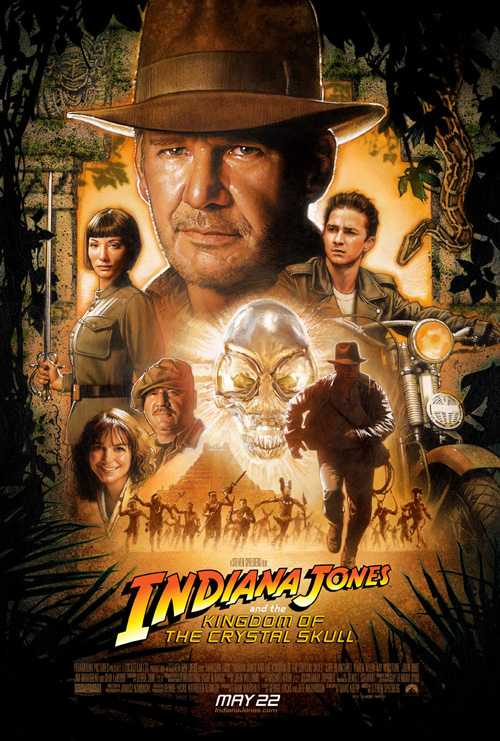
Indiana Jones and the Kingdom of the Crystal Skull

Movie Review                                                                                                                                 12/6/08

INDIANA JONES AND THE KINGDOM OF THE CRYSTAL SKULL
2008

Starring: Harrison Ford, Cate Blanchett, Shia LaBeouf and Karen Allen
Directed by: Steven Spielberg
Paramount Pictures
Piles of rejected scripts, downtrodden writers, and several shrouds of secrecy later, one of the longest-awaited returns of an icon arrives onscreen.

And no, I’m not talking about Superman Returns, but rather the fourth of the well-beloved contemporary classic series, so famous for its old-fashioned action-adventure and humour, and of course, Harrison Ford’s career-defining role. Fans and cynics crowded around the rumours of a fourth film like oversized army ants to any conceivable prey.

That aside, I finally caught the film in a tiny theatre and tried to forget all the criticism, deciding to just go in expecting a good time. It was loads of fun: I was cheering, laughing and clapping all the way. That said, I was the only one in the theatre doing so.

I’ll get on to the plot, then. Ironically, the story that creators Jeff Nathanson, George Lucas and Steven Spielberg tried so hard to protect got leaked out all the easier, with much hoo-ha surrounding an extra who blabbed and laptops that got stolen. This proved all quite unnecessary, because it isn’t the most ingenious plot either.

It’s 1957, and together with his sometime-partner/rival Mac (Ray Winstone), Indy (who else but Ford) is forced by Soviet Commies, led by the sca-reee KGB Col. Dr. Irina Spalko (Blanchett), to help them locate a mysterious corpse in an oddly familiar warehouse. There is the pre-requisite opening chase (which is actually quite inventive), after which our hero barely-and quite incredulously-escapes a nuclear blast.

Later, he’s approached about a missing old classmate, Prof. Harold Oxley (John Hurt), by greaser Mutt Williams (LaBeouf). Apparently, this all has to do with the myth of the lost city of Akator, and the titular Crystal Skull. An amusing close brush with the KGB later, Indy and his newfound sidekick go to South America in search of Oxley and the skull. He manages to get themselves hunted down by undead soldiers in an ancient temple complex and later gets kidnapped by the Soviet expedition, but is inexplicably reunited with former paramour Marion Ravenwood (Allen in a spunky reprisal of her role from the first flick). From here on, plot machinations lead to fencing duels, jungle chases down waterfalls, a furious attack of the ants I mentioned earlier, the expected supernatural encounter and an ending that is not anti-climatic per se, but is still pretty much a letdown.

For those who remember the era, the flick has a wonderfully nostalgic 50's flavour, what with McCarthyism, old-fashioned diners and greaser gangs, nuclear testing and the fascination with science fiction that’s more “fiction” than “science”. It’s also excellent exposure for today’s generation to peek into a time when muscle cars, leather jackets, pleated skirts and knitwear sweaters were all the rage.

Hearing John Williams’ seven-note trumpet theme and seeing Ford back in that creased leather jacket, battered fedora and wielding a bullwhip after so long is exciting to almost anyone, since the character is such a pop culture icon. A strong point is that film acknowledges the passing of the years, with Grail-hunting Nazis giving way to Reds seeking power over minds. Even though Ford is now 65, he still packs quite the punch. Ford is right in his element, considering that most of his recent roles contain traces of Indy anyway. His face might have creased and his hair may have turned grey, but his acting chops have only gotten better. Wry jokes about his age and a hilarious incident involving Indy’s fear of snakes, as well as loving mentions of characters we miss (Sean Connery’s Henry Jones Sr. and the late Denholm Elliot’s Marcus Brody) bring back some of that flavour from the Indy films of yore.

While many of the new characters prove unnecessary at times, there are moments where the talent of the big-name cast truly shines through. Cate Blanchett visibly relishes her every moment wielding a rapier and wearing the frightening hairdo and starched uniform of Irina Spalko. Playing a stereotype, complete with a Boris-and-Natasha faux Russian accent, is something new to the Academy Award-winning actress, but this is certainly a role that she pulled off with much aplomb. Shia LaBeouf’s turn as the “kid sidekick” shirks some of the conventions associated with that term, and he doesn’t simply tag along for the ride but offers plenty of fun and character dynamics. An especially memorable moment is his rapier duel with Spalko on two moving vehicles, while his mother chides him about his fencing pose.

Speaking about Mutt’s mother, she is of course Marion. Instead of pulling in a new love interest, the film’s use of the character is excellent. A few wrinkles aside, Karen Allen looks almost just as she did in “Raiders of the Lost Ark” and her hilarious love/hate dialogue with Harrison Ford provides some of the film’s funniest moments.

Other characters such as Mac, Howard Oxley and the requisite evil henchman Col. Dovchenko (Igor Jijinkine) all get their time in the limelight, but seem disposable at best.

Sadly enough, the gist of the plot also falls into the same category. Historically, stories of “Crystal Skulls” have littered the occult and puzzled archaeologists around the world for years, most experts reaching the consensus that the few found are mere hoaxes. Therefore, this reviewer thinks expanding on it is futile in the first place. Once the film takes off (pardon the pun) into territory best left to Agents Mulder and Scully of the X-Files, there is no saving it. In fact, it makes me wonder if the next film might involve Easter Bunnies and the Loch Ness Monster. Even though most of the stories in the Indy franchise are rather far-fetched, they are still somewhat built upon historical relics or well-known legends. Any reference to ancient civilizations in Kingdom of the Crystal Skull is simply cleverly-conceived conjecture. This makes the movie decidedly, as my Dad so put it so succinctly, “un-Indy” for me.

Famous for overusing computer graphics imagery (CGI) in the much-derided Star Wars prequels, George Lucas does the same here, despite earlier promises that the movie would be an old-fashioned adventure yarn. While it is not as noticeable as in The Phantom Menace, the use of CGI is almost just as excessive. On the plus side, though, the Lucas-owned effects company ILM has to be given proper kudos-the ants look scary enough and the nuclear blast is disturbingly spectacular-but what made the first three movies special were the innovative effects in an age before CGI, and spectacular sequences that still hold up to scrutiny today.

However, when real-life sets designed by Guy Hendrix Dyas are used, the result is reasonably awe-inspiring: Indy’s period-furnished home and Marshall College’s classrooms and halls sure bring back the memories, moving stone staircases in the temple complex provide sufficient tension and the warehouse piled to rafters with crates looks amazing in the flesh (it was a matte painting in the first film).

All in all, the film is a fun ride that never lets up and has many enjoyable instances. As a big Indy fan, it pains me to say this: but with just as many a weak moment, it’s not the 65-year old Ford that buckles at the knees, but the story’s core that does so instead.

RATING: 3/5 STARS

By Jedd Jong