Showing posts with label Jennifer Lawrence. Show all posts

Thursday, May 19, 2016

X-Men: Apocalypse

X-MEN: APOCALYPSE

Director : Bryan Singer
Cast : James McAvoy, Michael Fassbender, Jennifer Lawrence, Oscar Isaac, Nicholas Hoult, Rose Byrne, Olivia Munn, Evan Peters, Kodi Smit-McPhee, Sophie Turner, Tye Sheridan, Alexandra Shipp, Lucas Till, Josh Helman, Lana Condor, Ben Hardy
Genre : Action/Adventure
Run Time : 2 hrs 25 mins
Opens : 19 May 2016
Rating : PG13 (Violence & Brief Coarse Language)

The end is the beginning is the end for our ever-expanding cast of mutant heroes as they face their most insurmountable foe yet. The year is 1983 and after a millennia-long slumber, En-Sabah-Nur/Apocalypse (Isaac), the first and most powerful mutant in history, has awoken. Apocalypse goes about recruiting mutants to be his new Four Horsemen: the still-bitter Erik Lensherr/Magneto (Fassbender) is “War”, the telekinetic swordswoman Elizabeth Braddock/Psylocke (Munn) is “Pestilence”, weather-controlling Ororo Munroe/Storm (Shipp) is “Famine” and the winged Warren Worthington III/Angel (Hardy) is “Death”.


In the meantime, Raven Darkhölme/Mystique (Lawrence) has become an icon to mutants everywhere following her actions in Washington D.C. ten years earlier. In her mission to free oppressed mutants, she rescues Kurt Wagner/Nightcrawler (Smit-McPhee), a circus performer with the ability to teleport. Among the new students in Professor Xavier’s (McAvoy) school are Scott Summers/Cyclops (Sheridan), Jean Grey/Phoenix (Turner) and Jubilation Lee/Jubilee (Condor). These young, inexperienced X-Men must look up to mentors like Professor X and Hank McCoy/Beast (Hoult) for guidance, with speedster Peter Maximoff/Quicksilver (Peters) returning to the fray as well. Everyone will be caught in Apocalypse’s unrelenting thirst for absolute power, as the X-Men have to fight for their lives and their future.


 X-Men: Apocalypse is the ninth film in the X-Men series, counting Deadpool from earlier this year. With the successes of both Days of Future Past and Deadpool, expectations for Apocalypse were understandably high. While there is a surfeit of wink-and-nod references for fans of the source material to lap up, Apocalypse does suffer from ‘sequelitis’ – it’s not an incurable case, but the symptoms are there. The 144-minute run time does mean this is bursting at the seams – if you thought there were too many characters in the earlier films, you ain’t seen nothing yet. The pacing, particularly in the front half, suffers, then the latter half of the movie almost drowns in frenetic, overwrought action sequences. The film’s reach tends to exceed its grasp, and there are so many complicated visual effects-heavy scenes that the large-scale destruction tends to feel synthetic and bereft of weight.


The central tempestuous and compelling relationship between Charles and Erik was the driving force of First Class. While this plot thread had to share screen time with many others in Days of Future Past, it was still given enough play. Here, it gets pushed to the sidelines, but director Bryan Singer seems eager to assure us that he hasn’t forgotten about it. As good as McAvoy and Fassbender are in their respective roles, most of the interaction between the two characters here seems like a re-tread, with Magneto’s character development going around in circles. Even more obvious here than in the previous film is the sense that Mystique has been pushed to the forefront to capitalise on Lawrence’s current stardom. There’s also an excuse written into the plot for why we see so little of Mystique in her scaly blue true form. Lawrence seems the tiniest bit checked out, as if she’s glad that she’s still part of a juggernaut franchise after the conclusion of the Hunger Games series, but would rather move on to something else.


When the first images of Apocalypse as depicted in this film were revealed, the comparisons to Ivan Ooze started flooding the internet. For this reviewer, the problem is not so much that the supervillain physically resembles a Power Rangers baddie, but that he acts like one. The original omnipotent mutant should be a force to be reckoned with, but Isaac’s hammy performance and some clunky snatches of dialogue prevent Apocalypse from actually being intimidating at all. It’s a shame that this unstoppable, ancient entity comes across as petulant and unintentionally funny.


Quicksilver stole the show with the slow-mo kitchen sequence in Days of Future Past, and there’s a generally decent attempt to recreate that here with a set-piece set to Sweet Dreams Are Made of This. It’s too bad that it can’t help but feel like a desperate attempt to bump a breakout character up the roster. The younger versions of Cyclops, Phoenix and Nightcrawler are generally fine – this reviewer particularly enjoyed McPhee’s turn as the sensitive, easily-startled and good-hearted Kurt. Fans of the X-Men: Evolution animated series will probably enjoy what is the closest we’ve come to a live-action version of that show, in the moments when the recruits are hanging out. And yes, the Wolverine (Hugh Jackman) cameo is a hoot.


In between all of this, Singer and screenwriter Simon Kinberg find the time to make a particularly nasty dig at X-Men: The Last Stand, in a line of dialogue uttered by Jean as she, Scott and Jubilation are leaving the theatre after watching Return of the Jedi. Sure, The Last Stand’s flaws have been consistently acknowledged and Days of Future Past exists predominantly to wipe it off the slate, but perhaps Singer and company shouldn’t be so smug. There’s less room for the character dynamics to breathe, the action is more generic and less inventive, and at times the large ensemble comes across like the Rockettes performing a kick line at Radio City Music Hall. On top of all that, a major supervillain whose live-action debut has been highly anticipated is disappointingly realised. Here’s hoping this is a momentary stumble, because if the post-credits scene is anything to go by, there’s more to come.


Summary: X-Men: Apocalypse has its entertaining moments and there’s no shortage of things for eagle-eyed fans to catch, but these are generally drowned out by loud, generic action and an overstuffed cast.

RATING: 2.5 out of 5 Stars

Jedd Jong 

Wednesday, November 18, 2015

The Hunger Games: Mockingjay - Part 2

For F*** Magazine

THE HUNGER GAMES: MOCKINGJAY - PART 2 

Director : Francis Lawrence
Cast : Jennifer Lawrence, Josh Hutcherson, Liam Hemsworth, Woody Harrelson, Elizabeth Banks, Julianne Moore, Philip Seymour Hoffman, Jeffrey Wright, Sam Claflin, Jena Malone, Natalie Dormer, Donald Sutherland
Genre : Fantasy/Adventure
Run Time : 2 hrs 17 mins
Opens : 19 November 2015
Rating : PG13 (Some Violence)

The Mockingjay sings her last in the conclusion of the Hunger Games saga. The nation of Panem is in the throes of a revolutionary war, with Katniss Everdeen (Lawrence) continuing to bear the burden of being the symbolic figurehead of the uprising, the Mockingjay. Katniss teams up with a group of her closest allies – including Gale (Hemsworth), Finnick (Claflin), Cressida (Dormer) and Peeta (Hutcherson) – to infiltrate the palace of President Snow (Sutherland) and assassinate him. After an extended period of captivity in the Capitol, Peeta is deeply shaken by the psychological torture he was subjected to and becomes hostile towards Katniss. District 13’s President Alma Coin (Moore) and her right-hand man Plutarch (Hoffman) are counting on this final assault to be the tipping point that allows them to overthrow Snow. As Snow becomes increasingly obsessed with destroying Katniss and putting a stop to the revolution, Katniss realises that as high as the stakes were before, they are ever higher now, with the future of Panem in her hands.


                The expectations are high for the final instalment in the Hunger Games film series, not just because of the massive following the Suzanne Collins novels and the films themselves have gained, but because the filmmakers went the route of splitting the last book into two films, increasing the build-up for Part 2. Typically, movies that close out a blockbuster series promise colossal, epic battles and a surfeit of spectacle. For both better and worse, Mockingjay Part 2 takes a different route. The emphasis is on the politics, an element which has set the Hunger Games series apart from most teen-aimed properties. From the word “go”, this is an appropriately bleak affair, an unrelenting downer. True, The Hunger Games was never meant to be particularly happy or uplifting, but Mockingjay – Part 2 will alienate or even confuse viewers who aren’t 100% invested in what has come before. Audiences are expected to be familiar with the preceding films and, preferably, the books as well.


                The Hunger Games series has taken a considerable amount of risks that have been rewarded critically and at the box office. After all, the basic premise of the first movie/book is a tournament in which kids kill each other for the entertainment of the masses. Finally overthrowing the tyrannical rule of President Snow should be a rousing triumph, but for a society as far gone as Panem, a quick fix simply won’t cut it. That the film not only acknowledges this but delves into the myriad ramifications of the revolution is admirably mature, if not viscerally exciting. Particularly during the first act, things can be a bit of a slog, and Mockingjay Part 2 struggles to gain momentum. The action sequences, in which Katniss and the District 13 Unit have to navigate booby-trapped stretches of the Capitol and fend off all and sundry threats that are flung at them, feel more perfunctory than truly thrilling.


                Jennifer Lawrence’s ever-rising star has paralleled Katniss’ journey from starving District 12 girl to bearer of the Mockingjay mantle, though we imagine being J-Law in real life is generally more fun than being Katniss. In a way, it’s a good thing that Jennifer Lawrence won’t be playing Katniss indefinitely and that she’s given an opportunity to see the character’s arc through to completion. Even more than in the earlier instalments, Mockingjay Part 2 asks the question “is this too much for one girl to handle?” point blank, answers “yes” and shows us all the ways in which it is too much. In the film’s opening scene, Katniss is trying to speak as she is being tended to by a nurse, after Peeta nearly crushed her windpipe in the previous film. There are many films about “finding one’s voice”, but instead of manufactured optimism, the Hunger Games series serves up unflinching brutality and Jennifer Lawrence’s final bow as one of this generation’s defining heroes is expectedly affecting and stirring.


                We also get a resolution to the love triangle, which director Francis Lawrence tries his darndest to couch as something secondary to the turning cogs of revolution. The wounded, feral quality that Peeta takes on is heart-rending and does give Hutcherson more shades to play, as well as switching up the dynamic between Peeta and Katniss. Gale’s bond with Katniss as a childhood hunting buddy is played up a little more in this one; Hemsworth has repeatedly demonstrated that he’s not an actor with immense range but not too much is demanded from him here.


There is quite literally an army of supporting players, so it is natural that some will get shorter shrift than others. This reviewer did enjoy that the film is packed with badass female characters in addition to Katniss, including Dormer’s Cressida, Patina Miller’s Commander Paylor, Gwendoline Christie’s Commander Lyme, Michelle Forbes’ Lieutenant Jackson, Jena Malone’s Johanna Mason and Moore’s President Coin. Moore is especially fun to watch as we see President Coin making increasingly questionable but decently justified decisions. Elizabeth Banks, clad in increasingly fanciful ensembles, seems to be crying out from all the greyness that surrounds her. Sutherland proves he was the ideal choice for President Snow from the beginning, exuding a deep malice that is several layers past idle moustache-twirling villainy and making us all the more eager to see Snow get his comeuppance.


In an age where series finale blockbusters seem almost mandated to include no-holds-barred clashes of epic proportions, the Hunger Games series’ more cerebral conclusion is welcome. However, if one has a particularly short attention span and isn’t fully immersed in the world of Panem as established by the earlier films, it is possible to become bored and frustrated by the ponderous proceedings. This is sure to be a smash hit (at least until Star Wars invades cinemas), so we hope Lionsgate doesn’t try to futilely stretch things out with spinoffs and a reboot, though, like the fall of Panem, that does seem depressingly inevitable.


Summary: The Mockingjay’s last song is resonant if not especially rousing, the final chapter of the Hunger Games series largely satisfying but at times overwhelmingly downbeat.

RATING: 3.5 out of 5 Stars

Jedd Jong
            

Tuesday, November 18, 2014

The Hunger Games: Mockingjay - Part 1

For F*** Magazine

THE HUNGER GAMES: MOCKINGJAY - PART 1

Director : Francis Lawrence
Cast : Jennifer Lawrence, Josh Hutcherson, Liam Hemsworth, Philip Seymour Hoffman, Julianne Moore, Natalie Dormer, Willow Shields, Woody Harrelson, Evan Ross, Elizabeth Banks, Sam Claflin, Robert Knepper, Gwendoline Christie, Donald Sutherland, Jena Malone, Stanley Tucci
Genre : Fantasy/Adventure
Rating : PG13 (Some Violence) 
Run time: 123 mins

It’s time to raise the three-finger District 12 salute and whistle that four-note motif again because another Hunger Games movie is in theatres. Following her actions in the Quarter Quell, Katniss (Lawrence) has been whisked away to the secret stronghold of District 13. Her best friend Gale (Hemsworth), sister Prim (Shields) and mother (Paula Malcomson) are among the survivors from the Capitol’s bombing of District 12 taking refuge in 13. President Alma Coin (Moore), along with Plutarch (Hoffman), is in the midst of staging a revolution, calling on Katniss to become the face of the uprising. Despite being reluctant to after the trauma she experienced in the arena, Katniss assumes the role of the symbolic “Mockingjay”. Peeta (Hutcherson), who couldn’t be rescued, is held in the Capitol and forced by President Snow (Sutherland) to make televised appearances exhorting a ceasefire. Because of this, he is branded a traitor by the revolutionaries, but it only strengthens Katniss’ desire to rescue him and the other victors even more.


            Mockingjay – Part 1 has followed in the footsteps of the Harry Potter and Twilight franchises by going the “last book adapted into two movies” route. Both Deathly Hallows – Part 1 and Breaking Dawn – Part 1 did a lot of treading water in padding things out. While Mockingjay – Part 1 fares far better than Breaking Dawn thanks to its denser plot, there’s still a degree of disappointment to be had from sitting through two hours of set-up, even if it is pretty good set-up. Introducing audiences to the subterranean District 13, there is the credible sense that this revolution is coming to a head. Moving past the Games themselves, we get to see more of the other districts, including the lumber-producing District 7, and power-generating District 5 with its massive hydroelectric dam. There is an increased sense of scale without it feeling like bloated and empty spectacle. There’s also more of the helicrafts in action, two of which Katniss shoots down with her bow and arrow.


            The film still is character-driven, Jennifer Lawrence returning to her star-making role with more of the drive, indignant determination and just the right amount of vulnerability she brought to the first and second films. Unlike a number of young adult novel adaptations, Mockingjay – Part 1 does a good job at establishing that there is much more to the story and the world than the protagonist’s personal struggles and heartache, without downplaying the importance of that. The premise of the franchise is televised bloodsport in which teenagers kill each other for the entertainment of the elite and to keep the masses in line. The role of media manipulation in shaping the perceptions of the public gets further explored here with the introduction of Natalie Dormer’s Cressida, a Capitol film director who defects to District 13. That the resulting propaganda films or “propos” end up looking like movie trailers is a sly, effective touch without having it go all Starship Troopers on us.


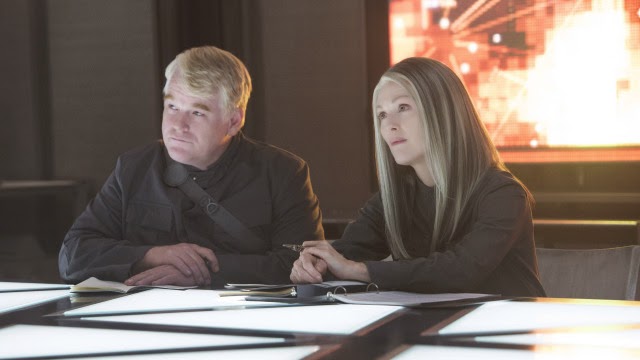
            The politics of The Hunger Games is one of the key components that gives it an edge over other film series aimed at a similar demographic. Julianne Moore retains her stern exterior (looking more than a little like Ysanne Isard from the Star Wars expanded universe) but plays a warmer, kinder authority figure than moviegoers are used to seeing her as. Both skilled actors, she and the late Philip Seymour Hoffman make for believable collaborating revolutionaries – this marks their fourth time co-starring in a movie. The film is dedicated to Hoffman’s memory and while he completed shooting all his scenes for Part 1, some of Plutarch’s scenes in Part 2 will have to be distributed to other characters.


            Much of the emotional content of the first two films was derived from the relationship between Katniss and Peeta and director Francis Lawrence uses the fact that the two characters are separated to generate a good amount of tension and anguish. Peeta being used as the Capitol’s new mouthpiece in his interviews with Ceasar Flickerman (Tucci) is contrasted and compared with how Katniss takes up the mantle of the Mockingjay for District 13. The role of Liam Hemsworth’s Gale is also expanded. It seems director Lawrence is all too aware that there are still detractors who dismiss this series as mopey teen romance, so scenes in which the love triangle is addressed appear sparingly.


            If Catching Fire was analogous to Empire Strikes Back, then Mockingjay – Part 1 is like if Return of the Jedi ended right after the escape from Jabba’s clutches. Perhaps this is an exaggeration, but there’s no denying that the climactic sequence, which director Lawrence has said was inspired by Zero Dark Thirty, feels like in belongs in the middle of a movie. Still, fans of the first two films are most likely more than willing to wait a year for the series’ conclusion and there is enough that takes place here to enticingly set the stage for the finale.


Summary: Despite suffering from “Part 1-of-a-two-parter-adaptation-itis”, the politics of Mockingjay and the turning gears of the revolution make this an intelligent, absorbing entry in the series.

RATING: 3.5 out of 5 Stars

Jedd Jong

Sunday, May 18, 2014

X-Men: Days of Future Past

X-MEN: DAYS OF FUTURE PAST

Director : Bryan Singer
Cast : Hugh Jackman, James McAvoy, Michael Fassbender, Jennifer Lawrence, Nicholas Hoult, Peter Dinklage, Patrick Stewart, Ian McKellen, Evan Peters, Halle Berry, Ellen Page, Shawn Ashmore, Omar Sy, Daniel Cudmore, Fan Bingbing, Adan Canto, Booboo Stewart, Josh Helman, Lucas Till, Evan Jonigkeit
Genre : Action, Adventure
Opens: : 22 May 2014
Rating : PG13 (Some Violence & Brief Coarse Language)

            The “biggest X-Men film yet” has almost everybody from both the X-Men trilogy and 2011’s X-Men: First Class in attendance as part of this decades-spanning odyssey. In a post-apocalyptic future, mutants are at war with formidable, super-advanced Sentinel robots. Professor Xavier (Stewart) and Magneto (McKellen) hatch a plan to have Shadowcat (Page) project the consciousness of Wolverine (Jackman) into the body of his younger self; a sort of metaphysical time-travel. “Arriving” in 1973, Wolverine has to wrangle Xavier and Magneto’s younger selves (McAvoy and Fassbender respectively) in order to stop the war before it begins. A threat to mutants emerges in the form of Dr. Bolivar Trask (Dinklage), the inventor of the Sentinels. Mystique (Lawrence) is on a mission to hunt and kill Trask, but it is this action that will set the world on its dark path. The various mutants, too many to list in this paragraph, must band together to avert their horrific destiny.


            To say the X-Men film franchise has had its ups and downs is very much an understatement. As such, fans were understandably wary of X-Men: Days of Future Past, which takes its name and premise, if not every last detail, from the landmark 1981 comics story arc. The “everyone and their mother” cast (well, Mystique’s here but alas, Nightcrawler isn’t) led many to fear that this would be a bloated affair. We’re happy to report that director Bryan Singer has somehow managed to keep all the plates spinning. Because one metaphor isn’t enough to describe how masterful the balancing act here is, Days of Future Past is a football field-sized sheet of paper which has been folded into an intricate origami crane. X-Men: First Class is quite different in tone and style from the X-Men trilogy proper, so to marry those two into a cohesive universe is quite the achievement.


            Naturally, the plot is a complex one and neophytes might feel left out in the cold. For those who have stuck with the mutants’ cinematic outings through thick and thin however, X-Men: Days of Future Past will be rewarding and exhilarating. There’s character development aplenty and the interactions we’ve become familiar with, particularly the pivotal, rocky relationship between Xavier and Magneto, get a good deal of play. A section of the film is set against the real-life Paris Peace Accords (with Mark Camacho as a pretty darn good Nixon), lending the film historical context. In addition to all this, spectacle is not in short supply. We’re treated to a variety of combat scenes and action sequences in which the characters’ myriad abilities are showcased in full. There’s also just enough levity amidst the drama; Evan Peters’ kleptomaniac speedster Quicksilver in particular gets to steal the show with what might just be the single greatest slow-motion sequence ever put on film, set to Jim Croce’s ballad “Time in a Bottle”.


            Comic book fans have often joked of “Wolverine publicity”, that Marvel shamelessly coasts on the popularity of the clawed Canuck. In the comics, it was Shadowcat who did the time-travelling but here, everything rides on Logan. Jackman is as good in the role as always; ripped to shreds, baring his butt and playing mediator and guide, a role that’s unfamiliar for the short-tempered Wolverine. McAvoy’s turn is riveting, his lost, broken and argumentative Xavier in stark contrast to the signature tranquillity and wisdom of Patrick Stewart’s portrayal. Thankfully, screenwriter Simon Kinberg has preserved the in-flux relationship between Xavier and Magneto that Matthew Vaughn and Jane Goldman presumably wrote into their draft of the script. Fassbender is majestic, commanding, unwaveringly intense yet undeniably sexy, further proving that casting him as young Magneto was a stroke of genius.  


            Jennifer Lawrence’s Mystique is almost as big as Wolverine is on the poster and she does play a key role; her pursuit of Trask driving the 1973-set portion of the film alongside Wolverine’s quest. Lawrence and her stunt doubles break out some impressive acrobatic fight moves and Mystique’s shape-shifting power is used cleverly and surprisingly several times. The very sympathetic Mystique in X-Men: First Class differs greatly from the cold-blooded lackey in the X-Men trilogy and Lawrence strives to make the character’s transition believable. Dinklage delivers a captivating performance, confident, focused and just menacing enough. Trask is the designated antagonist but he’s certainly not made out to be a cackling, one-dimensional villain. Dinklage’s casting carries a hint of comic book psychology, that perhaps the invention of oversized giant robots is Trask’s way of compensating for his slight physical stature.


            If there’s something about the film that doesn’t completely succeed, perhaps it’s the aesthetics. For every dazzling visual effects flourish, there is a questionable design choice or a casting of a supporting character that doesn’t quite work. Twilight teen idol Booboo Stewart is far from convincingly tough as Warpath. Quicksilver does come off looking quite silly, but Evan Peters’ joyous portrayal overcomes that. Mystique’s makeup consists mostly of a skin-tight bodysuit here, which no doubt saves application time but also means the scales can look glued-on. The Future Sentinels’ resemblance to the Destroyers in Thor is sometimes distracting; especially the way their faces open up to unleash a burst of flame. Josh Helman also looks way too much like Seann William Scott to be taken seriously as Young Stryker, the character having previously been played by character actors Brian Cox and Danny Huston.


            That said, it’s hard to be bothered by perceived surface-level imperfections when everything else blends and melds so seamlessly. Sequels can have a difficult time justifying their existence, not least when they’re the seventh entry in a long-running franchise. Days of Future Past does more than justify its existence, it becomes a stunning, involving epic that matches awe-inspiring visuals (plus some good 3D effects) with ever-evolving character dynamics. Stick around past the end credits for an appetite-whetting taste of where the story’s headed next.


Summary: The biggest, most ambitious X-Men film yet is also the greatest.

RATING: 4.5 out of 5 Stars

Jedd Jong

Wednesday, November 20, 2013

The Hunger Games: Catching Fire

For F*** Magazine

THE HUNGER GAMES: CATCHING FIRE

Director: Francis Lawrence
Cast:   Jennifer Lawrence, Josh Hutcherson, Liam Hemsworth, Lenny Kravitz, Elizabeth Banks, Stanley Tucci, Donald Sutherland, Toby Jones, Woody Harrelson, Jena Malone, Philip Seymour Hoffman, Amanda Plummer, Lynn Cohen, Patrick St. Esprit, Meta Golding, Bruno Gunn, Alan Ritchson, E. Roger Mitchell, Maria Howell, Stephanie Leigh Schlund, Sam Claflin, Jeffrey Wright
Genre: Action, Drama, Sci-Fi
Run Time: 146 mins
Opens: 21 November 2013
Rating: PG13 (Some Violence)


2012 probably saw an uptick in the number of kids signing up for archery classes, characters like Merida from Brave and Hawkeye from The Avengers making a weapon dating back to the Upper Palaeolithic cool again. The figure who played the biggest part in this was Katniss Everdeen, the protagonist of the blockbuster adaptation of the first book in Suzanne Collins’ Hunger Games series who returns in Catching Fire.


Katniss (Lawrence) and Peeta (Hutcherson) come home triumphant from the 74th annual Hunger Games and embark on a victory tour throughout the twelve districts of Panem, leaving behind loved ones including Katniss’ sweetheart Gale (Hemsworth). The autocratic ruler of Panem, President Snow (Sutherland), sees that Katniss and Peeta have given the masses hope and might have sown the seeds for a revolution. Together with the new gamemaker Plutarch Heavensbee (Hoffman), he plans for Katniss and Peeta to take the fall in as dramatic a way as possible. For the 75th Hunger Games, the tributes are reaped from existing winners – meaning Katniss and Peeta are plunged back into the lion’s den and pitted against experienced killers. The pair work to form an alliance with the other tributes, including the dashing Finnick (Claflin), the elderly Mags (Cohen), rebellious and unpredictable Johanna (Malone), and the tech-savvy duo of Beetee (Wright) and Wiress (Plummer). Mentor Haymitch (Harrelson) warns that “there are no winners, only survivors” – and Katniss and Peeta learn just how right he is.


Young adult novels and film adaptations of said novels have earned something of a bad reputation, often associated with shallow romance and the inane cries of “woe is me”. The Hunger Games is a series that is firmly about something, exploring the idea of violence as the opiate of the masses through the eyes of a strong, relatable heroine. This film delves deeper into the futuristic dystopia that is Panem, having established what the Hunger Games are and being able to spend more time further developing the characters of Katniss and Peeta. Director Francis Lawrence (no relation to star Jennifer), known for films like Constantine, I Am Legend and Water for Elephants, takes the directorial baton from Gary Ross with an assured turn behind the camera, working from an eloquently-adapted screenplay by Oscar-winners Simon Beaufoy and Michael Arndt (credited here as Michael DeBruyn).


The immense success of the first film allowed this one a bigger budget, $140 million in comparison to $78 million. While an excellent film, The Hunger Games did suffer a tad in its production values and this film is definitely an improvement in that regard. For example, the murderous mandrills look better than the wolf-like Muttations in the first film. However, the film is not spectacle-driven and it is a good one and half hours before the 75th Hunger Games actually begin. The focus of this one is the aftermath of the events of the previous film and the toll that that experience has had on Katniss and Peeta, Katniss in particular emerging as a shell-shocked veteran, haunted by the carnage she bore witness to first-hand. It is to the filmmakers’ credit that just because the games haven’t begun proper, it doesn’t mean the proceedings are boring. Moments that are equal parts intense and emotional, including a scene in which Gale is flogged in public by the totalitarian “peacekeepers”, are not in short supply.


Jennifer Lawrence, now an Oscar-winner for The Silver Linings Playbook, makes a confident return to the role that made her a superstar. The character doesn’t sit around moping and licking her wounds, Lawrence excelling at showing the conflict between Katniss’ true anguish and the public façade she has to don in the midst of this life-or-death situation. Josh Hutcherson’s Peeta has not lost all of his idealism from the first film and learns to play to the cameras, though he wishes that the romance wasn’t all for show. Hutcherson ably supports the film’s leading lady alongside Woody Harrelson, Lenny Kravitz and Elizabeth Banks, all returning from the first film as the team who prepares Katniss and Peeta for the Games.


The casting in the first film was pitch-perfect, and that certainly continues in this film. Philip Seymour Hoffman effortlessly lends the picture gravitas as the sly master strategist Plutarch, sharing most of his scenes with Donald Sutherland – who is once again absolutely frightening without so much as lifting a finger. Also, since Toby Jones returns, this means there are two Truman Capotes in the same movie. The tributes who align themselves with Katniss and Peeta in the arena are all well-portrayed as well: Lynn Cohen bringing a warmth and sadness to the silent Mags, Jena Malone entertainingly spunky as Johanna, Sam Claflin suave and strapping as the sexy Finnick and Jeffrey Wright and Amanda Plummer eccentric but reliable as Beetee and Wiress respectively. This is a bunch we truly can root for and yet are never 100% sure if they won’t turn on each other.


While The Hunger Games: Catching Fire is a solid film, it is very much a middle instalment in the vein of The Empire Strikes Back and viewers are advised to watch the first film beforehand. The events of this film are not cleanly resolved and it does end on a cliffhanger, but this does not feel like a lazy tactic and we are keenly looking forward to Mockingjay Part 1.

SUMMARY: This sequel sets the screen ablaze with an engrossing, masterfully-told follow-up to The Hunger Games. Now can we stop with the Twilight comparisons already?

RATING: 4 out of 5 Stars

Jedd Jong

Sunday, April 1, 2012

The Hunger Games review published!

Thanks to Royston Loh, editor of F*** Magazine, for publishing my review of The Hunger Games in the April issue.


Thursday, March 22, 2012

The Hunger Games

What do you know, I'm back!


Movie Review                                                                                                             23/3/12
THE HUNGER GAMES
(2012)

Starring: Jennifer Lawrence, Josh Hutcherson, Liam Hemsworth
Directed by: Gary Ross
Lionsgate/Color Force
          
  It was inevitable that Suzanne Collins’ 2008 best-selling and critically-acclaimed novel would receive the big-screen adaptation treatment. After all, it was a formula that worked out well for the Harry Potter books, and the vampire-love-story-that-must-not-be-named (though not so well for my favourite young adult series, the Alex Rider books). I have not read the book (blasphemy, I know), but will review the film based on its merits as a, well, film. And, possess many merits it does.

            For the uninitiated, the titular “games” refer to an annual tournament in which the 12 districts of Panem, a dystopian, future America, send one boy and girl aged 12-18 (known as “tributes”), chosen by ballot, to battle in a brutal televised death match, until the lone survivor is crowned the victor. The story centres on the two tributes from the poor coal-mining colony of District 12, Katniss Everdeen (Lawrence) and Peeta Mellark (Hutcherson), Katniss having volunteered to save her sister Primrose (Willow Shields) from being sent to the games and Peeta a baker’s son who nurses an unrequited crush on Katniss. Back home is Gale Hawthorne (Hemsworth), Katniss’ best friend, hunting partner, and the hypotenuse in a developing love triangle.

            The film hinges on themes such as the class divide, oppressive governments, the voyeuristic thirst for reality TV-style entertainment, survival and independence, while serving as a coming-of-age story too. This is heavy political commentary dressed up in a fantastic metaphor, and something that the film is generally very successful at conveying, though it lacks the sharper and more subtle observation of such classics as Brave New World and 1984, settling instead for something more accessible to the masses.

            And then there’s of course the controversial hot-button issue of kids killing kids. To reduce the story to just that is something of an injustice, and apparently the movie has toned the violence down quite a bit from the source material to keep with a PG-13 rating (and so as not to alienate its youthful fanbase), but it still is pretty gnarly to watch teenagers getting stabbed and shot at with arrows by their peers. One must bear in mind that this is hardly uncharted territory though – the 1999 Koushun Takami novel Battle Royale, which Collins claims to have never heard of until after turning in her book, comes to mind.

            Jennifer Lawrence, Oscar-nominated for her role in Winter’s Bone, beating out the likes of Chloe Moretz, Hailee Steinfeld, Saorise Ronan and Shailene Woodley (and practically every teenage-or-thereabouts actress in Hollywood) for the role, brings Katniss to life as one of the strongest female protagonists of our generation. Handy with a bow and arrow, she is quietly strong yet appealingly vulnerable. Josh Hutcherson, proving himself to be one of the finest young male actors currently working, lends his square jaw and slightly stocky frame to the youthful masculinity of Peeta, and it is interesting to see the relationship between him and Katniss develop. Liam Hemsworth doesn’t have much to do in this one, appearing mainly when we cut to Gale looking pained that Katniss seems to be falling for someone else. This is probably for the better as Hutcherson is clearly the superior actor.

            Something this movie gets very right, as did the Harry Potter films, is assembling a stellar supporting cast of older characters who frame the story and pull the strings. There’s Elizabeth Banks as flamboyant chaperone Effie Trinket, Stanley Tucci as charismatic emcee Caesar Flickerman, Lenny Kravitz as Katniss’ kind and nurturing stylist Cinna, and Donald Sutherland as President Snow, the autocratic ruler of Panem whose distinguished demeanour belies a dangerous sadistic streak.

            The standout though is Woody Harrelson as Haymitch Abernathy, a former winner of the Games who has degenerated into a scruffy alcoholic, and is responsible for mentoring Katniss and Peeta. Harrelson deftly portrays the bitterness left over from the trauma of the games and proves to be savvy and strategic. A brief scene depicts him hob-nobbing with the elite to earn Katniss “sponsors” to provide her with supplies during the games, and he suggests playing up the romantic aspect of Katniss and Peeta’s relationship as good entertainment – much like how many authors use romance to manipulate their audiences.

            The Hunger Games shows up its teeny-bopper ilk with panache, and is one of the few modern films aimed at a teenage demographic that has any depth or substance. A captivating visual look, strong performances, an engrossing story and a dash of the unsettling turn the odds in favour of this one. I know I should save this for the review of the second film, but The Hunger Games is on fire.

SUMMARY: The Hunger Games proves it fully deserves to the next big thing. By turns entertaining and thought-provoking, it is refreshing to see a franchise flick give teenagers something to chew on at the movies other than their popcorn.

RATING: 4/5 STARS

Jedd Jong Yue