Showing posts with label Martin Scorsese. Show all posts

Thursday, December 18, 2014

Life Itself

As published in Issue #59 of F*** Magazine


LIFE ITSELF
(2014)

Starring: Roger Ebert, Chaz Ebert, Marlene Iglitzen, A.O. Scott, Richard Corliss, Ramin Bahrani, Errol Morris, Werner Herzog, Martin Scorsese
Directed by: Steve James
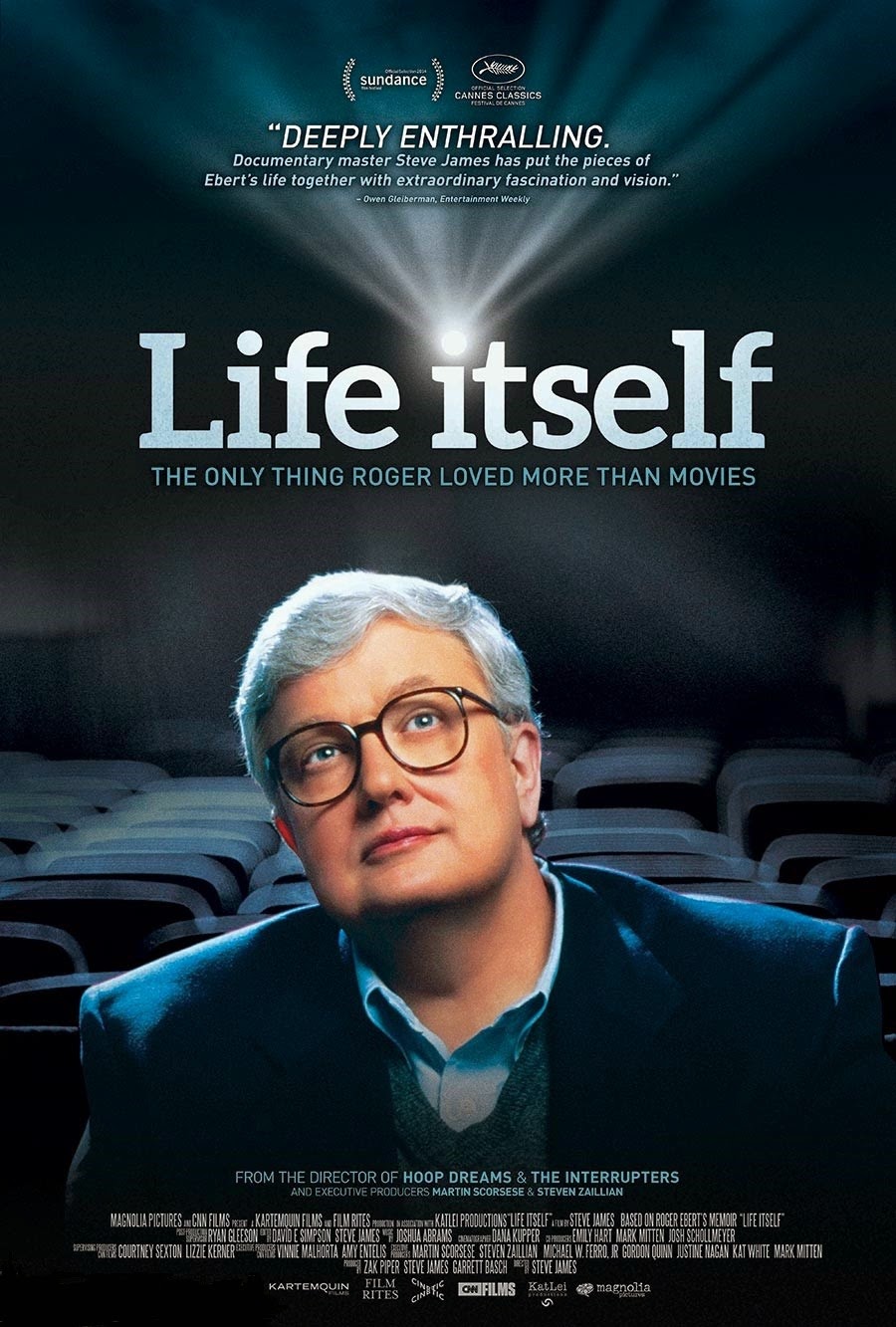
            In 2013, filmmakers and moviegoers alike mourned the passing of the well-known, respected film critic Roger Ebert, a household name thanks to the At the Movies television program he co-presented. Documentary filmmaker Steve James brings us Life Itself, based on Ebert’s 2011 memoir of the same name. A fond, in-depth look at Ebert’s life and career, Life Itself tracks the film critic’s childhood in Urbana, Illinois, the beginnings of his journalistic career at his college newspaper The Daily Illini, his Pulitzer Prize win, co-hosting At the Movies with Gene Siskel and coping with his illness in the final months before his death.

            Life Itself also features interviews with a large array of Ebert’s friends and colleagues, which range from his fellow Chicagoan journalist William Nack to his wife Chaz to director Martin Scorsese, one of the executive producers on Life Itself. Watching the film, one gets the sense that this was a man who truly found fulfilment in his life’s work and was a cinephile through and through – the license plate of his car even spells “MOVIES”. We are regaled with accounts of the Cinema Interruptus event which Ebert would host each year at the Conference of World Affairs, in which he would spend hours dissecting a given film frame by frame. We see just how much he enjoyed covering the prestigious Cannes Film Festival and how he stuck by his ritual of staying at the same hotel and having breakfast at the same cafĂ© each time he returned to the French Riviera.


            If you’re not a fan of Ebert, it would perhaps be easy to dismiss him as a snob. After all, what business does any critic have telling anyone what they think? The film makes it clear that beyond being more than qualified to do so, Ebert didn’t get his kicks from feeling he was above it all and those are footsteps this reviewer has tried to follow in. The film is far from afraid of presenting a very human look at its subject, including aspects of him that might be considered embarrassing. Ebert says of the Russ Meyer-directed exploitation film Faster Pussycat, Kill, Kill, “the posters displayed impossibly buxom women and I was inside the theatre in a flash.” Ebert ended up penning the screenplay of Beyond the Valley of the Dolls for Meyer and in one of Life Itself’s funniest moments, film critic A.O. Scott gulps, takes a long pause and then talks about the “earthier” elements of cinema that Ebert was drawn to (i.e., boobs).


            A good portion of the film focuses on the fascinating frenemy-bromance between Roger Ebert and Gene Siskel, with Siskel’s widow Marlene Iglitzen providing a good deal of insight. For starters, they were the film critics of rival newspapers – Ebert wrote for the Chicago Sun-Times and Siskel for the Chicago Tribune. They also had wildly different upbringings and backgrounds, Ebert having been a journalist since he was in school while Siskel was a personal friend of Hugh Hefner’s, cavorting with Playboy bunnies aboard the Bunnyjet. The film reveals the deep extent of the competition that went on between the two – for example, everything was decided by coin toss, and that’s how Siskel got top billing in the title of the show. Time magazine critic Richard Corliss amusingly describes Siskel and Ebert’s double act as “a sitcom about two guys who lived in a movie theatre”. In Life Itself, we get lots of clips of the two getting into really heated arguments, including outtakes from the show. However, it’s also made heartbreakingly clear how much Siskel meant to Ebert and how he was affected after Siskel’s death from a brain tumour. Oddly enough though, Siskel’s eventual replacement Richard Roeper is not interviewed or even mentioned in the film.



            Naturally, Siskel and Ebert’s brand of TV-friendly film criticism had its, well, critics. It was seen as advertising for a film instead of objective, thorough analysis. In an essay in Film Comment, Corliss wrote “movie criticism of the elevated sort is an endangered species. Once it flourished; soon it may perish, to be replaced by a consumer service that is no brains and all thumbs.” At one point in Life Itself, Corliss reads his essay in Film Comment from which that passage is taken aloud, before he chokes up, unable to continue.


            The film also illuminates the influence Ebert’s reviews had on the careers of filmmakers such as Ramin Bahrani, Ava DuVernay and Errol Morris, with Selma director DuVernay recounting how excited she was to have her photo taken with Ebert when she was a little girl standing outside the Shrine Auditorium with her aunt on the day of the Oscars. There’s also a love story here, the relationship between Ebert and his wife Chaz a truly beautiful one. Ebert weighed 300 pounds when they first met and Chaz tells how she found it sexy that Ebert was comfortable in his own skin. “She is the love of my life. She saved me from a life alone, which is where I seemed to be heading,” Ebert says. It also feels genuinely emotional rather than plainly manipulative when Chaz breaks down while discussing her husband’s deteriorating health.


            Sure, if you feel that Ebert is overrated as a film critic and that his writing lacks insight or that his recognition is ill-deserved, this film is unlikely to change your mind. If you’re sufficiently cynical, you might say scenes such as Ebert being fed via g-tube is awards-baiting. However, if you’re a fan of Ebert’s work, if you have even a passing interest in film criticism or if you’re just a cinephile in general, odds are you’ll find this documentary inspirational, uplifting, entertaining, funny and deeply moving.


Summary: Life Itself  paints a rich, compelling portrait of a man who loved movies, delighted in sharing his knowledge of and passion for movies and who continued living and working even in the face of dilapidating illness through to the end.

RATING: 4.5 out of 5 Stars

Jedd Jong 

Tuesday, January 7, 2014

The Wolf of Wall Street

For F*** Magazine

THE WOLF OF WALL STREET

Director: Martin Scorsese
Cast:        Leonardo DiCaprio, Jonah Hill, Matthew McConaughey, Jean Dujardin, Jon Favreau, Kyle Chandler, Rob Reiner, Margot Robbie, Jake Hoffman, Shea Whigham, Jon Bernthal, Ethan Suplee, Kenneth Choi, P.J. Byrne, Christine Ebersole
Genre: Drama, Comedy
Run Time: 175 mins
Opens: 9 January 2014
Rating: R21 (Coarse Language, Sexual Scenes And Drug Use)


We all know the catchphrase popularised by Michael Douglas’ Machiavellein stockbroker character in 1987’s Wall Street, so say it with us: 1, 2, 3: “greed, for lack of a better word, is good”. Part of the controversy surrounding The Wolf of Wall Street is that the film not only makes greed look good, it makes it look like immense amounts of fun. Based on former stockbroker and convicted fraudster Jordan Belfort’s memoir of the same name, The Wolf of Wall Street takes viewers on a rocket ship ride into the stratosphere – but the interesting part is when the engines cut out and the vessel plummets down to the ground.


It is 1987 and Jordan Belfort (DiCaprio) becomes a Wall Street stockbroker, his boss Mark Hanna (McConaughey) teaching him that drugs and prostitutes are the only things that will keep him going. Belfort falls victim to the Black Monday crash, losing his position at the prestigious firm L.F. Rothschild. His wife Teresa (Milioti) finds him a job dealing in penny stocks in a dingy boiler room and being the gifted pitchman he is, Belfort soon earns a fortune. He befriends his neighbour Donnie Azoff (Hill) and they gather a band of misfits to found the Stratton Oakmont firm, which attracts the attention of the likes of Forbes magazine who dubs him “the Wolf of Wall Street”. It also attracts the attention of FBI agent Patrick Denham (Chandler). Belfort continues his extravagant existence, taking on blonde trophy wife Naomi (Robbie) as he dumps Teresa and getting addicted to cocaine and Quaaludes. As he must, the man who has everything realises it’s all slipping through his fingers. He does, right?

The wolf that Jordan Belfort (as depicted in the film) most resembles is the “insanity wolf” internet meme, the one all crazy-eyed, baring its fangs and favouring mutilation and immolation as solutions to all problems. Belfort is a wolf in wolf’s clothing: he’s already a wolf, but he’ll skin another wolf and wear the skin to prove how hard-core he is. Martin Scorsese has created what is essentially Contact High: the Movie, a film that is a wildly unmatchable thrill ride that also has something to say. The person this reviewer saw the film with described it as being the cinematic equivalent of getting drunk – complete with the hangover afterwards.


It is inevitable that a film of this sort will get called out for supposedly glorifying its subject. After all, this won’t be the first zeitgeist-y button-pusher of a movie to get misunderstood: how many guys went “hey dude, Tyler Durden’s so cool, I wanna be just like him”, “Patrick Bateman is the greatest!” or “that Travis Bickle has got it all figured out!”? This reviewer would argue that because The Wolf of Wall Street pulls no punches in its depiction of the sybaritic excesses Jordan Belfort wallows in, it doesn’t feel sanctimonious when the message of “the bigger they are, the harder they fall” eventually kicks in. There are times in the film when Belfort comes off as utterly pathetic, a noteworthy one being a scene in which he is almost paralyzed by a drug overdose and makes an agonising crawl out the door, down the stairs and to his car – it’s an inspired moment of physical tragicomedy which is almost Three Stooges-esque.


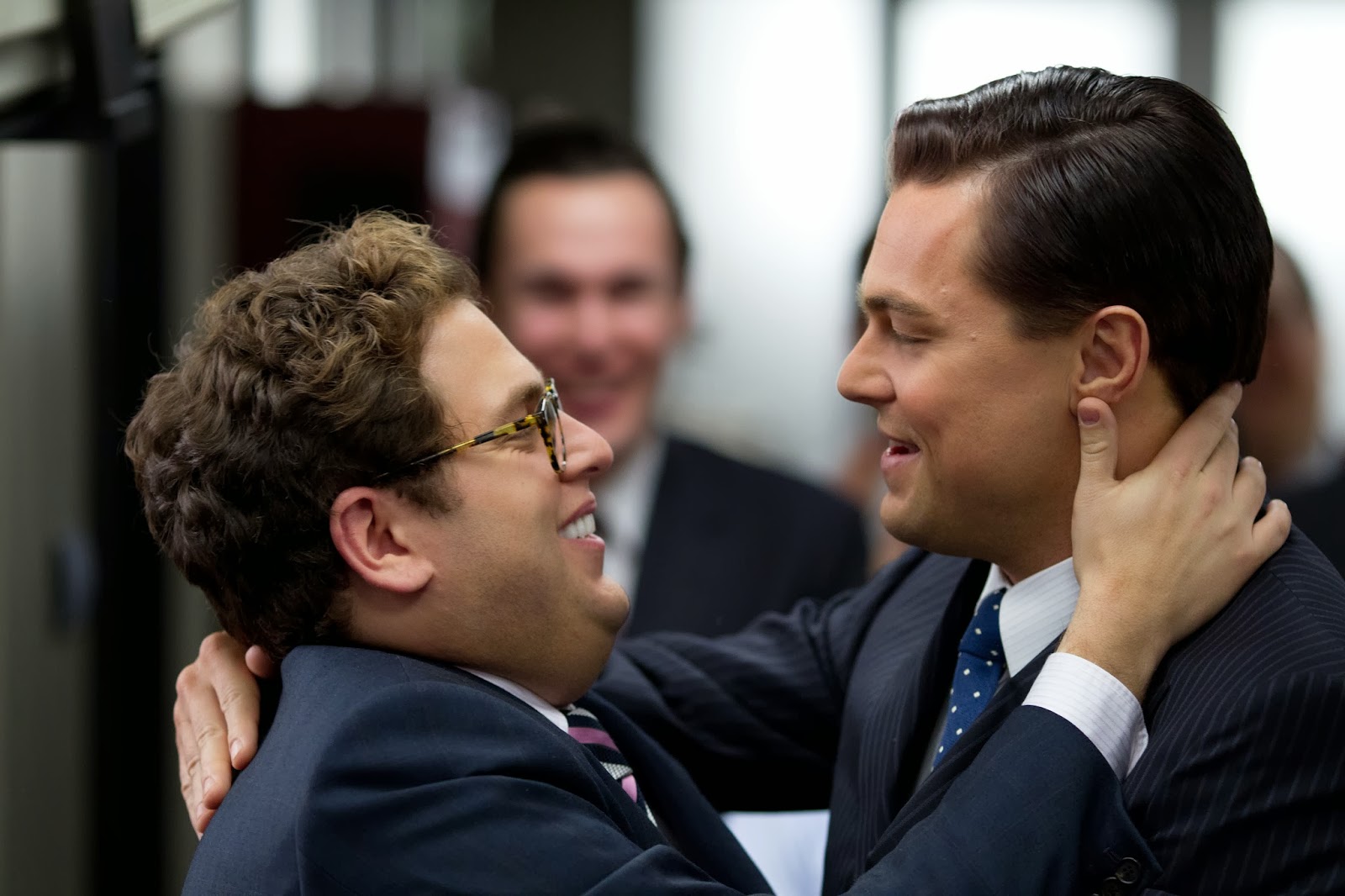
Between this and The Great Gatsby, Leonardo DiCaprio sure was partying it up in 2013. While both Jay Gatsby and Jordan Belfort are immensely wealthy, relatively young men who harbour a certain hollowness deep within, there’s no question that Belfort is more openly a maniac and boy, does Leo have the time of his life with this part. Yes, there are the lines and lines of coke, the gratuitous, wanton lovemaking, the white Ferrari “like Don Johnson’s in Miami Vice” and the pet chimpanzee.  But of course there’s the wounded, directionless, broken little boy at the very centre of it all who is drowning in the waves just like his luxury yacht caught in a storm - and you can bet that DiCaprio nails that in his portrayal of the character. Look out for a cameo from the real Belfort as the host of a seminar at the end of the film. Unfortunately for Leo, it seems Chiwetel Ejiofor is still the prime awards favourite at this point.


This being a Scorsese picture, it’s a given that the supporting cast comes out guns a-blazin’. Young Aussie actress Margot Robbie goes all Real Housewives, complete with a Brooklyn accent and a coiffed hairsprayed ‘do and pumps up the sex appeal yet manages to make Naomi more than a mere object in a turn reminiscent of Daryl Hannah’s in the afore-mentioned Wall Street. Who would’ve thought Jonah Hill, more Apatow’s type than Scorsese’s, would end up an Oscar nominee for Moneyball and star alongside Leonardo DiCaprio in this film? His turn as a panting, sycophantic lackey is comedy gold and it is to Hill’s credit that he’s also able to bring the sadness and shame in the part to the surface. Kyle Chandler’s FBI agent character is described as a “boy scout” and the strait-laced authority figure is a glimmer of order in the chaos that swirls around Jordan Belfort. Matthew McConaughey is in this for really just about two scenes, but he makes an impact as the guy who inducts Belfort into the wolves’ den. Jean Dujardin is also a hoot as a suave Swiss banker and money launderer.


The Wolf of Wall Street distinguishes itself from the awards contender pack by completely shedding any self-seriousness and being in-your-face irreverent. Scorsese pulls off that rare, glorious feat by crafting a film that’s wild and looks fast and loose, yet he knows where all the pieces are on the board every step of the way and juggles all those plates with impeccable precision. Sure, at 180 minutes, this is a long movie – but the time does zip by and then again, it fits the theme of excess (even though a good 20 minutes could have been cut without major consequence). It all adds up to an intriguing effect of subtly wearing the audience down after sending them corkscrewing into europhia, which seems to be exactly what Scorsese and company intended.

SUMMARY: While some might find it too rich for their blood, The Wolf of Wall Street is raucously funny, showcases Leonardo DiCaprio at his best and is entertaining without being inconsequential. This Wolf is on a bull run.

RATING: 4.5 out of 5 Stars

Jedd Jong