Showing posts with label documentary. Show all posts

Wednesday, May 4, 2016

Where to Invade Next

For F*** Magazine 

WHERE TO INVADE NEXT

Director : Michael Moore
Cast : Michael Moore, Krista Kiuru, Claudio Domenicali, Tim Walker, Vigdís Finnbogadóttir
Genre : Documentary
Run Time : 121 mins
Opens : 28 April 2016
Rating : M18 (Some Nudity and Drug Use)

After a six-year-long hiatus from feature films, Michael Moore, the enfant terrible of documentary movies, has returned with a vengeance – but a vengeance of a friendly sort. It’s no secret that many Americans have become dissatisfied with their way of life, proclamations of the United States being “the greatest country on earth” getting harder and harder to make with a straight face. From income inequality to staggering student loans to unaffordable healthcare, the average 99%-er has a good deal to be frustrated about.

            Moore imagines that he’s been sent on a mission by the U.S. Joint Chiefs of Staff to suss out where in the world the United States should invade next. He embarks on a quest through several European countries and one North African one to see how the people do things differently from in the States.  In Italy, the average worker has eight weeks paid holiday, in France, students get nutritious gourmet school lunches and Finland’s top-ranked education system does away with standardised tests and excessive homework.

Next, Moore visits a coloured pencil factory in Germany where the employees work a total of 36 hours a week, he takes a tour of the surprisingly luxurious prisons in Norway, meets with female government and business leaders in Iceland and sees how Tunisia’s government has rebuilt itself after overthrowing a dictator, with more than 50% of its parliament being women at the present. He attempts to wrap his head around the free college education offered in Slovenia and Portugal’s complete decriminalisation of drug use. At the end of each segment, Moore plants an American flag in the ground wherever he is, proudly declaring that he’s come across another excellent idea that the U.S. can, uh, appropriate.


            Out of all the press screenings we’ve attended, the showing of Where to Invade Next probably drew the loudest laughter from the audience we’ve ever heard. Moore is known for being a confrontational firebrand, famously conducting ambush interviews and staging demonstrations as part of his films. This movie sees him gentler, albeit no less driven. All the interview subjects are willing participants, largely because they’re given platforms on which to wag a finger at Americans in general. The people whom Moore talks to range from schoolchildren to blue-collar workers to such luminaries as former Icelandic president Vigdís Finnbogadóttir, the world’s first democratically-elected female president, and current Slovenian president Borut Pahor.


            Most of the humour is derived from the sense that what we’re seeing in this panorama is all too good to be true. Two hour lunch breaks? A law against sending emails after work? Prescriptions for a three-week-long spa getaway to combat stress? Corrupt bankers actually getting sentenced to prison? Absurd! This could pretty much be called “The Grass Is Greener On the Other Side: The Movie”, and the scene of the interview subjects telling Moore how unbelievably good they have it, with a reaction shot of him looking slack-jawed, occurs multiple times. Moore also makes his point with infographics presenting bleak statistics, including one that demonstrates the slightly higher taxes in European countries afford their citizens greater benefits than the Average American has access to. As with his previous films, Moore also employs news footage and amateur video to make his point. The hardest-hitting of these is a montage of American inmates getting beaten up and otherwise abused by wardens and fellow prisoners – this is shown after Moore takes in the civilised and straight-up swanky prison facilities in Norway.


            The use of humour throughout makes the audience more amenable to Moore’s arguments, and in most cases, just how functional the societies being showcased are does speak for itself. While it is staggeringly one-sided, as is Moore’s modus operandi, the film is also compelling and persuasive. It does cover a great amount of ground, not just geographically but with regards to the subjects discussed as well. There’s a strong feminist component, with several powerful, successful women sharing what they do differently. There are a few jarring tonal shifts which work astoundingly well – we go from a former Mercedes CEO talking about how the company’s servers block emails sent by bosses after working hours, to a German classroom where the Holocaust is being taught, with the words “Why Remember?” written on the chalkboard. In another scene, Moore sits down with a Norwegian father whose son was gunned down at summer camp by extremist Anders Breivik. The film’s larger structure and context ensures these scenes do not feel awkwardly out of place.


            If you’re predisposed to despising Moore, Where To Invade Next might not make you do a 180 on the documentarian. As manipulative and imbalanced as it can get, Where To Invade Next does have an undercurrent of sincerity. Yes, Moore’s antics might primarily be for our entertainment, but there is a strong sense of purpose to the tour he embarks upon here and while it still has bite, it seems a lot less bitter than some of his other work. Is it all a progressive’s pipe dream? Probably, but the positivity that Moore exudes here does have its charm, and the work manages to be a thought-provoking one.

Summary: While it is heavily one-sided, Where To Invade Next sees Michael Moore weaving a fascinating, entertaining, educational and immensely funny travelogue, in which he asks “what can we learn from you?” rather than merely being the traditional idiot abroad.

RATING: 4 out of 5 Stars


Jedd Jong 

Thursday, December 18, 2014

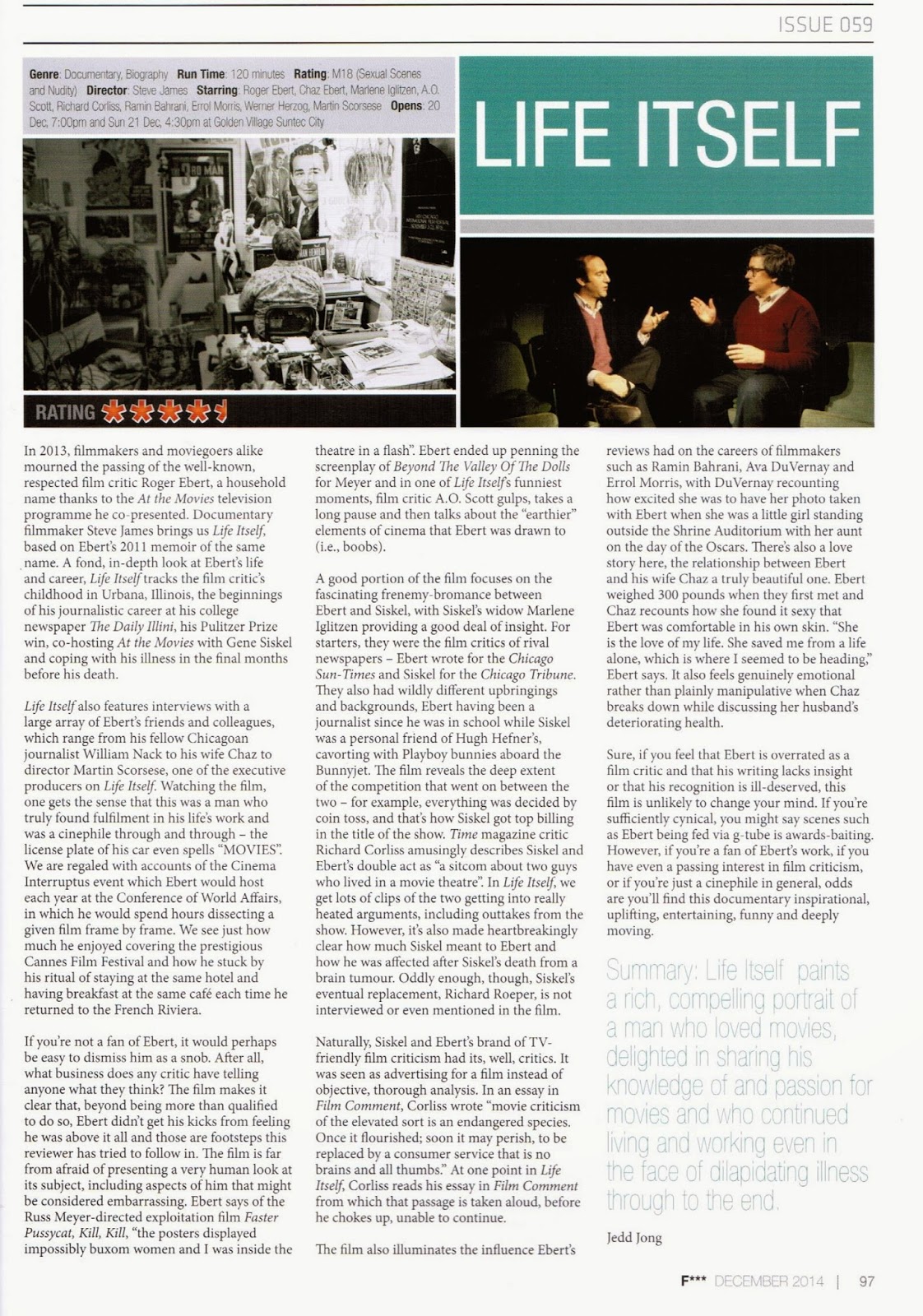
Life Itself

As published in Issue #59 of F*** Magazine


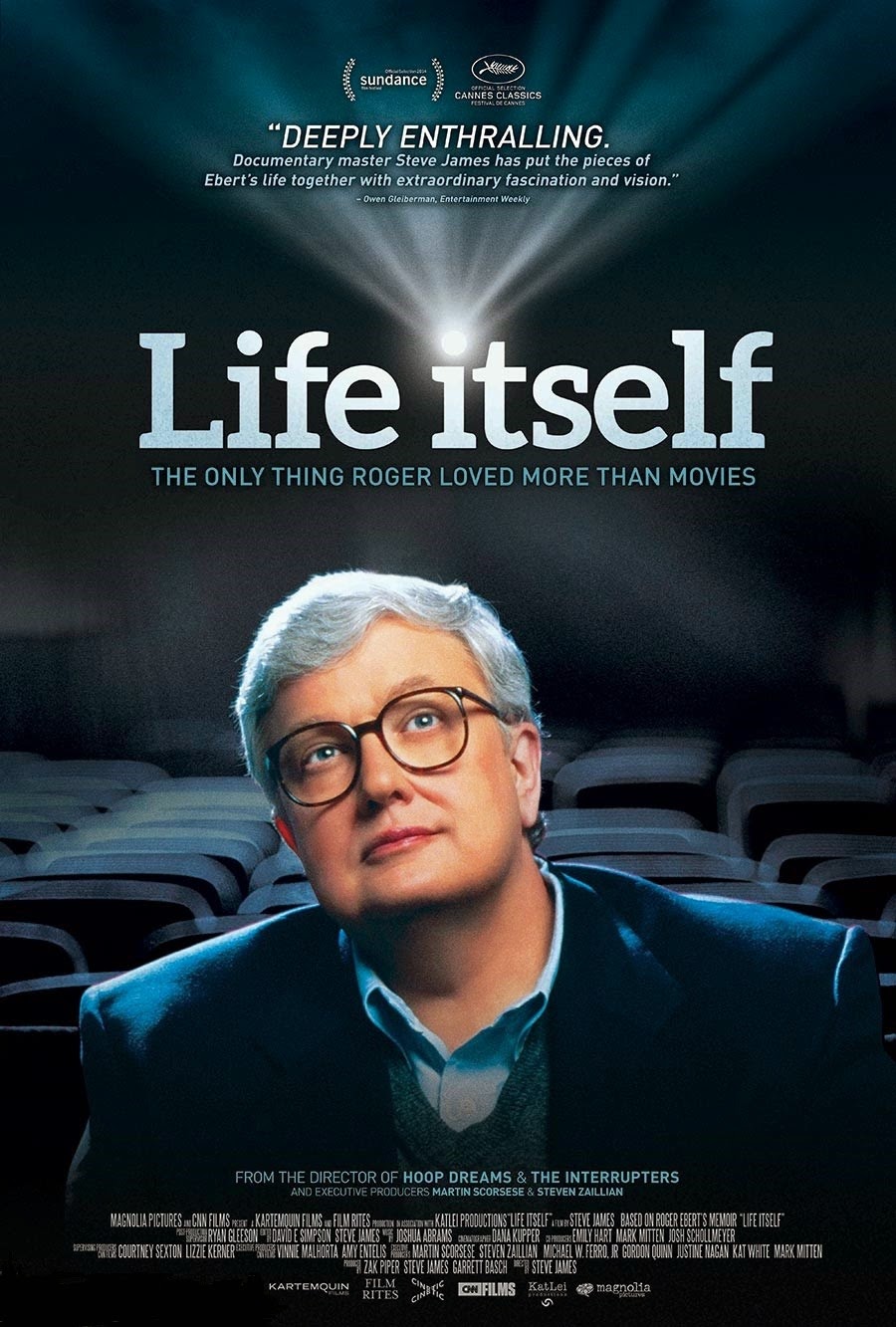
LIFE ITSELF
(2014)

Starring: Roger Ebert, Chaz Ebert, Marlene Iglitzen, A.O. Scott, Richard Corliss, Ramin Bahrani, Errol Morris, Werner Herzog, Martin Scorsese
Directed by: Steve James

            In 2013, filmmakers and moviegoers alike mourned the passing of the well-known, respected film critic Roger Ebert, a household name thanks to the At the Movies television program he co-presented. Documentary filmmaker Steve James brings us Life Itself, based on Ebert’s 2011 memoir of the same name. A fond, in-depth look at Ebert’s life and career, Life Itself tracks the film critic’s childhood in Urbana, Illinois, the beginnings of his journalistic career at his college newspaper The Daily Illini, his Pulitzer Prize win, co-hosting At the Movies with Gene Siskel and coping with his illness in the final months before his death.

            Life Itself also features interviews with a large array of Ebert’s friends and colleagues, which range from his fellow Chicagoan journalist William Nack to his wife Chaz to director Martin Scorsese, one of the executive producers on Life Itself. Watching the film, one gets the sense that this was a man who truly found fulfilment in his life’s work and was a cinephile through and through – the license plate of his car even spells “MOVIES”. We are regaled with accounts of the Cinema Interruptus event which Ebert would host each year at the Conference of World Affairs, in which he would spend hours dissecting a given film frame by frame. We see just how much he enjoyed covering the prestigious Cannes Film Festival and how he stuck by his ritual of staying at the same hotel and having breakfast at the same café each time he returned to the French Riviera.


            If you’re not a fan of Ebert, it would perhaps be easy to dismiss him as a snob. After all, what business does any critic have telling anyone what they think? The film makes it clear that beyond being more than qualified to do so, Ebert didn’t get his kicks from feeling he was above it all and those are footsteps this reviewer has tried to follow in. The film is far from afraid of presenting a very human look at its subject, including aspects of him that might be considered embarrassing. Ebert says of the Russ Meyer-directed exploitation film Faster Pussycat, Kill, Kill, “the posters displayed impossibly buxom women and I was inside the theatre in a flash.” Ebert ended up penning the screenplay of Beyond the Valley of the Dolls for Meyer and in one of Life Itself’s funniest moments, film critic A.O. Scott gulps, takes a long pause and then talks about the “earthier” elements of cinema that Ebert was drawn to (i.e., boobs).


            A good portion of the film focuses on the fascinating frenemy-bromance between Roger Ebert and Gene Siskel, with Siskel’s widow Marlene Iglitzen providing a good deal of insight. For starters, they were the film critics of rival newspapers – Ebert wrote for the Chicago Sun-Times and Siskel for the Chicago Tribune. They also had wildly different upbringings and backgrounds, Ebert having been a journalist since he was in school while Siskel was a personal friend of Hugh Hefner’s, cavorting with Playboy bunnies aboard the Bunnyjet. The film reveals the deep extent of the competition that went on between the two – for example, everything was decided by coin toss, and that’s how Siskel got top billing in the title of the show. Time magazine critic Richard Corliss amusingly describes Siskel and Ebert’s double act as “a sitcom about two guys who lived in a movie theatre”. In Life Itself, we get lots of clips of the two getting into really heated arguments, including outtakes from the show. However, it’s also made heartbreakingly clear how much Siskel meant to Ebert and how he was affected after Siskel’s death from a brain tumour. Oddly enough though, Siskel’s eventual replacement Richard Roeper is not interviewed or even mentioned in the film.


            Naturally, Siskel and Ebert’s brand of TV-friendly film criticism had its, well, critics. It was seen as advertising for a film instead of objective, thorough analysis. In an essay in Film Comment, Corliss wrote “movie criticism of the elevated sort is an endangered species. Once it flourished; soon it may perish, to be replaced by a consumer service that is no brains and all thumbs.” At one point in Life Itself, Corliss reads his essay in Film Comment from which that passage is taken aloud, before he chokes up, unable to continue.


            The film also illuminates the influence Ebert’s reviews had on the careers of filmmakers such as Ramin Bahrani, Ava DuVernay and Errol Morris, with Selma director DuVernay recounting how excited she was to have her photo taken with Ebert when she was a little girl standing outside the Shrine Auditorium with her aunt on the day of the Oscars. There’s also a love story here, the relationship between Ebert and his wife Chaz a truly beautiful one. Ebert weighed 300 pounds when they first met and Chaz tells how she found it sexy that Ebert was comfortable in his own skin. “She is the love of my life. She saved me from a life alone, which is where I seemed to be heading,” Ebert says. It also feels genuinely emotional rather than plainly manipulative when Chaz breaks down while discussing her husband’s deteriorating health.


            Sure, if you feel that Ebert is overrated as a film critic and that his writing lacks insight or that his recognition is ill-deserved, this film is unlikely to change your mind. If you’re sufficiently cynical, you might say scenes such as Ebert being fed via g-tube is awards-baiting. However, if you’re a fan of Ebert’s work, if you have even a passing interest in film criticism or if you’re just a cinephile in general, odds are you’ll find this documentary inspirational, uplifting, entertaining, funny and deeply moving.


Summary: Life Itself  paints a rich, compelling portrait of a man who loved movies, delighted in sharing his knowledge of and passion for movies and who continued living and working even in the face of dilapidating illness through to the end.

RATING: 4.5 out of 5 Stars

Jedd Jong