Showing posts with label Roger Ebert. Show all posts

Thursday, December 18, 2014

Life Itself

As published in Issue #59 of F*** Magazine


LIFE ITSELF
(2014)

Starring: Roger Ebert, Chaz Ebert, Marlene Iglitzen, A.O. Scott, Richard Corliss, Ramin Bahrani, Errol Morris, Werner Herzog, Martin Scorsese
Directed by: Steve James
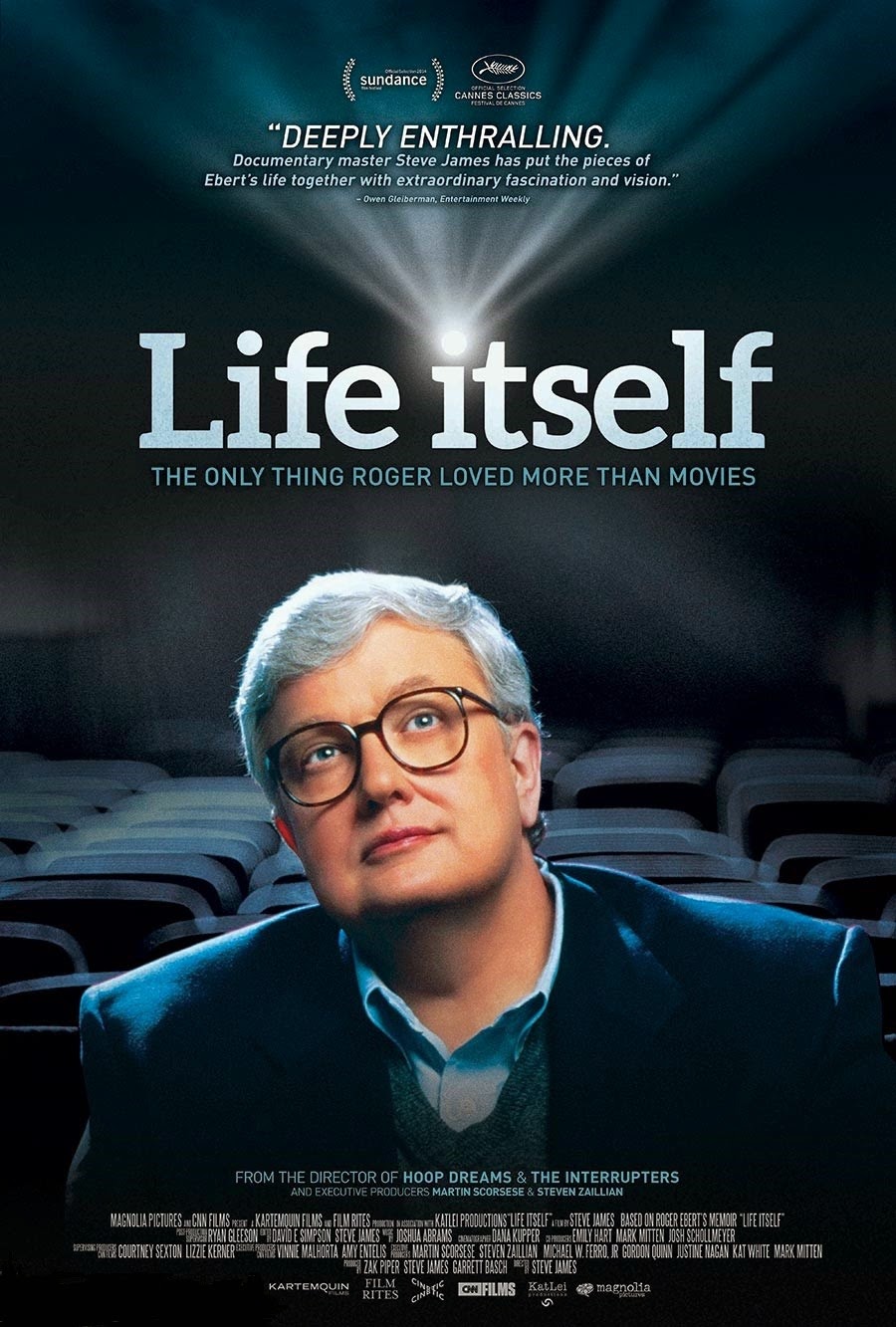
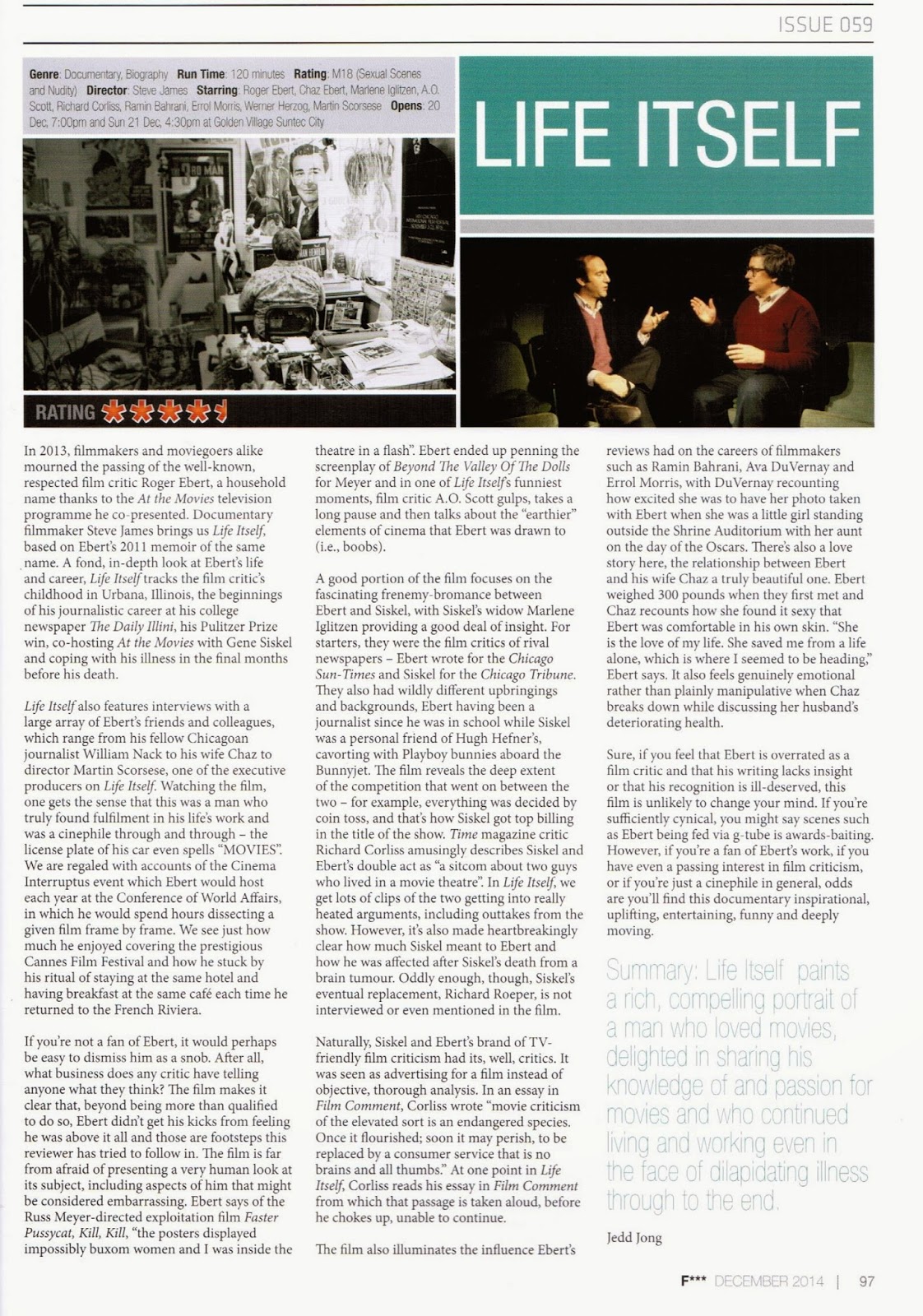
            In 2013, filmmakers and moviegoers alike mourned the passing of the well-known, respected film critic Roger Ebert, a household name thanks to the At the Movies television program he co-presented. Documentary filmmaker Steve James brings us Life Itself, based on Ebert’s 2011 memoir of the same name. A fond, in-depth look at Ebert’s life and career, Life Itself tracks the film critic’s childhood in Urbana, Illinois, the beginnings of his journalistic career at his college newspaper The Daily Illini, his Pulitzer Prize win, co-hosting At the Movies with Gene Siskel and coping with his illness in the final months before his death.

            Life Itself also features interviews with a large array of Ebert’s friends and colleagues, which range from his fellow Chicagoan journalist William Nack to his wife Chaz to director Martin Scorsese, one of the executive producers on Life Itself. Watching the film, one gets the sense that this was a man who truly found fulfilment in his life’s work and was a cinephile through and through – the license plate of his car even spells “MOVIES”. We are regaled with accounts of the Cinema Interruptus event which Ebert would host each year at the Conference of World Affairs, in which he would spend hours dissecting a given film frame by frame. We see just how much he enjoyed covering the prestigious Cannes Film Festival and how he stuck by his ritual of staying at the same hotel and having breakfast at the same café each time he returned to the French Riviera.


            If you’re not a fan of Ebert, it would perhaps be easy to dismiss him as a snob. After all, what business does any critic have telling anyone what they think? The film makes it clear that beyond being more than qualified to do so, Ebert didn’t get his kicks from feeling he was above it all and those are footsteps this reviewer has tried to follow in. The film is far from afraid of presenting a very human look at its subject, including aspects of him that might be considered embarrassing. Ebert says of the Russ Meyer-directed exploitation film Faster Pussycat, Kill, Kill, “the posters displayed impossibly buxom women and I was inside the theatre in a flash.” Ebert ended up penning the screenplay of Beyond the Valley of the Dolls for Meyer and in one of Life Itself’s funniest moments, film critic A.O. Scott gulps, takes a long pause and then talks about the “earthier” elements of cinema that Ebert was drawn to (i.e., boobs).


            A good portion of the film focuses on the fascinating frenemy-bromance between Roger Ebert and Gene Siskel, with Siskel’s widow Marlene Iglitzen providing a good deal of insight. For starters, they were the film critics of rival newspapers – Ebert wrote for the Chicago Sun-Times and Siskel for the Chicago Tribune. They also had wildly different upbringings and backgrounds, Ebert having been a journalist since he was in school while Siskel was a personal friend of Hugh Hefner’s, cavorting with Playboy bunnies aboard the Bunnyjet. The film reveals the deep extent of the competition that went on between the two – for example, everything was decided by coin toss, and that’s how Siskel got top billing in the title of the show. Time magazine critic Richard Corliss amusingly describes Siskel and Ebert’s double act as “a sitcom about two guys who lived in a movie theatre”. In Life Itself, we get lots of clips of the two getting into really heated arguments, including outtakes from the show. However, it’s also made heartbreakingly clear how much Siskel meant to Ebert and how he was affected after Siskel’s death from a brain tumour. Oddly enough though, Siskel’s eventual replacement Richard Roeper is not interviewed or even mentioned in the film.


            Naturally, Siskel and Ebert’s brand of TV-friendly film criticism had its, well, critics. It was seen as advertising for a film instead of objective, thorough analysis. In an essay in Film Comment, Corliss wrote “movie criticism of the elevated sort is an endangered species. Once it flourished; soon it may perish, to be replaced by a consumer service that is no brains and all thumbs.” At one point in Life Itself, Corliss reads his essay in Film Comment from which that passage is taken aloud, before he chokes up, unable to continue.


            The film also illuminates the influence Ebert’s reviews had on the careers of filmmakers such as Ramin Bahrani, Ava DuVernay and Errol Morris, with Selma director DuVernay recounting how excited she was to have her photo taken with Ebert when she was a little girl standing outside the Shrine Auditorium with her aunt on the day of the Oscars. There’s also a love story here, the relationship between Ebert and his wife Chaz a truly beautiful one. Ebert weighed 300 pounds when they first met and Chaz tells how she found it sexy that Ebert was comfortable in his own skin. “She is the love of my life. She saved me from a life alone, which is where I seemed to be heading,” Ebert says. It also feels genuinely emotional rather than plainly manipulative when Chaz breaks down while discussing her husband’s deteriorating health.


            Sure, if you feel that Ebert is overrated as a film critic and that his writing lacks insight or that his recognition is ill-deserved, this film is unlikely to change your mind. If you’re sufficiently cynical, you might say scenes such as Ebert being fed via g-tube is awards-baiting. However, if you’re a fan of Ebert’s work, if you have even a passing interest in film criticism or if you’re just a cinephile in general, odds are you’ll find this documentary inspirational, uplifting, entertaining, funny and deeply moving.


Summary: Life Itself  paints a rich, compelling portrait of a man who loved movies, delighted in sharing his knowledge of and passion for movies and who continued living and working even in the face of dilapidating illness through to the end.

RATING: 4.5 out of 5 Stars

Jedd Jong 

Wednesday, May 8, 2013

Roger Ebert: A Life at the Movies

As published in F*** Magazine Issue #40


---

(Text)

ROGER EBERT: A LIFE AT THE MOVIES

F*** remembers the film criticism icon

By Jedd Jong 5/4/13

On April 4 2013, film critic Roger Ebert passed away at age 70 after 11 years of battling cancer. Ebert was not a movie star or film director, but he is a beloved figure among moviegoers all the same. Through television shows such as At the Movies and books like his essay collections The Great Movies I, II and III, Ebert became more than a critic; his famous “two thumbs up” endorsement entering the popular culture lexicon. We’re the first to admit that movie critics may not be the most endearing personalities ever, but over the course of his four-decade long career in the field, Ebert became America’s knowledgeable, witty uncle to turn to in picking out films for a movie night. In 1975, Roger Ebert became the first movie critic to take home the Pulitzer Prize for Criticism and in 2005, was the first movie critic to be honoured with a star on the Hollywood Walk of Fame.

Behind the glittering acclaim was ultimately a man with a deep love for the movies. Roger Joseph Ebert was born on June 18, 1942 in Urbana Illinois, to Walter and Annabel Ebert. As a high school student, Ebert took up sports writing for the local newspaper, The News-Gazette in Champaign, Illinois. However, he probably owes his writing career to being something of a passionate fanboy from the very beginning - even though he has ruffled some fanboy feathers in his time, with his negative reviews of movies like, well, Fanboys. In the days long before internet forums and newsgroups, science-fiction fanzines were the foremost avenue for lovers of the genre to discuss, analyse and enthuse and over their favourite sci-fi stories; Ebert contributing articles to several of them. Also among Ebert’s early influences was the parody magazine Mad, which frequently featured comic strip spoofs of movies that sensitized Ebert to the clichés and formulae beneath the surface of many films.

Roger Ebert was an alumni of the University of Illinois at Urbana-Champaign, where he worked as a reporter for The Daily Illini. One of his very first reviews, written for the paper and on the 1960 Fellini classic La Dolce Vita (which is, coincidentally, about a journalist), opened with this sentence: “There is in La Dolce Vita a great deal to be puzzled about, and a great deal to be impressed by, and perhaps a great deal which we as Americans will never completely understand.” And thus began Ebert’s film criticism legacy.

In 1966, Ebert was hired as a general reporter and feature writer for the Chicago-Sun Times, taking on the post of film critic the next year after the departure of Eleanor Keane. 1967 also saw the publishing of Ebert’s first book Illini Century: One Hundred Years of Campus Life, a history of the first 100 years of his alma mater. Ebert dabbled in filmmaking, writing the screenplay for Russ Meyer’s Beyond the Valley of the Dolls. Ebert would further collaborate with schlockmeister Meyer on such raunchy exploitation flicks as Beneath the Valley of the Ultra-Vixens and Up! (absolutely not to be confused with the Pixar film).

What launched Roger Ebert into the public spotlight was his appearance on TV as a broadcast film critic. In 1975, Ebert and Gene Siskel, a film critic from the Chicago Tribune, teamed up for the film review show Opening Soon at a Theatre near You, created by Chicago-based PBS-affiliate station WTTW. The show was renamed Sneak Previews after two seasons. In 1982, the duo left the show to establish At the Movies, which was followed by Siskel and Ebert and the Movies, shortened to Siskel and Ebert in 1987. The pair were known for their spirited discussions and for making film appreciation accessible to the television-viewing and movie-going audience at large. It was always entertaining to watch them really get into it and argue over a film they disagreed upon, such as with Silence of the Lambs, Baby’s Day Out and Cop and A Half. The pair often traded brickbats on talk shows and made a memorable guest appearance voicing versions of themselves in the animated sitcom The Critic.

And of course, there were the thumbs. On this method of rating the films, Ebert said “stars are relative, not absolute. Thumbs are a little more pure, because they basically say ‘yes, I recommend that you go see this movie’ or ‘no, I recommend that you don’t go see this movie’ and when you talk to a friend and ask ‘should I go see this movie’, they say ‘yes’ and they say ‘no’.” The thinking was that a more binary approach that the usual “star” or “points” system would have more clarity. The duo trademarked the phrase “two thumbs up” (though not their actual thumbs, as has been rumoured) in 1989, and it became a sought-after endorsement proudly displayed on movie posters and DVD covers.

Gene Siskel died from complications of a brain tumour surgery in 1999, and Ebert dedicated an entire episode of the show to his late co-host. “People always asked if we really hated each other,” Ebert said in the episode. “One thing I know for sure is that we didn’t.” *Sniff*. Ebert knew the show had to go on, and searched for someone to replace Siskel by his side, eventually settling on Chicago Sun-Times columnist and film critic Richard Roeper. While Roeper was younger and more energetic, fully recapturing the chemistry that Ebert and Siskel had together would prove elusive.  

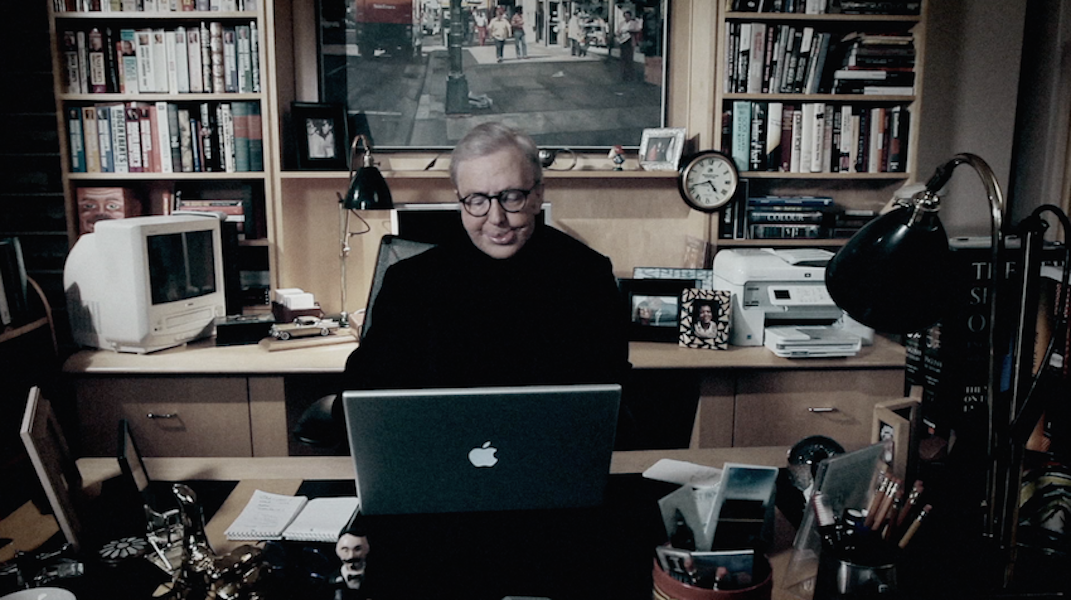
Unfortunately, Ebert would face tragedy again in the form of his ill health. In 2002, he was diagnosed with papillary thyroid cancer and in 2006 had part of his jaw bone removed. He nearly died from a burst carotid artery and was eventually no longer able to speak, eat or drink. While he was unable to further co-host At the Movies (which cycled through many potential replacement critics), Ebert became active online and continued to write print reviews for the Chicago-Sun Times. He communicated via a computerised voice system and in 2011 proposed the “Ebert test”, which would gauge how closely a synthetic voice could mimic the real thing by seeing if the voice could tell a joke and make someone laugh.

Roger Ebert’s opinions were divisive at times, as should be expected of a film critic of his stature. He gave A Few Good Men a thumbs down rating, expressing disappointment in its predictability and its ending. Ebert was also one of the very few who praised Speed 2: Cruise Control, widely regarded as one of the worst films of all time. His controversial stance that video games are not, and probably will never be for a long time, “art” made many gamers consider him a snob. He also earned the ire of fans of Transformers: Revenge of the Fallen by suggesting that by liking the film, they were not “sufficiently evolved”.

In the introduction to his book The Great Movies III, Ebert wrote “I was indeed a snob, if you agree with this definition: ‘A person who believes that their tastes in a particular area are superior to those of other people.’ I do. That is not ego. It is a faith that after writing and teaching about films for more than forty years, my tastes are more evolved than those of a fanboy.”

He also famously told Rob Schneider, star of Deuce Bigalow, European Gigolo, “your movie sucks.” Imagine Ebert’s surprise then, when he was ill and a bouquet of flowers accompanied by a handwritten note wishing him a speedy recovery arrived. It was a gift from the actor, signed “Your Least Favourite Movie Star, Rob Schneider”. Touched, Ebert wrote “although Rob Schneider might (in my opinion) have made a bad movie, he is not a bad man”.

From the outpouring of sympathy following Ebert’s death, it is clear that in spite of the saying “nobody likes a critic”, he was an influential figure who meant a lot to those who make movies, those who watch movies, and those who love movies.

Director Steven Spielberg said in a statement, "Roger loved movies. They were his life. His reviews went far deeper than simply thumbs up or thumbs down. He wrote with passion through a real knowledge of film and film history, and in doing so, helped many movies find their audiences.”

Director Christopher Nolan said “Roger really to me has been emblematic of a wonderful everyman approach to criticism. He never became jaded… even while bringing a very thoughtful critical eye.”
Director Martin Scorsese declared that “the death of Roger Ebert is an incalculable loss for movie culture and for film criticism. And it’s a loss for me personally…There was a professional distance between us, but then I could talk to him much more freely than I could to other critics. Really, Roger was my friend. It’s that simple.”

Even the President of the United States himself, Barack Obama, felt compelled to make a statement. "Roger was the movies. When he didn't like a film, he was honest; when he did, he was effusive — capturing the unique power of the movies to take us somewhere magical. Even amidst his own battles with cancer, Roger was as productive as he was resilient — continuing to share his passion and perspective with the world. The movies won't be the same without Roger, and our thoughts and prayers are with Chaz and the rest of the Ebert family."

Perhaps the saddest statement to read of them all was the one issued by Ebert’s widow, Chaz. "I am devastated by the loss of my love, Roger — my husband, my friend, my confidante and oh-so-brilliant partner of over 20 years. He fought a courageous fight. I've lost the love of my life and the world has lost a visionary and a creative and generous spirit who touched so many people all over the world. We had a lovely, lovely life together, more beautiful and epic than a movie. It had its highs and the lows, but was always experienced with good humour, grace and a deep abiding love for each other." 

Roger Ebert wrote his final entry on the blog “Roger Ebert’s Journal”, entitled “A Leave of Presence” (April 2 2013), explaining that he would be writing less reviews himself owing to his ill health. “What in the world is a leave of presence? It means I am not going away. My intent is to continue to write selected reviews but to leave the rest to a talented team of writers handpicked and greatly admired by me. What's more, I'll be able at last to do what I've always fantasized about doing: reviewing only the movies I want to review.” He ended off the post with “So on this day of reflection I say again, thank you for going on this journey with me. I'll see you at the movies.”

The balcony may be closed and the aisle seat may be vacated, but Ebert is indeed not going away. Filmmakers Steve James, Steven Zaillian and Martin Scorsese are at work on a bio-documentary film about the movie critic’s life. For all the things that he was – reviewer, journalist, screenwriter, fiction author, cookbook writer (see The Pot and How to Use It: The Mystery and Romance of the Rice Cooker) – Ebert was a bona fide cinephile, someone whose love and knowledge of the movies was infectious and influential. He has left behind a legacy of an understanding and a passion for movies, and has imbued in so many that there’s so much more to the medium than just entertainment, and that discussing and thinking about movies is a fulfilling, enjoyable endeavour.

It’s been said that “nobody ever built a monument to a critic”. Well, perhaps an exception might be made for Roger Ebert.