Showing posts with label special effects. Show all posts

Thursday, May 28, 2015

Resurrecting the Dinosaurs: the special effects of Jurassic Park

As published in Issue #64/65 of F*** Magazine


---

Text:

RESURRECTING THE DINOSAURS
F*** goes back to the genesis of the Jurassic Park film series and explores the movie magic that brought the park’s denizens back from extinction
.

By Jedd Jong


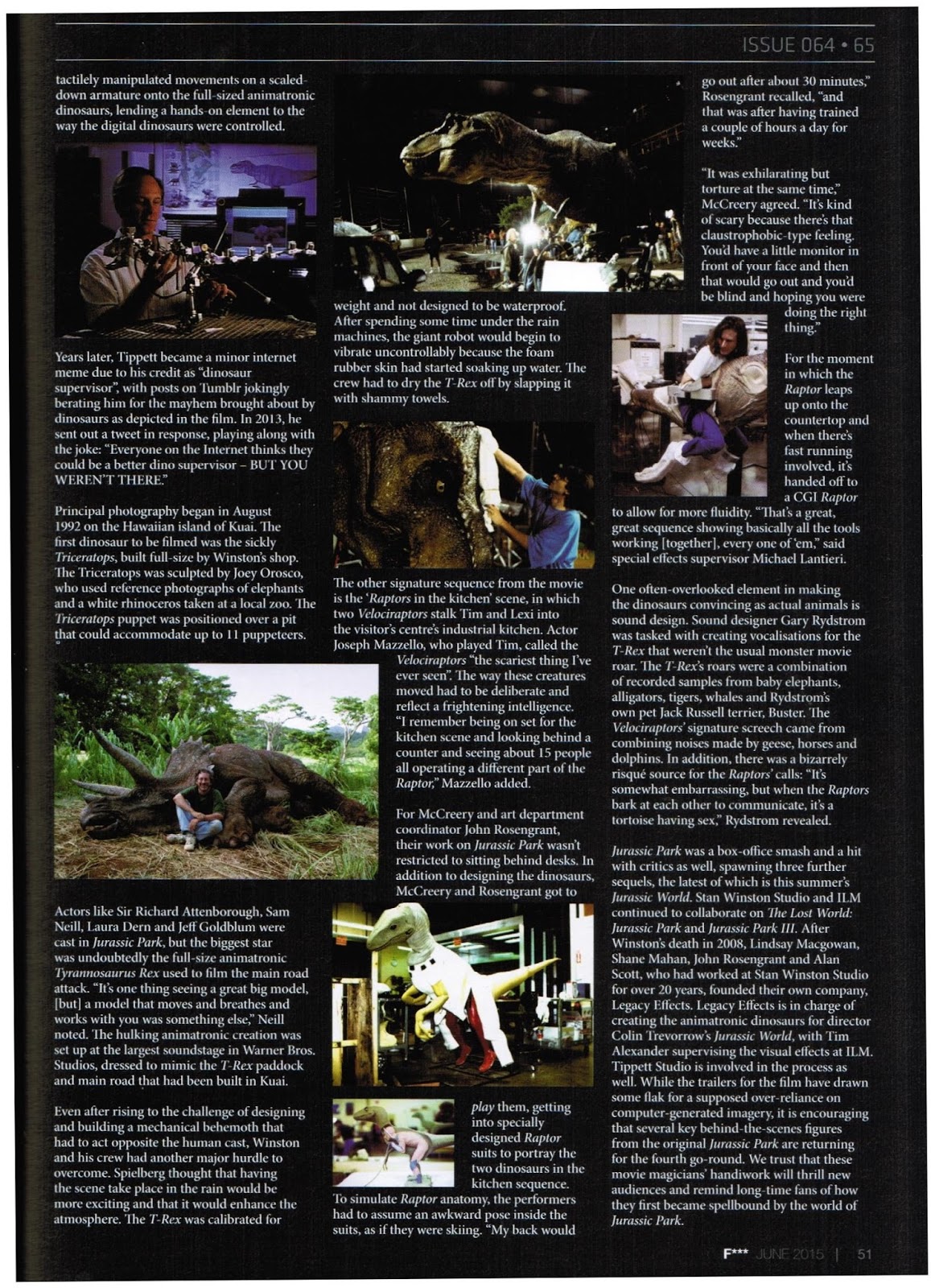
This June, Jurassic World continues the legacy of a film franchise that has enthralled audiences with its depictions of prehistoric beasts stomping among (and occasionally chomping on) mankind. The first Jurassic Park movie, which was released in 1993, broke more than its share of ground in the realm of special and visual effects that marked a great leap forward in filmmaking technology. In the story, it is InGen’s geneticists who clone dinosaurs from preserved DNA, but behind the scenes, it was Stan Winston Studio, Tippett Studio and Industrial Light and Magic (ILM) who resurrected these titans of a bygone era.


Jurassic Park is based on the 1990 novel of the same name by Michael Crichton. Even before the book was published, a fierce bidding war for the film rights was sparked. Universal Pictures, director Steven Spielberg and Amblin Entertainment won the rights. Spielberg had a tough time working with animatronic creatures on Jaws, which was plagued by constantly malfunctioning mechanical sharks. The plan of action was that the dinosaurs of Jurassic Park would be created with the joint methods of stop-motion puppets and full-scale animatronic dinosaurs.


Spielberg first turned to theme park attraction creator Bob Gurr, who was working on a King Kong attraction at Universal Studios. Upon realising that particular method was infeasible, the director sought the help of Stan Winston, a legendary special effects creator whose studio was responsible for the monsters of the Alien, Terminator and Predator franchises, amongst other films. “Everyone who does the kind of work we do are dinosaur fans,” Winston professed. The puppets, which would be used for wide shots of the dinosaurs in motion, were to be created by animator Phil Tippett. Tippett had devised an improved stop-motion animation technique called “go-motion”, which he used on the film Dragonslayer. The addition of digital motion blurring would reduce the jerkiness that is characteristic of stop-motion animation.


Winston engaged concept artist Mark “Crash” McCreery to begin designing the dinosaurs; McCreery’s artwork informed by palaeontologist Jack Horner, who has been a consultant for all the Jurassic Park films so far. Among Horner’s contributions was the then-recent discovery that dinosaurs were more closely related to birds than they were to reptiles. Initially, the Raptors would’ve been depicted with snake-like flicking tongues, an idea Horner nixed. The intent was that these would be living, breathing creatures that the audience could buy as real animals rather than otherworldly movie monsters. The design process started a full year before actual production began. “We wanted these dinosaurs to be authentic, not ‘Hollywood’ dinosaurs, and so we really did our research,” Winston said.


Over at pioneering visual effects house ILM, famous for their work on the Star Wars saga, visual effects supervisor Dennis Muren was in charge of digitally enhancing Tippett’s puppetry work and exploring new uses for computer graphics in the making of the film. In the midst of pre-production, ILM presented computer-generated test footage to Spielberg, which depicted a heard of skeletal Gallimimus running through a field. It turns out that actors aren’t the only ones who practice method acting as the ILM animators studied under a movement coach and performed the Gallimimus run to provide their own reference material.

Animators Mark Dippé and Steve Williams later worked on animating a walk cycle for the T-rex. Spielberg was impressed, saying “it was so authentic and smooth, I said ‘well that’s the future, that’s the way it’s going to be from now on’…this technology came along and changed my movie forever and in that sense changed the world forever.”

Naturally, Tippett and his go-motion animation team were devastated by this change of approach to the wide shots. “It was a big emotional moment, like when your dog dies,” Tippett recalled.


“We’re extinct, we’re the dinosaurs, and that irony wasn’t lost on any of us,” said dinosaur motion supervisor Randal M. Dutra. This was given a nod in the dialogue of the film, when palaeontologist Dr. Alan Grant says “we’re out of a job” and mathematician Ian Malcolm corrects him by saying “don’t you mean extinct?” However, the work that Tippett and his team had developed did not go to waste – the elaborate go-motion puppets were used to create animatics (moving storyboards) that helped Spielberg plan the action beats precisely and served as a guide to the other animators and puppeteers involved. Tippett’s team also designed a telemetry system called the “Dinosaur Input Device” that could project tactilely manipulated movements on a scaled-down armature onto the full-sized animatronic dinosaurs, lending a hands-on element to the way the digital dinosaurs were controlled.


Years later, Tippett became a minor internet meme due to his credit as “dinosaur supervisor”, with posts on tumblr jokingly berating him for the mayhem brought about by dinosaurs as depicted in the film. In 2013, he sent out a tweet in response, playing along with the joke: “Everyone on the internet thinks they could be a better dino supervisor - BUT YOU WEREN'T THERE.”

Principal photography began in August 1992 on the Hawaiian island of Kuai. The first dinosaur to be filmed was the sickly Triceratops, built full-size by Winston’s shop. The Triceratops was sculpted by Joey Orosco, who used reference photographs of elephants and a white rhinoceros taken at a local zoo. The Triceratops puppet was positioned over a pit that could accommodate up to 11 puppeteers.


Prolific human actors like Sir Richard Attenborough, Sam Neill, Laura Dern and Jeff Goldblum were cast in Jurassic Park, but the biggest star was undoubtedly the full-size animatronic Tyrannosaurus rex used to film the main road attack. “It’s one thing seeing a great big model, [but] a model that moves and breathes and works with you was something else,” Neill noted. The hulking animatronic creation was set up at the largest soundstage in Warner Bros. Studios, dressed to mimic the T-rex paddock and main road that had been built in Kuai.


Even after being up to the task of designing and building a mechanical behemoth that had to act opposite the human cast, Winston and his crew had another major hurdle to overcome. Spielberg thought that having the scene take place in the rain would be more exciting and that it would enhance the atmosphere. The T-rex was calibrated for weight and not designed to be waterproof. After spending some time under the rain machines, the giant robot would begin to vibrate uncontrollably because the foam rubber skin had started soaking up water. The crew had to dry the T-rex off by slapping it with shammy towels.


The other signature sequence from the movie is the “Raptors in the kitchen” scene, in which two Velociraptors stalk Tim and Lexi into the visitor’s centre’s industrial kitchen. Actor Joseph Mazzello, who played Tim, called the Velociraptors “the scariest thing I’ve ever seen.” The way these creatures moved had to be deliberate and reflect a frightening intelligence. “I remember being on set for the kitchen scene and looking behind a counter and seeing about 15 people all operating a different part of the Raptor,” Mazzello added.


For McCreery and art department coordinator John Rosengrant, their work on Jurassic Park wasn’t restricted to sitting behind desks. In addition to designing the dinosaurs, McCreery and Rosengrant got to play them, getting into specially designed Raptor suits to portray the two dinosaurs in the kitchen sequence. To simulate Raptor anatomy, the performers had to assume an awkward pose inside the suits, as if they were skiing. “My back would go out after about 30 minutes,” Rosengrant recalled, “and that was after having trained a couple of hours a day for weeks.”

“It was exhilarating but torture at the same time,” McCreery agreed. “It’s kind of scary because there’s that claustrophobic-type feeling. You’d have a little monitor in front of your face and then that would go out and you’d be blind and hoping you were doing the right thing.”

For the moment in which the Raptor leaps up onto the countertop and when there’s fast running involved, it’s handed off to a CGI Raptor to allow for more fluidity. “That’s a great, great sequence showing basically all the tools working [together], every one of ‘em,” said special effects supervisor Michael Lantieri.

One often-overlooked element in making the dinosaurs convincing as actual animals is sound design. Sound designer Gary Rydstrom was tasked with creating vocalisations for the T-rex that weren’t the usual monster movie roar. The T-rex’s roars were a combination of recorded samples from baby elephants, alligators, tigers, whales, and Rydstrom’s own pet Jack Russell terrier, Buster. The Velociraptors’ signature screech came from combining noises from geese, horses and dolphins. In addition, there was a bizarrely risqué source for the Raptors’ calls: "It's somewhat embarrassing, but when the Raptors bark at each other to communicate, it's a tortoise having sex," Rydstrom revealed.

 Jurassic Park was a box office smash and a hit with critics as well, spawning three further sequels, the latest of which is this summer’s Jurassic World. Stan Winston Studio and ILM continued to collaborate on The Lost World: Jurassic Park and Jurassic Park III. After Winston’s death in 2008, Lindsay Macgowan, Shane Mahan, John Rosengrant, and Alan Scott, who had worked at Stan Winston Studio for over 20 years, founded their own company, Legacy Effects. Legacy Effects is in charge of creating the animatronic dinosaurs for director Colin Trevorrow’s Jurassic World, with Tim Alexander supervising the visual effects at ILM. Tippett Studio is involved in the process as well. While the trailers for the film have drawn some flak for a supposed over-reliance on computer-generated imagery, it is encouraging that several key behind-the-scenes figures from the original Jurassic Park are returning for the fourth go-round. We trust that these movie magicians’ handiwork will thrill new audiences and remind long-time Jurassic Park fans of how they first became spellbound. 

Wednesday, March 11, 2015

Face/Value: Interview with special effects makeup artist David Willis

As published in F*** Magazine Issue #62


---

FACE/VALUE


Special effects makeup artist David Willis chats exclusively with F***
By Jedd Jong

Special effects makeup artists: they’re responsible for transforming handsome leading men into hideous beasts, making it look as if someone’s been scalped without hurting a hair on their head and aging up 20-somethings so they look indistinguishable from actual octogenarians. Often as unsung as they are integral to the production, these artists make movie magic happen.

F*** spoke exclusively to David Willis, a special effects makeup artist with nearly 20 years of experience under his belt. David’s handiwork can be seen in films and television shows such as the Matrix trilogy, Star Wars Episodes I and II, Superman Returns, Farscape and the upcoming Mad Max: Fury Road.

In addition to working in film and TV, David has done work for advertising campaigns, museums and theme parks and has lectured and given masterclasses around the world. His work has taken him from his native Australia to New Zealand, the United States, Sweden, France, the United Arab Emirates, Singapore, Malaysia, Philippines, Thailand and China. Those who visited the first two Halloween Horror Nights events at Universal Studios Singapore would have witnessed David’s frightening creations first-hand.

Over coffee, David discussed his childhood turning his sisters into goblins and ghouls, the movie that was “so wrong” it convinced him that this was what he wanted to do for a living and the evolution of special effects makeup techniques and how they can co-exist alongside computer-generated effects work. David also weighed in on the Best Makeup nominees for the 87th Academy Awards, explained the frustrating politics of movie credits, shared what it was like working with A-list celebrities and explained how a certain cephalopod became the bane of his existence for a period.

As a kid, did you have Dick Smith’s Do-It-Yourself Monster Makeup Handbook on your bedside table?

I didn’t, but I had like 50 Fangoria magazines, which also had Dick Smith’s stuff in it. When I started, there was no internet, so it was just the library and the book shop, spending lots of money buying and ordering books in from the U.S. This was way before Amazon, if you wanted to do research on makeup effects, anything to do with creatures or even sculpting, the books are like $110. Fangoria magazine was $24 Australian. Every month, I would be at a place called Comics Kingdom in Sydney, which still exists, and I used to buy all the Cinefex and Fangoria magazines and there was Gorezone, which was really cool. And it just had disgusting blood and guts, that was cool. It had stuff from The Thing, back to the old days it had Dick Smith in it, it had Rick Baker in it, Steve Johnson, it had all the legends of makeup. I did have The Art of Makeup for Film, Television and Theatre and that was the only book I had. It was only 72 pages. This was in the early ‘80s.

Was there a film that you watched growing up that make you decide “I want to become a makeup artist”?

Hellraiser. That was the movie. I watched that when I was 12 years old. Remember, this was the most disgusting movie. It’s scary, it’s a guy with pins in his head. The other movie was A Nightmare on Elm Street. I grew up in the 80s so that’s the slasher time. The other one was The Thing and Alien. I couldn’t watch that until…I watched it when it came on video. I was so spooked. It was so scary. Now I watch it and go [scoffs]. It was so good. I’d say Hellraiser was the #1 film that made me go “I want to do that. It’s so wrong, I want to do that.”


In school, did everyone go to you for help with their Halloween makeup?

Remember in Australia, Halloween is not that popular, but I used to do tricks with my friends, like “Mum, Mum I’ve cut myself!” We didn’t have Halloween, it wasn’t popular, but we still had fun with it. My sisters, I used to turn them into ghouls and goblins with tissue and latex. I used to experiment with very expensive products so every Christmas or birthday, I used to get some sort of makeup effect blood stuff. My mother and father thought I was nuts.

Not the kind of makeup you’d usually associate with sisters!

No. But I would get lipstick and try and do bruises, bit of purple and red. I loved to make model aircraft, planes and trains. I used to be a big train buff; I had this huge train set, it was amazing. I was a nerd. I was a makeup, models and props nerd.

So this is your dream job, what you’re doing right now?

Yeah, I’m doing what I used to do as a hobby.

How did you get your first professional gig?

It’s all about who you know, isn’t it? I was learning makeup. I did work experience, that was like on Babe and also working with some local effects houses and it wasn’t necessarily going in and being paid full-time, it was doing an internship and I was also being a musician, I was cleaning toilets, I was being a waiter, I used to help with an electrician, I had just finished school and didn’t know what I wanted to do. I mean, I knew what I wanted to do, I needed to save money. Makeup is not cheap. Full stop. Opportunity came when some of the effects houses were working on commercials, I actually really started in commercials. That’s through the effects houses where I was first doing internships. Eventually for films, it didn’t come in until I started doing a makeup course in Sydney. It was through that that I got to know the teachers and the teachers were on jobs and you become friends, they like your work and the rest is history. I’d say the first big, known work that I was doing was Farscape. That was with Jim Henson’s Creature Shop.

Did you have to communicate a lot with the other departments?

Yes, we were doing stuff where the mould department had to talk to the animatronic department because the animatronic had to fit in the mould before you could cast it. From there, you’ll be talking to the costume tech department because the makeup effects for the big prosthetics has to fit into the costume. The makeup, hair, costume and makeup effects department are all very close. Now, those areas are talking to CG, depending on what the director wants. We don’t really talk to sound and lights and all that stuff, [but] the cinematographer, we do. We want to know the colours he uses.


What have been the major advances in makeup technology from when you first started until now?

I’d say silicone. The different products for making prosthetics, the evolution from a standard prosthetic to a silicone prosthetic to a 3D transfer. A 3D transfer is basically like a makeup tattoo. That was introduced during The Passion of the Christ, which [Christien] Tinsley and Brian Sipe created for the back, when Christ is being whipped. It was just so cool. The enhancements with Photoshop for pre-viz, design, 3D programs such as ZBrush, it’s like sculpting for makeup artists in 3D and I think the makeup effects industry has had to evolve and reinvent itself because we’re competing with CG.

That leads into the next question. What are your attitudes with regards to the use of computer-generated imagery to supplement or altogether replace makeup effects? We’ve seen that used to create aging effects in The Curious Case of Benjamin Button and Captain America: The Winter Soldier.

With stuff like Benjamin Button, it was all done [first] in physical makeup. Greg Cannom had done all the makeup effects for the pre-viz designs, he literally laid it all out for the 3D guys and girls. My attitude towards it is that it is a tool that can be used effectively but, like makeup, if it is done in a rush, it can look crappy. Another thing is that when it first came out, everyone was like “wow, this is so amazing.” The novelty of it, it’s already worn off. The general public who have no idea about the technical skills or advancements or whatever about CG and makeup, they know what is good and what is not.

So audiences have becoming more discerning?

Yes, exactly. Just because of the internet, YouTube, they know what they like. At the end of the day, it comes down to the story. Why do you need to put so much CG into something? You sit down to be entertained. As soon as you’re entertained, you start to zone out. It loses its “wow” [factor]. Bad CG automatically makes you go “now I’ve lost it.” The same with makeup. I’ll give you an example: I was watching the first Hobbit. Within 30-40 minutes, I was bored. Not because of the story, but you could tell. You could see all the lace wigs!

Again, with the advancement of technology, it has made our job harder; you’ve got all these high-res cameras. Even with 3D renderings and animation, they have to be in line with the camera work and it’s just so advanced. The cameras which they’re using now, the resolution is so big that your eyes can’t even see it, it’s like a lens you put into space. So when they transfer it back to what we see, you can tell the difference – “okay, they’ve put a lot of money and thought into that” and there’s another production “no, that’s crap”, and there’s another one, they used hardly any makeup effects or any major special effects in terms of visual or spectacle, you go “ah, that’s fantastic!”

At the end of the day, it’s about the story. It’s what our jobs are. It’s to enhance the director’s vision of the story that’s being portrayed. CG forgets that, it always forgets it. But I believe in both, if it’s in service of what the director wants to tell the story. We will not have a makeup effect if we do not believe that it will enhance the story. That’s our job, telling the director or producers “yes” or “no”. CG now is more expensive than practical. Practical is usually better because it’s in-camera, it’s physically there. If you ask me, I like both.


What is the experience like working on big movies, and what are celebrities like in the makeup chair?

Actors in the chair…I’m going to refer to The Matrix on this one. We were doing the life cast of Hugo Weaving, we did all the Agent Smiths. We did 120 Agent Smiths then we did all the masks, so we had an extra 80 people wearing the mask of Agent Smith. Tom Hardy, we did the body cast, when he’s on the truck in the movie [Mad Max: Fury Road], that’s not him, it’s a prop. He’s extremely nice, Hugo Weaving is extremely nice, Laurence Fishburne is awesome; we worked with him. We were walking in the Fox studio and he even came out to acknowledge the talent who works on the film, not just with our department but the other departments. On Star Wars, Natalie Portman, we got to do a couple of things with her which was really nice, she’s lovely.

Paris Hilton’s a bit funny, wouldn’t want to be working with her again [laughs], I don’t think she’ll ever do a movie ever again. That was just a slasher, “kill the celebrity” [movie, House of Wax]. It was awesome. On Wolverine, I worked on the first one, we did [work] with Hugh Jackman – he’s awesome. On Moulin Rouge, we did some stuff with Nicole Kidman, she’s lovely – everybody’s lovely! I’ve actually been very blessed to have very nice talents who respected all the crews, everybody’s just very nice. The only time I’ve heard anyone have a complaint was with Tom Cruise, but I’ve never worked on any of his movies.

I’d say that from Star Wars, Matrix, House of Wax, Superman [Returns], even the Farscape crew, everyone’s been awesome. In terms of how it feels to be on set and what the experience of being on set is, it’s like “go go go go” and then all of a sudden you’re standing around for 5 hours not doing anything. There’s a lot of waiting; it gets very boring. But it does get exciting especially if you’re in the makeup department because that’s where everybody goes. Everybody wants to know what’s happening in the makeup department. That’s where everybody hangs out. It’s really funny, like on the makeup truck, there’s always the ones that are very well-received by the majority of the crew, but are not respected by the directors and producers. We are the first ones on set with the grips and the lighting and we are the last people to go. We’re always there and we’re always around. It’s funny when I’m on there doing makeup because the majority of the makeup people are female and they’ll go “where are the makeup girls?” and I’ll go “ah, I’m not the girl,” because they’re so used to it being all girls.

You just worked on Mad Max: Fury Road. How were you affected by the production delays on that film?

The whole movie shut down for a year. It rained and the whole of the outback of Australia, for the first time in over 150 years, it flowered. They relocated to Namibia, just above South Africa. I didn’t do it because I had a contract with Universal, so I couldn’t go.

I’m originally from Australia and I moved to Los Angeles. From there, I was doing stuff with KNB, just inside the shop, working around inside the workshops and then I came back here, went around the planet, depends on where the job is. At the time, Australia went through a full renaissance with filmmaking because of the dollar. For nearly 12 years, all the movies came to Australia, all the big ones. And then, I was fortunate that I was able to part of that, because I was there. If I wasn’t there, I wouldn’t be where I am [today].

Around the time of Dark City, The Matrix…

Dark City, that was my very first movie. I was 15 years old, being an assistant coffee runner. I was part of the effects atmospherics department. I was still in school, I used to ditch school to go and work on production, calling it work experience. Just being there and seeing how it all works. I mean, it’s completely boring, sitting around waiting between each take, all the set-ups, but it was just fascinating. Then the next movie was The Matrix. I was working for a company called MEG, the Makeup Effects Group, I was still learning. They did the baby in the first Matrix, they did the torso of Keanu Reeves, when that little robot goes in, in the taxi. That was the only thing I did on the first Matrix.

For Matrix 2 and 3, that was a 2 and a half year project, back to back. That was when the Australian dollar was 50 cents to the US dollar, so they doubled the money. I ended up going in there as part of mould shop, part of the art department. Then I got moved to models and props, and then from models and props I moved to the makeup effects department. So it was 2 and a half years in 3 departments which you never, ever, ever get anymore, those days are over. There were some people in there that would be credited for something that they never were in. It would be like “why am I ‘scenic painter’ when I was never even scenic?” I was a “plasterer”. That’s how it works. You’re in the makeup department but you’re in the hair design department, and I was like “what?” Because they didn’t have any more space. Or they run out of money, because every credit costs money. If there’s not enough money for that, then they go “I don’t need that person, I don’t need that person”. Or they shift you to the bottom. It’s like “what am I going to be this time?” It’s always a surprise. Every time we walk out of the theatre, it’s like “huh? Why are you there man?”

That’s a shame, because I think a lot of times, people behind the scenes in special effects or makeup don’t get their due credit.

We get credited within the industry ourselves, because everybody knows, the circle of people, everybody knows who did what, it’s not just one person that did it, there was a team inside that. If we’re not credited on something we were working on, whether it was for 2 weeks or 6 months or a year, [shrugs]. The only time it becomes a real problem is if we really put blood and sweat and tears into the movie, then you just get rejected, not even being acknowledged in the credits, and that’s when we get pissed off, because that’s a real slap in the face.

How many times has that happened to you?

All the time, all the time. On House of Wax, it ended up that ¾ of the makeup department and the wax department weren’t even credited. Only the wax technician, which is my good friend Keith, and some of the KNB boys, which were like 4 [were credited], and then there’s 30 of us. What sucks is that some of the people who were credited were only on there for 2-3 weeks and for us, we were on there for 8 months, working 12 hour days, 7 days a week, the studio burnt down, it was so much fun but at the same time it’s like “hey! Here’s our photo, here we are with everybody on the team, where’s our credit?” So that’s why we don’t care about it. The circle of people in the industry, they know about it.

The general public, they don’t even look at the credits. As soon as it finishes, if you’re not in the intro, no one, I don’t know anybody that sits [through] after the lights go on. It’s very rare. I’ll give you an example: my dad was watching Star Wars II, and then my younger sister went “oh, there’s David’s name” while the credits were still rolling. My Dad went “what?” My Dad didn’t even know. He rang me up, at 3 o’clock in the morning because I’m on Los Angeles time, and goes “I just saw your name in the credits, my God, my son’s in the credits of Star Wars!” and I went “yeah? That was 7 years ago!” But he doesn’t watch those kinds of movies.

What’s the most fun you’ve had on a job?

After-parties! Not so much now, but before, they used to be really, really good. That’s when everybody gets together to say thank you, the directors and the producers all come and hang out and everybody gets drunk and we celebrate the fact that we’ve finished. Long, crazy hours dealing with people’s egos and good friends become enemies, enemies become friends, all within the span of 2-3 months, and then you move on to the next job. It’s not easy, to work in the movie or television industry, the entertainment industry overall, it is a roller-coaster ride. You have to expect the unexpected. If you’re not that inclined or not ready for that, you won’t last 5 minutes. That’s a wild ride.

How do you find that sweet spot for horror makeup to be scary but not over-the-top and make someone say “pfft, that’s just makeup”?

Less is more. That’s an easy question [chuckles]. What happens is people overdo it. A good makeup effect is something that is subtle. You think it’s real, and you go “that’s so real” then you go back and go “oh my god, that’s a prop, that’s a prosthetic”. They’re the ones that win Oscars. It’s not the big, over-the-top makeup effects, aliens, whatever – they don’t win Oscars. It’s the old age or the character makeups. Character makeups are one of the hardest makeups to do. That’s why old age makeups are always seen as the pinnacle of a good makeup artist, because they’re difficult. It’s got to be real.

Everyone knows what an elderly person looks like, nobody knows what an alien looks like.

Exactly. And also diseases, deformities, if there’s some sort of makeup effect that’s been executed well, respect. It’s not just starting from the application of the makeup, it goes all the way back to the beginning, from the life cast, to the sculpting, to the moulding, to the casting, to the painting, and then there’s application. There could be 6 people involved in that whole process right up until that application. That’s why the people who do get the awards, it’s usually the head of makeup who’s there to receive the award. But it is the team. And majority of the time, they thank their team, they say the names and stuff. If they don’t, then they’re a bit arrogant, because they didn’t do it all by themselves.

Speaking of awards, what are your thoughts on the Oscar nominations? They are Foxcatcher, The Grand Budapest Hotel and Guardians of the Galaxy. (Since this interview, The Grand Budapest Hotel has won the Oscar)

You know what? Budapest Hotel. It is so good. I watched that recently and it is such a character-driven film. In terms of the Galaxy one, I didn’t even bother going and watching it, I said “this looks like crap”. And the makeups look like stuff from Farscape. My head of makeup department even mentioned “you know what’s funny? Half the characters all look like they’re being copied from Farscape”. The bright colours, there’s the red-green striped…

Drax.

The Drax. Is he meant to be a paddle pop? It doesn’t work for me and it hasn’t worked for a few makeup artists who have actually gone “you know what? Good movie for kids” but in terms of the makeup, I think “nah”.

Some people have been saying that Maleficent was snubbed this year, what do you think about that film?

Good movie, I liked it. The makeup was great, they’re just transfers. In terms of makeup, there’s nothing fancy about it. In terms of the story and Angelina Jolie, I mean Angelina Jolie’s the one that pulled it off, she’s just got the look for the character. Overall, it’s designed for children. It did have that dark side to it but I’d say overall, the movie did quite well, I enjoyed it. But the makeup? Eh.

Looking through your Facebook page, you’ve done a lot of work in many different media, including stuff for museums. What’s the weirdest assignment you’ve had to accomplish?

[Laughs] Things that are not shown! Yeah, I’ve done some weird stuff. I love doing museum work because you get asked to do an exhibition and it’s land, sea or air creatures, it’s really interesting because it used to exist or it still exists and you can’t put the real thing in the exhibit because it would shrivel up and die. This was just mind-boggling - they wanted a Blue-Ringed Octopus to be put in a glass bottle. I said “how am I going to do that? How am I going to get the damn thing through that hole?” They said “oh, just cut the bottom off and we’ll just stick it back on”. I said “I’ll see what I can do” and it didn’t work. You still see the ring. So I made it out of silicone, but made it really, really like “sproing” [makes stretching gesture]. Then I just poked it in and “bloop!” it worked. But it took me 3 months to figure it out [laughs]. A lot of trial and error and it was always on my bench. It was the first task I was asked to do and it was the last one I finished. Eventually it was just trial and error. The museum lets me experiment a lot more than the films, because you have the time to do it.

How about theme parks?

[Chuckles] I first did makeup for Halloween Horror Nights in Los Angeles, for Universal [Studios theme park]. That was a one-month-of-a-year job and I did it for like 5 years. Then I stopped doing it because I came back to Australia and was doing other projects. It doesn’t necessarily pay a lot of money, but it’s fun, blood and guts!

When I was teaching around the planet, I ended up in Southeast Asia and my ex-girlfriend introduced me to Universal Studios Singapore. I was more or less going “where is that?” because where do you put it?! I thought it was going underground! She told me it was on Sentosa, I’d never heard of it. It had not even officially opened yet. I went in there and saw the makeups that were being done and said “why on earth are they doing this in 40° heat!?” I rang Resorts World and asked for the entertainment clerk and the next day I had an interview and 2 days later, I had a job. It was all just because I was in town.

First, I ended up being the consultant for Universal Studios Singapore, then I ended up being the head of makeup and then getting ready for the first Halloween, so I was the main guy giving them information on what to do, how to do it. There was a designer who’s now living in Norway, he used to work for Universal Studios Orlando. He didn’t end up winning the bid, but he helped with some of the designs. It was the first one, Singapore had never seen a Halloween Horror Nights ever and it was huge.

Working with Universal, it was interesting, definitely a struggle because it’s so difficult to get product. Sometimes it’s like “why are we using this product? We shouldn’t be using a commercial brand, we should be using professional brands.” But that’s a deal that gets done with suppliers. So I was in Singapore for 2 and a half years, I did the opening, then I did Halloween Horror Nights…my role was to help the locals to do the job at Universal, all the foreigners leave, that’s how they start up. Train the locals, “now it’s your turn to take care of it”. I did 2 Halloween Horror Nights. Possibly again for Halloween this year, I don’t know. Then I opened up my own horror park in Manila, Scream Park, which will be reopened again at the end of this year. Theme parks are fun but they’re not a full time [job]. You just go in, have fun, and pull out. I’d rather do productions in TV and film.


What are some of the considerations with regards to doing makeup in Southeast Asia because of the heat and humidity?

Wherever you go, no matter where you are in the world, first thing you need to do is determine what the weather is doing. Then you understand “okay, we’re going to be using a particular product or method to balance out what’s going on with the weather.” Now – humidity hates everything. It’s extremely difficult because you sweat, everybody’s different. When it comes to makeup, especially if it needs to last longer, you need to use less, not more.

Now the industry here and the culture here, it’s very thick where it should be going the other way around. It’s funny because in the northern hemisphere and the southern hemisphere, it’s quite light. But then the more northern you get, the thicker it gets, maybe it’s due to the cold weather. But when you get to the equator areas around the planet, it’s very thick. I don’t know why! But it’s cultural as well. If you go to Indonesia, Thailand, Malaysia, Singapore, Philippines, Cambodia, the history of makeup is more theatrical. It’s an indigenous culture. Even going into China, Japan, it’s more of a theatrical style of makeup, not the typical style of what we see as makeup. That sort of thing transcended over time into normal everyday makeup. Weddings are seen as something that is very theatrical, whereas to western eyes, it’s meant to be very natural. That’s a cultural thing.

The makeup industry has grown so much over the many, many years it’s been around. For me, when I’m here, I’m always asking the makeup artists “what’s the biggest problem?” they say “it’s the heat. The makeup always runs.” I say “why don’t you use…not necessarily a better product, but understand your product. It might not be something that’s superior, it might be something that’s cheaper but lasts longer.” Less is more, but less should have enough pigment such that it stands out, and that’s the point. Does that make sense?

Yes, it does. The last question I’d like to ask is, is there anything you’d like to do personally or professionally that you haven’t done yet?

What I’d like to do are my own productions. I want to do more film, but either if it’s independent or if I’m producing it or co-producing it. I wish I could do more personal projects, but I don’t get time, because personal projects don’t pay the bills. It’s evolved, if you ask me this question next year, it keeps changing. That’s what makeup effects is, it’s constantly evolving. An elderly artist might see their early work and go “oh, that’s crap!” It’s a journey, it’s a personal one. I guess you could say that I want to do everything that I possibly can that I haven’t done, then I want to go back to what I’ve done before and do it again, and revamp it. 

Friday, November 22, 2013

Ray Harryhausen: Master of the Haus

Here's an article I wrote several months back on the legendary special effects maestro Ray Harryhausen, on his passing.


---

Text:

MASTER OF THE HAUS
RAY HARRYHAUSEN’S SPECIAL EFFECTS LEGACY

By Jedd Jong 13/5/13

We hear the term “escapism” used a lot to describe a good time at the movies. There are certain genres audiences love for their ability to whisk us away from the mundane for two hours or so. Genres like fantasy, adventure and science-fiction. And there’s an undeniable mass appeal to movies that lead to collective jaw-dropping and gasps of “how did they do that?!”

One of the pioneers of the art of making moviegoers drop their jaws and gasp “how did they do that?!” was special effects maestro Ray Harryhausen. Harryhausen was responsible for creating some of the most iconic beasts, critters and magical beings to ever stomp and slither their way across the silver screen. The swordfighting skeletons from Jason and the Argonauts? The six-armed scimitar-wielding Kali statue from The Golden Voyage of Sinbad? The fast-growing Ymir that crushed Rome beneath its reptilian feet in 20 Million Miles to Earth? All lovingly crafted stop-motion puppets and the handiwork of Ray Harryhausen.

But isn’t all this quaint and old-fashioned? Hasn’t computer-generated imagery long since usurped jerky puppets as the go-to method for creating movie magic? Read on, for you just might be surprised at the far-reaching effect the work that Harryhausen did has on some of the most prolific and well-regarded filmmakers today.

THE MOTHER GOOSE STORIES (1946)
THE STORY OF LITTLE RED RIDING HOOD (1950)
THE STORY OF HANSEL AND GRETEL (1951)
THE STORY OF RAPUNZEL (1952)
THE STORY OF KING MIDAS (1953)

Before exploring the realm of fearsome mythological creatures and lumbering dinosaurs, Harryhausen’s earliest professional work was slightly cuddlier. “The Fairytales were what I really call my ‘teething rings’,” he recalled. His father Fred helped machine the metal armatures for the puppets and his mother Martha crafted the clothes said puppets would wear.

The Impact:

Nick Park, animator and creator of Wallace and Gromit and Shaun the Sheep, says the Mother Goose stories were his first exposure to Harryhausen’s work and he went on to become a lifelong fan. “I always considered Ray Harryhausen’s work so fine that it was way out of my league,” the animator graciously wrote in his tribute to Harryhausen.

MIGHTY JOE YOUNG (1949)


If Harryhausen is considered the grandfather of stop-frame animation, then Willis O’Brien could be considered the great-grandfather. O’Brien was responsible for realizing the titular character in the 1933 classic King Kong. Harryhausen cites King Kong as the film that got him really interested in pursuing a career in the industry, and he got to work alongside Willis O’Brien as his assistant on a slightly different giant gorilla film, Mighty Joe Young.

Harryhausen had a particularly healthy method when animating Joe Young: “I thought I’d get in the mood by eating celery and carrots for my tea break so I’d feel like a gorilla!”

The Impact:

“I think that’s some of his best stuff because the personality in Joe Young is amazing!” said John Landis, director of An American Werewolf in London. “And the way he moves, he does move like a gorilla whereas King Kong doesn’t move like a gorilla at all.”

Mighty Joe Young was remade in 1998, this version starring Charlize Theron.

THE BEAST FROM 20, 000 FATHOMS (1953)

Harryhausen’s good friend and fellow “Ray”, science fiction author Ray Bradbury, said “Ray Harryhausen and I showed up at the same time, and he said ‘well, maybe someday, you’ll write a screenplay for me and I’ll do dinosaurs for you,’ and I said ‘well, I’m gonna pray to God for that’.” The Beast from 20, 000 Fathoms, based on a short story by Bradbury, was the eventual result.

The titular Beast, a “Rhedosaurus”, was a fictional dinosaur devised by Harryhausen, the writers and producers of the film. In order to complete the film economically, Harryhausen devised a revolutionary rear projection method that would allow him to superimpose his stop-motion animation on the live-action photography – a precursor of sorts to digital compositing.

The Impact:

What’s the first thing that comes to mind when one hears “giant lizard rampaging about a big city”? That thing was inspired by The Beast from 20, 000 Fathoms.

““Gojira is a direct result of Beast from 20, 000 Fathoms! Exactly! I think Toho (studios) said ‘we’ll make one of those!’” John Landis declared.

The Japanese filmmakers took a different approach in creating their monster, though. As Harryhausen himself put it, “(Gojira) was a man in a suit stomping around on miniature sets!”

IT CAME FROM BENEATH THE SEA (1953)


Producer Charles H. Schneer wanted to create a monster movie about a giant octopus attacking San Francisco. Schneer and Harryhausen had a hard time getting the City Fathers to cooperate, as they felt that seeing an octopus bring down the Golden Gate Bridge would shake the confidence of moviegoers. Harryhausen recounted the ‘guerrilla tactics’ they used in the making of the film. “We had to do things from devious means. We put a camera in the back of a bakery truck and went back and forth on the bridge to get projection plates, secretly”.

Due to budget constraints, the octopus from It Came from Beneath the Sea only had six tentacles. Harryhausen had to animate it in such a way as to hide this shortcoming. He apparently liked referring to his creation as the “sextopus” (feel free to insert your own adult anime reference here).

The Impact:

The Kraken in Pirates of the Caribbean: Dead Man’s Chest was given six tentacles as a reference to the octopus in It Came From Beneath the Sea. Davy Jones was also designed to emulate the “in-your-face” feel of Harryhausen’s creature animation.

Steve Johnson, animatronics and prosthetics artist and special effects supervisor on Spider-Man 2 noted “I think it’s pretty obvious that Sam Raimi is a huge fan of Ray Harryhausen if you take a look at the work in Spider-Man 2 – Doctor Octopus.” The way Doc Ock’s robot arms moved and behaved gave them a personality not unlike that displayed by some of Harryhausen’s creatures.


And from another superhero film sequel, Hellboy II: The Golden Army, the ‘Forest Elemental’.


EARTH VS. THE FLYING SAUCERS (1953)

The 50s were arguably the height of UFO mania, and Hollywood was quick to capitalize on it and stoke the fires. Senior Visual Effects Supervisor at ILM, Dennis Muren, said “there were a lot of movies made in the 50s with flying saucers that were pretty dull to look at but Ray gave them personality and life and you were just enthralled as a kid looking at them.”
Harryhausen found it a challenge to give the suggestion of an alien intelligence within the metallic discs – without ever showing what exactly was inside. The flying saucers were machined with the help of Ray’s father Fred, and Ray invented a geared aerial bracing system that allowed him to suspend the flying saucers at an angle.

Harryhausen happily declared, “I knocked over the Washington monument long before Tim Burton did!”

The Impact:

Mars Attacks! , of course!

Independence Day went a tiny bit larger with its monument-destroying flying saucer.

20 MILLION MILES TO EARTH (1957)

In this film, an alien beast from the planet Venus crashes on earth off the Sicilian coast – he starts out tiny, but very soon he’s fighting elephants and rampaging through Rome. The monster was to have originally laid waste to Chicago, but Harryhausen “changed it to Rome because (he) wanted a trip to Europe”.

“I felt you could get much more emotion out of a humanoid type of figure than with an animal type of figure,” Harryhausen said of the decision to give the Venusian Ymir a humanoid torso.

The Impact:

“The Ymir is probably one of the best black-and-white monsters that he’s ever created, particularly in the early stages when it’s small…(with) all the humanoid gestures that make these monsters so personable and so much more appealing,” said Joe Dante, director of films such as Piranha and Gremlins.  “The design of the creature that we have in Piranha is a little bit like an Ymir,” he pointed out. “In Piranha, there was no stop-motion monster written into the script. The stop-motion monster was in the movie simply because Jon Davison, the producer, and I liked stop-motion. Any kind of stop-motion in my movies is a tribute to Ray Harryhausen or Willis O’Brien.”


Vicenzo Natali, director of the sci-fi horror film Splice, also remarked on Harryhausen’s ability to make his creatures likeable to a degree. “You can’t make a creature film without thinking of Ray Harryhausen because he created creatures that were so sympathetic and let’s face it, he made some of the greatest monster movies of all time.”

THE 7th VOYAGE OF SINBAD (1958)


The 7th Voyage of Sinbad marked Harryhausen’s first foray into the realm of period fantasy in which he would create some of his best-remembered work. Harryhausen said “I destroyed New York with the Beast, I destroyed San Francisco with the octopus, I destroyed Rome with the Ymir and I destroyed Washington with the flying saucers, and that got rather tedious so I was looking for a new avenue in which to use stop-motion animation, and I latched upon Sinbad.”

Sinbad was a risk for the studio because a then-recent film on the same subject, Howard Hughes’ Son of Sinbad, was a flop. “Oh, costume pictures are dead,” studio executives would say. Harryhausen was inspired by the likes of the Arabian Nights films from the 40s and The Thief of Baghdad.

For The 7th Voyage of Sinbad, Harryhausen would produce what went on to be among the best-loved of his creations. “I get more fan mail coming in about the Cyclops I think than any other creature,” he said. “I designed the Cyclops very carefully because I didn’t want people to think it was a man in a suit, so I put goat legs on like a satyr in ancient mythology. I gave him an appearance of three fingers so no one could assume that there was a man inside the Cyclops, and I think it worked out very well.”

The Impact:

“It’s so inspiring that it made you want to make movies,” Pixar and Walt Disney Animation Studios Chief Creative Officer John Lasseter said. The Pixar film Monsters, Inc. included a shoutout or two in the form of the Cyclopean characters Mike and Celia who go to eat at the fancy restaurant named ‘Harryhausen’s’.

“Without The Seventh Voyage of Sinbad, you would never have Lord of the Rings,” Vicenzo Natali commented. He might’ve been right: take a look at this guy Peter Jackson brought along to the Return of the King set from a short film he had made at age 15, called The Valley:

“When I was 12, 13 years old and other kids were getting interested in cars, sport and girls, I used to love monsters and I particularly loved Ray’s films,” Jackson said fondly of his teen years.


JASON AND THE ARGONAUTS (1963)


Based on the Greek myth of Jason and the Golden Fleece, Jason and the Argonauts is held by many as Harryhausen’s crowning achievement. “A lot of people find Jason and the Argonauts one of our best films,” Harryhausen acknowledged. “It’s my favourite because it was the most complete.”

“Some of the films are better made than others. And some of them have better scripts than others. I mean Jason and the Argonauts probably has the most literate screenplay, so it is a better movie,” John Landis remarked.

“I want to speak on behalf of all the actors that appeared in Harryhausen films,” John Cairney, who played Hylas in Jason, said. “They weren’t all monsters, they weren’t all effects – there were real live actors in there…We were trained to be classical actors. To appear at the Old Vic, that was our standard. But there was I, eating sand in Palinuro – and loved it, loved it, loved being there, being part of this titanic imagination of this man.”

But of course, the stars still were the creatures. Jason and the Argonauts boasted the seven-headed Hydra (in lieu of a more ordinary dragon) and the gigantic Bronze figure of Talos that rises from its pedestal to stomp across the beach. However, the most iconic sequence from the film probably was the skeleton fight.

The skeletons were conceptualized with rotting flesh hanging off them, but in order to avoid an X rating, Harryhausen went with the clean-cut skeletons we’re so familiar with today. The skeletons were designed with all the joints a real human skeleton would have, and it wasn’t easy putting it all together. The actors meticulously rehearsed the battle with stuntmen, and then shadow-fought against nothing with the skeletons inserted later via Harryhausen’s rear-projection method. “Sometimes I would only get about 13-15 frames a day,” Harryhausen revealed (you need 24 frames for one second of film). “It took four months to animate the sequence; it only took two weeks to shoot the live-action.”

The Impact:

Where do we even begin?

Army of Darkness

Pirates of the Caribbean: Curse of the Black Pearl
The Terminator

“The images of those skeletons leaped off the screen and drove straight into my DNA… I’m sure there’s a direct link between those demonic skeletons and the chrome death figure in The Terminator,” James Cameron said of the influence the Jason and the Argonauts scene had on him.

Spy Kids 2: The Island of Lost Dreams

FIRST MEN IN THE MOON (1964)

Ray Harryhausen had always loved the works of H. G. Wells and wanted to make a film based on a Wells story. After finding that the rights to War of the Worlds and The Time Machine were unavailable, he settled on First Men in the Moon. The film was also owed a fair bit to Georges Méliès’ A Trip to the Moon and Harryhausen even owned an original business card of the pioneering filmmaker.

The Impact:

“I’m always saying to the guys I work with now in computer graphics, ‘do it like Ray Harryhausen’ or ‘why don’t you look at Ray Harryhausen and see what he did,” said Phil Tippett, creature visual effects supervisor on Starship Troopers.


ONE MILLION YEARS B.C. (1966)

Yeah, we know this film is best remembered for the fanservice Raquel Welch so lovingly provided. “Raquel Welch was cast in the picture; that was one of her first films. She never looked like a real cavewoman; she wasn’t supposed to – that wouldn’t have been very entertaining to the public. If cavewomen in prehistoric days looked like Raquel Welch, we’ve regressed today!” laughed Harryhausen. 

The film was a remake of a 1940 film starring Victor Mature and Carole Landis – for that film, lizards with fins glued to their backs stood in for dinosaurs, something Harryhausen felt looked too “phony”. The dinosaur models in the newer one were inspired by paintings and drawings done by Charles R. Knight, one of the first painters to envision what dinosaurs might’ve looked like back in the day. Harryhausen also made research trips to the American Museum of Natural History in New York. In order to make the dinosaurs look less static, he would animate them with their tails swishing about as they moved.


The Impact:

“Ray Harryhausen’s work had a huge impact on us during the design of King Kong (2005). There are a lot of different ways we could possibly go with the design of the creatures and the dinosaurs, and Peter (Jackson) especially, he said he didn’t want them to be real dinosaurs as such, he wanted them to be movie dinosaurs,” said Greg Broadmoore, concept designer on King Kong. “So we were trying to evoke that era of dinosaurs from movie history and really wanted to capture that, so in that sense they were more like monsters in their characters than true animals.”

There’s also Roland Emmerich’s 10 000 B.C.


THE VALLEY OF GWANGI (1969)


The next feature film Harryhausen worked on also dealt with dinosaurs and was about a group of cowboys who hope to stage the ultimate rodeo after capturing the “Gwangi” of the title – a vicious Allosaurus – from the valley of the title. The film is most famous for a scene in which the cowboys attempt to lasso Gwangi, a sequence that took Harryhausen well over two and a half months to complete. Unfortunately, the film was released too late and dumped on the market, with moviegoers assuming it was a Japanese production. Harryhausen has stated that it didn’t have the advertising required to give it visibility, and that perhaps it was too kitschy for audiences to swallow even then.

The Impact:

This bit where poachers try to lasso a Parasaurolophus in The Lost World: Jurassic Park.

THE GOLDEN VOYAGE OF SINBAD (1973)

Following the box office failure of Gwangi, Harryhausen decided to do a Sinbad sequel. This would be followed by Sinbad and the Eye of the Tiger in 1976. The film is known for the six-armed Kali idol which comes alive to battle Sinbad and his compatriots. The Kali sequence was a vestige of the intention to use India as a filming location; the movie was eventually shot in Spain.

“I think my favourite creature from a Ray Harryhausen film would probably be from the first one I ever saw, which was The Golden Voyage of Sinbad, and it was the Kali, the giant statue that comes to life,” Vicenzo Natali said. “And it was just so shocking to see so beautifully rendered and animated and I think stands the test of time. It hasn’t really aged one bit and I still find it terrifying.”

The Impact

Notice the way General Grievous extends his extra arms in Star Wars Episode III: Revenge of the Sith.


And the Brahman statue that comes to life in Lara Croft: Tomb Raider.


CLASH OF THE TITANS (1981)

The last major motion picture Ray Harryhausen worked on gave him the chance to create mythological creatures that would stand alongside the pantheon of Greek gods and goddesses – including Sir Laurence Olivier’s “I’m only doing this for the money” turn as Zeus. One of the highlights of the film is the tension-filled sequence in Medusa’s lair.


Ray Harryhausen recalled a film that portrayed Medusa by way of giving an actress a wig with rubber snakes that would bobble around as she walked. “It wouldn’t frighten a two year-old child!” He declared. “I tried to design her so that she wouldn’t have clothes, that’s why I gave her a reptilian body, because I didn’t want to animate flowing cloth. We gave her the arrow from Diana’s bow and arrow and the rattlesnake’s tail so that she could be a menace from the sound effects point of view. It became a big problem because she had 12 snakes in her hair; each snake had to be moved, the head and the tail, every frame of film, along with her body and her face and her eyes and the snake body.” He wanted to give the character green eyes, but had to make do with blue eyes that he manipulated with the eraser end of a pencil.

 The other famous creature Harryhausen made for Clash of the Titans was the Kraken – which is actually a sea monster from Norse, and not Greek, myth. Harryhausen opted for a more humanoid design, with tentacles that ended in hands. He cited French artist Gustave Doré as one of his main influences over the years - Doré was known for a dramatically-illustrated edition of the Bible.

Harryhausen found himself needing some assistance and hired animators Jim Danforth and Steve Archer – up until that time, he had done all of the animation himself. Danforth animated the bulk of the sequences involving Pegasus the winged horse, and Archer was responsible for most of the shots featuring Bubo the mechanical owl.


The Impact:

Clash of the Titans was remade in 2010. Many devotees feel that in spite of the refined look of the newer film, it just doesn’t match the heart and the charm of the original.


AND WHAT ABOUT CGI?

When asked about what led to his decision to retire, Harryhausen answered “young people have been brainwashed by television to want everything quickly, and you just can’t have an explosion every five minutes in Greek mythology, so I felt it was time to retire. I felt I had had enough.”

“Steven Spielberg, when Ray was in town, got him over to the editorial suite for Jurassic Park,” recalled Phil Tippett, animator and ‘dinosaur supervisor’ on that film. “Ray was blown away by it. He thought it was just really an amazing process.”

“I couldn’t say anything negative because it was most impressive!” Harryhausen admitted.

James Cameron said, “I think Ray would have loved to have had access to the tools that we have now for computer-generated animated characters, because…the stop-motion puppetry was a way for him to get the images that were in his head up on film, and that was the only way to do it at that time. If Ray were working right now, he’d be using the tools that we’re using right now, he wouldn’t cling to the puppetry, his imagination would require that he use the best, most fantastic techniques available.”

However, Harryhausen himself wasn’t so sure. “Well, I don’t know, it’s hard to say – it’s just another way of making films. I think I would prefer to make films with the model animation rather than CGI, today even…I would find it rather unappealing to just sit at a desk and push buttons to get a visual image up on a screen!”

Both stop-motion animation and computer-generated imagery are different ways of creating movie magic, and each has its own pros and cons. While stop-motion animation is, more often than not, not quite ‘realistic’, Harryhausen saw that as one of its charms. “There’s something that happens with a model I’ve always felt, when you use a model instead of computer-generated images, the model is strange, it gives the nightmare quality of a fantasy. If you make fantasy too real, I think it loses the quality of a nightmare, of a dream.”

The way Harryhausen made films, where it was largely just him designing, building and animating his models, just isn’t the way things work anymore. Now, there are armies upon armies of visual effects artist, each working on a small part of a scene. While it is more efficient, perhaps some of the human touch that Harryhausen gave to each frame by painstakingly manipulating the models by hand has been lost.

 “There’s a real danger of the effects not being special anymore, they’re just common,” Dennis Muren warns. It’s interesting to note that some of the big names in the digital effects business today, including Muren and Tippett, started out as stop-motion animators.

The Ray and Diana Harryhausen Foundation, which seeks to educate the public on stop-motion animation and preserve the heritage of Harryhausen’s work, was set up in 1986 to ensure that Harryhausen’s contributions to film history will always be remembered. Peter Jackson’s visual effects company Weta Digital helped make a digital duplicate of one of the skeletons from Jason and the Argonauts. So while the way visual effects are made may be changing, what won’t change is the tremendous effect Harryhausen’s work has had on filmmakers and film-lovers everywhere.


“His legacy of course is in good hands because it’s carried in the DNA of so many film fans,” James Cameron said. “I think all of us who are practitioners of the art of science fiction and fantasy movies now all feel that we’re standing on the shoulders of a giant. If not for Ray’s contributions to the collective dreamscape, we would not be who we are.”

“I just want to acknowledge the fact that we wouldn’t be here today making these movies like Jurassic Park and like Avatar without Ray, the father of all we do today, in the business of science fiction, fantasy and adventure,” said Steven Spielberg. “Ray, your inspiration goes with us forever.”

--

The primary source for this article was the 2011 documentary Ray Harryhausen: Special Effects Titan, which I highly recommend. Packed with revealing interviews, footage from all the films Harryhausen has worked on and behind-the-scenes images of him creating his magic.