Showing posts with label Daredevil. Show all posts

Wednesday, April 13, 2016

Better the Devil You Know: Lawyering Up with Charlie Cox

As published in Issue #75 of F*** Magazine


---
Text:

BETTER THE DEVIL YOU KNOW
F*** lawyers up with Charlie Cox, star of Netflix’s Daredevil
By Jedd Jong


Matt Murdock escaped the mean streets of Hell’s Kitchen for a sojourn in Singapore, which does not have nearly as many ninja assassins roving the streets. F*** was in attendance as Netflix put together a meet-and-greet for social media influencers to rub shoulders with the Man Without Fear himself, Charlie Cox. The lobby of boutique hotel The Club had been transformed into a Netflix theme park of sorts dubbed “Club Netflix”, sporting décor reflecting Orange is the New Black (duct tape slippers), Narcos (fake bills bearing Pablo Escobar’s face), Jessica Jones (an Alias Investigations sign on the washroom door), and, of course, Daredevil – a plaque reading “Nelson and Murdock: Avocados at Law” had been installed on the wall outside.

Cox was, as many of his fans would expect, supremely charming as he fielded questions from the star-struck social media personalities present. He looked thrilled to see a cosplayer show up to the shindig in full Daredevil regalia and reacted positively when this writer showed Cox a Matt Murdock custom action figure he had made.

Daredevil is currently in its second season, with all episodes streaming on Netflix. The Marvel Cinematic Universe (MCU) has spread far beyond the silver screen, now encompassing shows on TV and online streaming platforms. Cox’s portrayal of Murdock, a lawyer who was blinded as a child in an accident but gained superhuman senses as a by-product, has attracted praise from fans and critics alike.


“It’s a job,” Cox said with a laugh when asked what drew him to the role – but it was soon clear that this is a job the actor takes very seriously. “I just thought it was so different, interesting and sophisticated, unlike any superhero show that I’d seen, and I thought it was a very cool opportunity,” he said. Cox hadn’t read the comics before accepting the role, which he said was “helpful” as his first exposure to the character was the script for the first two episodes, written by Drew Goddard. Cox would later delve into the source material, and he identified Brian Michael Bendis’, Frank Miller’s and Jeph Loeb’s respective runs as writers on Daredevil as the biggest influences that the show drew upon.


Cox addressed the 2003 Daredevil film starring Ben Affleck, saying he was determined to be secure in his own portrayal of Murdock before watching the movie, which he eventually got around to. “I had heard a lot of jokey negativity about this film. Funnily enough, when I watched the film, I think Ben Affleck did a really good job. I really liked his Daredevil,” Cox remarked. He added that he feels “the film suffers tonally,” which is a widely-held opinion. “What’s interesting about it is that I don’t think you can compare the two,” he continued. “The film is closer tonally to Stan Lee’s Daredevil. It’s more light-hearted, it’s more comic book-y, and it’s geared towards a slightly younger audience. It’s a very different interpretation.”

As with any live-action portrayal of a comic book character, the costume has drawn much scrutiny. For the first 12 episodes of the 13-episode first season, we only see Murdock clad in a thrown-together black get-up, with the full reveal of the Daredevil costume coming in the final episode. “If you get it wrong, people are upset,” Cox said, acknowledging the importance of the design. The old-fashioned technique of constructing a special effects costume involves taking full-body moulds of the actor, but Cox underwent a more high-tech process: a full body laser scan.

When Cox wore the suit on the set for the first time, security was extremely tight so images would not be leaked, and the 150 person-strong crew were all eager to catch a glimpse of the Daredevil costume. “I felt a little embarrassed because everyone was looking at me,” Cox said. Donning the armour tapped into Cox’s childhood dreams of being Spider-Man. “Now I’m cooler, I’m Daredevil!” he exclaimed, throwing a little shade in the web-crawler’s direction.


While Cox confirmed that the initial black outfit was obviously more comfortable, he said the most recent suit, the third in the series’ continuity, is his favourite for reasons of form and function. “It’s the iconic red suit: it’s a very cool texture, it feels cool when you’re wearing the suit, but it’s also protective.” He clarified that it wasn’t like “really getting beaten up”, but the stunts and fighting still take their toll. Cox revealed that co-star Jon Bernthal (Frank Castle/The Punisher) got a little too into character. “He was kicking me in the stomach, really hard. He didn’t realise he was doing it! But luckily I had this chest plate on so it was protecting me. After about ten takes, I was like ‘dude, you gotta stop kicking me!’”


Speaking of The Punisher, his introduction into the MCU via Daredevil’s second season has gotten Marvel fans all giddy. The character serves as a foil for Daredevil, who does not endorse Punisher’s brutal, merciless brand of vigilante justice. Over the course of the season, Murdock comes to understand Castle and his tragic motives, but Punisher’s entry onto the scene is a wake-up call of sorts. Murdock comes to realise that he is “is responsible for people like Frank Castle showing up in Hell’s Kitchen and the carnage that they bring,” Cox pointed out. “Potentially more frightening is that if he is responsible, then he has to stop being Daredevil. And that is something I don’t think he’s able to do. I think at this point he’s heavily addicted to it and he will do everything in his power to protect his right to be Daredevil.”

Murdock’s romantic relationships have always been complicated. Season 1 sees him dating nurse Claire Temple (Rosario Dawson) and in Season 2, he falls in love with Karen Page (Deborah Ann Woll), the associate at the Nelson and Murdock law firm. A spanner in the works manifests itself in the form of Elektra Natchios (Elodie Yung), a debutante/assassin with whom Murdock was involved in college.


“Matt is completely himself with both of those women,” Cox said of Karen and Elektra, shedding light on the paradox of how they reinforce different aspects of Murdock’s personality but he cannot wholly be himself with either. “With Karen, he’s able to be the man he’s dreamed of being, the man his father wanted him to be. Someone who majors in kindness and generosity and authenticity and who fights for law and order and goodness,” Cox reasoned. “That’s who he is, that’s who he wants to be. But she doesn’t know about this other aspect of his life, which is a huge part of it, which is Daredevil.”


“With Elektra, the opposite is true,” Cox said of the femme fatale. “He’s able to be Daredevil. He’s unashamed of himself as Daredevil with her, she encourages him. But she also sees a darkness in him and she encourages him to have a disrespect for property and law and all those things, which isn’t truly him. He’s torn. Like a lot of people, men, women, across all generations, they often feel torn.” 
Cox got into some of the technicalities of portraying a sight-impaired person. He trained with consultant Joe Strechay, who is blind, and also incorporated some mannerisms from a blind dog he once had. You could hear the hearts in the room being warmed when Cox talked about his pet. “If you grow up with your sight, you use your eyes for so much stuff that you don’t even realise,” Cox shared. “Especially when you act, but even in real life, I can say one thing, but my eyes can tell you that I mean something very different.” Acting without the use of one’s eyes is a challenge, since “emotion comes from the eyes.” Cox noticed Strechay would look towards someone’s mouth when they were talking, because that’s where the sound comes from, and incorporated that into his portrayal of Murdock.

Cox was honoured by the American Foundation for the Blind with the Hellen Keller Achievement Award, and the actor feels privileged to be able to represent the sight-impaired community and collaborate closely with them. He admitted to feeling a little embarrassed at the award, saying “I’m just an actor who got a great opportunity to do a job and I took my job seriously. It’s lovely to be recognised.” Cox has been involved in outreach programs organised by the Foundation and recently spoke to the students of the Overbrook School for the Blind in Philadelphia.


Cox recounted how his mother often gets him to talk to her friend’s children when they ask for advice about being an actor, in order to dissuade them. “The thing that I say to them, which isn’t really advice, which probably isn’t fun to hear, but is the truth I think, is ‘get lucky. Get really lucky’,” Cox said. He elaborated that he knows a “huge amount of very talented actors” who have missed out on many opportunities. “Don’t get me wrong, I work very hard, but somehow, some way, I’ve been at the right place at the right time on a number of occasions.” Cox said he once heard Anthony Hopkins saying that he reads each script 200 times, and Cox endeavours to read the script more times than one would think is necessary, to absorb the character “by osmosis.” In addition to Hopkins, Cox listed Marlon Brando and Gene Hackman as actors he looks up to.

Funnily enough, out of everyone in the room that day, Cox was probably the only one without a social media presence. “It’s not really who I am,” he shrugged. Perhaps this adds to the appeal of Cox as a “serious actor” unoccupied with the frivolities of Twitter and Instagram.

He recounted the story of how an (unnamed) good friend of his, a “very well-known actor”, had been reading the Internet Movie Database (IMDb) message boards and found a thread calling him the “worst actor on earth”. “So I said to him “buddy, don’t read that! That’s stupid, why would you pay any attention to it?” However, Cox’s curiosity was piqued, and he was unable to resist the temptation to look up his own message boards on IMDb. “I started to scroll down, and the next part of my life happened in slow motion. As the message boards came up, the first title was a picture of me and it said ‘She-man?’ and there was a picture of me with really long hair when I was younger and big lips, I don’t know? My mum finds that hilarious. Whether that’s constructive criticism or not, I don’t know.”

The actor’s career has gone unaffected by such trifles and with more seasons of Daredevil in the works, plus a Defenders team-up show on Netflix and possible appearances in the movies themselves, Cox is ploughing ahead without fear.


Friday, September 12, 2014

STGCC 2014: Interview with David Mack

For The Shortbox

STGCC 2014: DAVID MACK INTERVIEW
By Jedd Jong 9/9/14


David Mack was in Singapore for the Singapore Toy Games and Comics Convention and The Shortbox was able to sit down and chat with the artist/writer. This year, he celebrates the 20th anniversary of his creation Kabuki and will be doing the covers for the Fight Club sequel comic book series, written by Chuck Palahniuk with interior art by Cameron Stewart. Mack also discusses the stylish end credits sequence of Captain America: The Winter Soldier, for which he did the art. 

What was your impression of Fight Club after first seeing the movie or reading the novel?

I saw it in 1999 on a Friday night, I went home and immediately did big drawings of it. I was so fascinated with that movie and there were actually a couple of lines in the film that were very similar to the lines I wrote in Kabuki. I remember turning to my girlfriend at the time going “I love how this guy writes, he writes like how I try to write.” I was so connected to the movie that the next day, Saturday, I went and saw it again, like two days in a row. Every time I saw it, I saw new things about it, I just really appreciated it, the metaphor of the movie. I saw it in the theatre twice and I’ve seen it a lot on DVD, I’ll just put it on while I’m working.

I was so connected to the movie, I was like “who is this guy?” I found out it was based on a book and I found all the other books that he’d done at that time, Invisible Monsters, and I was travelling through Europe, reading all his books on the train. I was really fascinated by the story so I wrote Chuck Palahniuk in the mail and told him I connected to his stuff and that I do some work too and he wrote back and told me to send him certain things that I did. At the time, 2006, there was a documentary film about my work called Alchemy of Art and I sent that to him also and he wrote back and he really liked it and he had this idea some day of getting together different creators from different mediums and doing some kind of, in his words, “tour bus” to sort of show people that they have their own responsibility to create their own culture.

I published that letter he wrote to me in the back of the Kabuki book. He sent his phone number in the letter and said “next time you’re in Portland, come meet up with me” and so every time I was in Portland, I would meet up with Chuck. I was usually staying at Brian Bendis’ house in Portland. Brian and I would stay up all night, go to sleep at like 7 in the morning, so Brian would wake up at noon and I would go “oh, I’m going to have lunch with Chuck Palahniuk, I’m coming back” and I would come back but he never would meet Chuck. He thought that maybe I was making it up, that Chuck was my Tyler Durden. But then I would have these lunches with Chuck that were so inspiring. He would come back and say “I’ve been writing all day long, in a trance, fugue state writing so much” and we’d talk about our ideas and the creative process.
Even early on, Chuck had a real curiousity about comic books and graphic novels and storytelling, he asked me lots of questions. Early on, the Daredevil: End of Days story had just come out in the last couple of years, 2006, 2007, Brian and I were writing it together. We had such great conversations and I invited him back to Brian’s house. He asked “what are you doing” and I said “I’m writing down our entire conversation”. I had this idea to do like an illustrated version of our conversation, it would be very fun to make it more abstract, move it around, the entire conversation was about ideas, how to make ideas real, he was asking questions about something I was working on and vice versa. And so, I just had this connection with him, every time we were in Portland we would meet up. Scott Allie, the editor-in-chief at Dark Horse, he told me that they were announcing a Fight Club sequel and he said “tell him to contact me, consider us as publisher.” I think Chuck probably chose to go with Dark Horse because they’re around Portland, where he is.

For the Winter Soldier end credits that you did, how much access did you have to information or material of the film and what was the process of coming up with that like?

It’s an interesting story, the origin of the Winter Soldier project because I did a design festival last year in Barcelona called OFFF Fest, mostly it’s digital designers and artists so I was really the only guy there that doesn’t use digital but I still gave a presentation and spoke there. I met a lot of other interesting photographers and designers there, we would see the sights and visit Barcelona together. One was this woman named Erin Sarofsky who has her own design studio and then last November, I think right around Thanksgiving, she sent me a text and said she had worked with the directors of Captain America [Joe and Anthony Russo] on something else before and now they were doing this film. They said that they already had a whole bunch of Marvel-approved design studios who were submitting pitches but she knew these directors so they were offering her a pitch too. She said “we’re going to send in five or six pitches, if you want to submit a pitch of your own, we’ll show it also and then we can collaborate on it.”


And so, that Thanksgiving I was leaving on a trip to Fiji and this would be like a 12 hour flight. She needed the pitch for it immediately, so on the 12 hour flight to Fiji I did all kinds of drawings of ideas for it. I talked to her on the phone and she had just seen the film with the directors so she gave me a sense of what kind of film it was. Based on that, we both mentioned Saul Bass, this iconic artist and designer who’s done stuff for Scorsese, Hitchcock, Kubrick; an incredible designer that we’re both inspired by and also I suggested to her that I was very inspired and influenced by Jim Steranko for the art of it and he had done Nick Fury: Agent of S.H.I.E.L.D. and Captain America so it would be a great homage to his comic book work as well.


And so we discussed like the look, we were both thinking black and white, stark qualities to the artwork and then on that plane trip, I stayed up the whole time drawing, it was a very enjoyable plane trip and then on the beach, I was inking it all, I would take a photo of it and email her the photos. I had half a coconut shell with my ink in it and there were all these mongooses running around. I had a backpack with my food and the mongooses would come up to my backpack with my art supplies and I would feed them breadcrumbs on the beach, you know, drawing Captain America. I took the photo, emailed it to her and she pieced it together, the sequence, she did all the typography and how it would all fit together, finessed it. She called back in a couple of days and I was on this island without much connection to anybody but she updated me and said we got the job, of all the different pitches they had, they chose the one that I sent. So that was great. And then there are some of those drawings in the original pitch that made it through to the final images in the film.


She works at a design studio in Chicago so they flew me out to Chicago in December and I worked at their studios in Chicago. There was a lot of security, like the Marvel guys came to the studio and said “in order for us to give you this job, we have all kinds of different security measures”. All kinds of security on our hard drive, a secure room with locks…they spent a lot of expenses to make their facility approved under the standards of Marvel. And then Marvel would send me all of the details, like all of the behind-the-scenes footage of Captain America, photographs that they had taken of all the equipment and all the actors. But it was all like super double-encrypted emails, it was a big hassle but it was so secure the way they worked. I had done certain things without having that reference so I had to redraw a lot of it so it was the exact hardware and tech from the film. So I just did that in Chicago, I was doing all the drawing and she was pinning them up onto the wall and like putting it in different orders and doing all the type. She had a whole team of animators all in the same room on the computers so they scanned in my drawings as soon as I finished it, they vectorised it and made it all three-dimensional and were moving it around.

Did you get to meet any of the actors from the film?

I met Sebastian Stan and Anthony Mackie, yeah. I was in Chicago two weeks ago at the Wizard World show and they were there and I was talking about how I did the drawings for them. Also, the Falcon, Sam Wilson, in Daredevil: End of Days, he’s the president in the Marvel universe so I mentioned that to them.

Shocker Toys did an action figure of Kabuki and they are kind of controversial; several 
independent comics creators have spoken out about working with them. What was your experience with Geoff Beckett and Shocker toys like?


Um, I don’t know that much about any of that controversy stuff, I had done like a series of action figures with Moore Creations, Clayburn Moore sculpted some amazing action figures, some Kabuki masks, he’s offering brand new masks and yeah, the Shocker people did a Kabuki action figure, it had more joints and stuff, but I felt like I didn’t really feel like we were working that close together. When I worked with Clay Moore, he would send me like every stage of the process and we discussed it, I would send him drawings from it, I approved every stage of it with Clay and the other people. I’m still working with Clay on some new stuff too, he’s working on new Kabuki statues and masks now.

Did David Fincher have anything to say about the new Fight Club comic?

Not a word. I don’t think he said anything. Hopefully, it will be such a great, awesome book that he kind of can’t resist doing a sequel based on our sequel. It’s pretty exciting though, when I was reading the script, all the dialogue written in the script I felt was so accurate and so dead-on to the characters that we’re familiar with, that were in the original book and the film. After you hear them talking in the film, you can’t help but hear the film voices reading everything.


Monday, March 31, 2014

Marvel-less: Top 10 Movies Marvel Would Rather We Forget

As published in Issue #51 of F*** Magazine


---
Text:

MARVEL-LESS
Top 10 movies Marvel would rather we forget
by Jedd Jong 16/3/14


Phase II of the Marvel Cinematic Universe is in full swing, with Captain America: The Winter Soldier in theatres now and Guardians of the Galaxy arriving in August. The rights to certain Marvel properties still reside with external studios: Spider-Man’s at Sony and Fox have X-Men and the Fantastic Four. There was a time before the cinematic House of M had a complete roof, and here F*** takes a look at some of the spottier entries on the Marvel movie track record, including made-for-TV movies and one that wasn’t even released. Prepare to cringe and thank the comic book movie gods that 2008’s Iron Man worked out as well as it did!

HOWARD THE DUCK
1986

A quirky, subversive creation of writer Steve Gerber and artist Val Mayerik, it’s safe to say that Howard the Duck is among the weirder Marvel characters, an anthropomorphic duck who provides social commentary and partakes in parodies of other comics. The Howard the Duck movie was a notorious failure, often considered one of the worst films ever made, and is also seen by many as George Lucas’ “start of darkness” years before the Star Wars prequels came along. Produced by Lucas and directed by Willard Huyck, who along with his wife Gloria Katz knew Lucas from film school, Howard the Duck was originally planned as an animated film, though it’s hard to say if it would have turned out better as one. The end result was baffling, alienating, disturbing, grotesque and nonsensical all at once, filled with upsetting sexual overtones between the title character and Beverly, a young aspiring singer played by Back to the Future’s Lea Thompson. Imagine how many parents were aghast, thinking it would be a great idea to bring their kids to see the latest movie “from the creator of Star Wars”. As Steven Tyler once said, “Well, hellfire, save matches, f*** a duck and see what hatches!”

CAPTAIN AMERICA
1979

Everyone knows the Incredible Hulk TV series starring Lou Ferrigno and Bill Bixby, but around the same time, Marvel attempted to launch TV shows starring some of its other heroes to not quite as much (okay, very little) success. 1979’s Captain America starred cult movie actor Reb Brown (remember Yor, The Hunter from the Future?) in the title role and was one of those “in-name-only” adaptations. Here, Steve Rogers wasn’t a World War II hero defrosted from an icy slumber, but a former Marine caught in a road accident. He was then injected with a super-serum created by his late father, who was a patriotic WWII-era government agent nicknamed “Captain America”. Behold the motorcycle helmet, semi-transparent shield and that hilarious bike! There were also no characters from the comics in the film besides Cap himself. This was followed up with a sequel the same year, entitled Captain America II: Death Too Soon. Reb Brown shared this anecdote from the set: “I came out of my motor home and I was in full Captain America regalia, had my shield and everything. There was a drunk sitting on the wall He looks up at me, falls off the wall and says 'I gotta stop drinking!’ He climbs back up on the wall, sees that I'm real, and says 'well, maybe not.'" You might need some of the hard stuff to sit through this one, that’s for sure.

CAPTAIN AMERICA
1990

Before Chris Evans became the star-spangled man, there was yet another attempt at bringing Captain America to the movies in the form of this schlocky, low-budget flick directed by B-movie veteran Albert Pyun. Donning the red white and blue was Matt Salinger, son of Catcher in the Rye author J. D. Salinger. The Red Skull became a fascist Italian operative instead of a Nazi one, and was apparently behind the assassination of Martin Luther King, Jr., JFK and Bobby Kennedy. In an interview with GQ Magazine, Salinger revealed “in my costume they gave me these ears—they weren't my real ears—they just had this plastic that was part of the costume, these rubber ears. And there were some shots where they just looked so bad. Really kind of cheesy.” He has been very good-natured about his participation in this unfortunate flick, saying “am I bitter? Not at all; it was fun and not that many people get to play a superhero.” The show was arguably stolen by that spy who comes in to congratulate government scientists on their success with the super soldier project, only to abruptly pull a pistol, yell “HEIL HITLER!” and shoot the guy. It’s that kind of movie.

THE PUNISHER
1989

Frank Castle is probably the anti-hero most comic book readers think of when they hear the term “anti-hero”. Succinctly described as “Batman if he didn’t have that hang-up about using guns”, the Punisher has appeared in three films so far, this one being the first. Dolph “I must break you” Lundgren, fresh off playing He-Man in the Masters of the Universe film, played Frank Castle – sans iconic skull logo. Co-writer Boaz Yakin fought hard for the preservation of that aspect, but it was deemed “too comic book-y”, this omission one of several areas in which this take on the Punisher strayed too far from the source material. He also lived in the sewer. However, taken on its own, it’s a half-decent vigilante thriller and works great as something to pop into the DVD player when you’re feeling nostalgic for cheesy late-80s action mayhem. There are entertaining stereotypical villains too, with Jeroen Krabbé as a Mafia kingpin and Kim Miyori as a Yakuza dragon lady. The Punisher also features one of the best Lundgren one-liners outside of that Rocky IV line: Frank’s ex-partner Lt. Berkowitz (Louis Gossett, Jr.) asks Frank “what the f*** do you call 125 murders in five years!?" to which he replies “work in progress.”

PUNISHER: WAR ZONE
2008

Following the mildly successful 2004 Punisher film starring Thomas Jane, it was decided that instead of a sequel, a reboot would be released, produced under the “Marvel Knights” banner. Ray Stevenson replaced Thomas Jane in the skull-emblazoned fatigues, and Dominic West played the supervillain Jigsaw. Released in December, it was a critical and commercial failure, but the story behind its making does earn Punisher: War Zone a second look, and the likes of comedian/actor Patton Oswalt have become vocal proponents of the film. It’s messy, violent, intense and theatrical; the late Roger Ebert deemed it well-made but “disgusting”. Director Lexi Alexander wanted to prove that female directors could take on big action flicks too and as a former World Point Fighting and Karate champion who played Kitana in the Mortal Kombat: Live Tour arena show, she’s one tough cookie. Her first short film was also an Oscar-nominated one. Turns out the director is probably more interesting than the Punisher: War Zone film itself. Ray Stevenson has also been a good sport about it, parodying his role by voicing the Punisher in kids’ cartoon The Super Hero Squad Show, in which the Punisher likens crime to Brussels sprouts on a plate of mac and cheese.

NICK FURY: AGENT OF S.H.I.E.L.D.
1998

In the current Marvel Cinematic Universe, pop cultural icon and all-around badass Samuel L. Jackson dons the eye patch as the head honcho of clandestine organisation S.H.I.E.L.D. Before him though, none other than the Hoff played Nick Fury in a television movie on Fox, based on the Earth-616 incarnation of Fury before the Ultimates one (modelled on Jackson himself) came along. In this 90s cheese-fest, retired super-agent Fury is called back into action when terrorist organisation HYDRA rears its head (or heads, rather), with La Contessa Valentina Allegra de la Fontaine (Lisa Rinna) and Madame Hydra (Sandra Hess) as the main threats. This travesty was written by David S. Goyer, who - *gulp* - seems to be in charge of shaping the DC cinematic universe, having written Man of Steel. Not content with chomping cigars and chewing scenery, David Hasselhoff, who let’s face it is no more than a pop culture punchline at this point, came forward to say he thinks he’s still a better Fury than Sam Jackson. "Stan Lee came on the set and told me all about Nick. He said 'You're the ultimate Nick Fury'. He gave me the greatest compliment ever,” Hasselhoff bragged. "I was hoping to have played him in the movie. And then Samuel L. Jackson came in and he was a great Nick Fury but he wasn't really the consummate Nick Fury, the way he was written. And I think that's a shame because he's a great character and a funny character… I'm hoping to do it again sometime,” he continued, blaming “whoever directed (The Avengers)”. Dream on, Mitch.

MAN-THING
2005

Now, stop snickering kids; we’ve all heard the “Giant-Size Man-Thing” jokes before. The character of Dr. Ted Sallis was a biochemist transformed by a mixture mystical swamp-dwelling forces and an attempted recreation of the Super Soldier serum into the mossy monster. Man-Thing’s first appearance in the May 1971 issue of Savage Tales predates DC’s similar creation Swamp Thing by two months, but a Swamp Thing movie was released in 1982 (directed by horror meister Wes Craven) while Man-Thing had to wait until 2005. The telefilm changed Ted Sallis from a scientist to a Native American Shaman, also excluding the character’s connections to A.I.M. (recently featured in Iron Man 3) and the super-soldier serum, instead opting for a more straightforward, schlocky creature feature approach. It was intended as a video release, then planned as a theatrical release during the 2004 Halloween season but bumped back to debuting on video and the Sci Fi Channel. Legend has it that half the audience up and left during a test screening of this film. Director Brett Leonard attempted to insert some shout-outs to comic book creators Steve Gerber, Mike Ploog and Val Mayerik with characters named after them (the last played by Leonard himself), but it was probably cold, wet, slimy comfort to any fans of the Man-Thing comics.

THE TRIAL OF THE INCREDIBLE HULK
1989

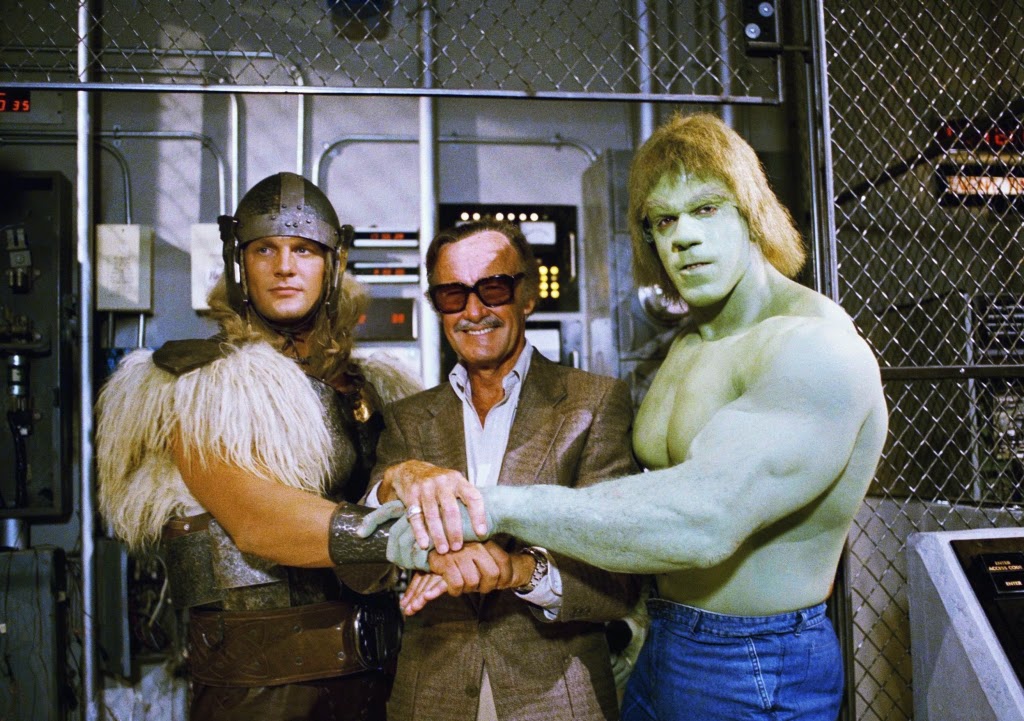
We’ve mentioned the 1978 Incredible Hulk television show, and after it concluded, there were three made-for-TV films produced to keep the Hulk name smashing on: The Incredible Hulk Returns (which is where that picture of Stan Lee, Hulk and Thor at the top of this article comes from), The Trial of the Incredible Hulk and The Death of the Incredible Hulk. The Incredible Hulk Returns was intended as a backdoor pilot for a Thor TV series, set to star Eric Kramer in the title role. Likewise, The Trial of the Incredible Hulk was to have launched a TV series for Marvel’s resident lawyer/vigilante, Daredevil. Neither of those shows materialised. Matt Murdock/Daredevil was played by Rex Smith, with his arch-nemesis Kingpin (sporting beard and hair unlike his comics counterpart and referred to only as “Wilson Fisk”) played by John-Rhys Davies. Daredevil’s appearance was intentionally quite different from that in the comics: an all-black, not red, suit, no devil horns on the cowl and an absence of the Double-D insignia on his chest. Spoiler alert: the “trial” of the title only takes place in a dream sequence, as “trial” is supposed to have a double meaning – like in “trials and tribulations”. A pretty disappointing, supposedly clever move. This is also noteworthy as the first Marvel movie in which Stan Lee made a cameo appearance, as the jury foreman in the Hulk’s “trial”.


GHOST RIDER: SPIRIT OF VENGEANCE
2012

Lifelong comic book fan Nicolas Cage (the “Cage” in his stage name is taken from Marvel Comics character Luke Cage) leapt at the chance to play Johnny Blaze/Ghost Rider in the 2006 film. While campy and forgettable, it’s far from as hated as the fiery bike wreck of a sequel, Ghost Rider: Spirit of Vengeance. Cage was the only returning cast member, with Mark Neveldine and Brain Taylor of Crank infamy taking on directorial duty. Set eight years after the events of the first movie, Spirit of Vengeance sees Johnny Blaze playing guardian angel to a young boy hunted by the demon Roarke (Ciarán Hinds). While promoting the film, Cage promised “moments that are for lack of a better word: freaky. You are going to be like, ‘Did I just see that happen?’ Hopefully it will mess with your mind, which is what I’m excited about.” Scenes like the Ghost Rider urinating a stream of fire and Cage exclaiming “he’s scraping at the door, scrapin’ at the doooaah!!” In our review of the film, we gave it 0.5 out of 5 stars, not even Idris Elba in a supporting role as a French monk could salvage this.

Said our writer, “It's not often that writing a movie review feels like rendering a public service, but in this case, we feel like superheroes saving humanity from evil when we state this warning: do not watch this movie.”

"Personally, I'm done," Cage said when asked if he would return to the role. Like Johnny probably felt after peeing fire, we can say we’re relieved.

THE FANTASTIC FOUR
1994

The 2005 Fantastic Four film and its 2007 sequel, both directed by Tim Story, are fluffy throwaway flicks, if not awful ones, and are often dismissed. But the Fantastic Four movie that has stayed in the collective geek consciousness is the one that wasn’t even released. Produced by Z-movie king Roger Corman and directed by music video director Oley Sassone, this curiosity exists just so production company Constantin Film could cling to the movie rights for the Fantastic Four property, as they were due to revert to Marvel soon. Stan Lee claimed that “the movie was never supposed to be shown to anybody." Co-producer Bernd Eichinger has long disputed Lee’s claims. What we know is that this was a movie that was essentially a “watch this space” notice, hastily slapped together and boasting special effects that would be dated in 1964, let alone 30 years later, Johnny Storm in flame-on mode essentially a cartoon. The bootleg has been a comic convention staple and has made its rounds on the internet. Filmmaker Marty Langford’s exposé documentary Doomed! The Untold Story of Roger Corman's The Fantastic Four is due out later this year. We’re honestly more excited for that than for the actual remake.


Wednesday, September 4, 2013

STGCC 2013: David Mack Interview


Together with several other journalists, I got to speak to comic book artist/writer David Mack, best known for his creator-owned original title Kabuki and for his run on Daredevil. He is famous for his unique collage-style painted artwork and has worked with names synonymous with modern-day Marvel comics, such as Brian Michael Bendis and Joe Quesada.

You're pretty well known as both a writer and an artist, so how did you start in comics? 

Well, I started doing my book Kabuki when I was in college, and I ended up turning it in for my senior thesis literature while I was in college, and I had done artwork my whole life, I'd also written things, but when I was doing Kabuki, I only intended to write it start with. I was looking for different artists to do it and something which you might think is funny now, was in 1993, Brian Bendis and I met and we became friends, and started working together a lot. At the time, we both had little creator-owned projects at Caliber comics. They just published The Crow like in the early 90s, and we were doing like smaller books there with them. But as soon as Brian and I met in Chicago at a convention, and he was making a living as a penciller and was looking for an inker, and his story is that as soon as he showed me his pencils, I...I don't think I really did this, I think that this is (just) his memory - he says I immediately inked on his pencilling and told him the right way to do it and that he says it changed his inking style, but actually I just told him what would be better for his crime book. So he immediately liked...he got me a job that day at the convention as his inker for a project he was getting paid for, so we were working as a penciller-inker team for some other things we were working on, and he was going to be the artist for Kabuki. And so I have all these 1993 Brian Michael Bendis Kabuki drawings and pages. I own 'em all, they're in my house. Gonna frame 'em.

And there were  a couple other artists that I met that I felt were more talented than I was, as an artist who wanted to do Kabuki and had little Kabuki art from them. But eventually, for some reason, I felt there was somewhat of a disconnect between the way I wanted to tell the story visually with the writing and all the art that was coming together. So then one night, it was just late at night, and I thought "why don't I just do like a small...I still plan on having artists draw it, but why not just a small 8-page Kabuki story that I draw myself to see what it's like?" And in doing it, I ended up really liking it, really liked telling the story visually. So I kept making these little chapters and eventually just made a book of it, and did it that way.

And then I did Kabuki all through college, it was being published through college, and while I was in college, and then I met Joe Quesada in 1995 at a convention and I gave him my first Kabuki volume. And he called me like the next week and said he really liked my writing, and that he wanted to work with me as a writer someday. He mentioned a few things that never worked out, when he was at his own publishing company Event comics, he was doing Ash at the time. And then one day, he eventually took Kabuki from Caliber to Image Comics, and did a new series at Image where I was writing and drawing Kabuki, and when that started I got a call out of the blue from Joe Quesada and he said "nobody knows about this yet, but I'm gonna be taking over some books from Marvel Comics and we're gonna call it 'Marvel Knights' and we're gonna...Kevin Smith is going to be writing Daredevil..." and then he asked me if I would write Daredevil with him as an artist, after Kevin Smith. So really Kabuki got me the invite to be a writer at Daredevil for Marvel, so my first work for Marvel was as a writer, but it was based on the Kabuki work. And so eventually  I was able to do some art on it too.

The funny story is that while I was then working, writing Daredevil, Joe would ask...we did all the covers together, me, Joe and Jimmy Palmiotti, and he had this idea that...he was so busy, he was becoming editor in chief while we were on the project, so he was getting increasingly busy. He would ask me to do layouts sometimes, and I would send him layouts for all the covers and he would do a drawing based on my layout, and then Jimmy Palmiotti would ink it, and he would FedEx-it to me and I would paint directly on it, try not to mess it up because it was the original art they wanted me to paint on. So it was fun to have like the first design of the cover, like the layout, and then the final word on it with the painting.

And I was sending them back in FedEx boxes so my friend Brian Bendis had these crime comics called Torso, he wrote and drew it himself. So I took all his Torso comics and crammed them in the FedEx package and sent them to Joe, so when he opened the cover he'd be like "what are all these books in here?" and (I'd say) "my friend Bendis, he writes this crime comic and draws it, you should check out his work!" And he'd say "I really don't like his art, but I think he's a really good writer, you guys want to do something together?" And so that's how...and then Brian started writing his Daredevil story right after my Daredevil story, and I did the artwork for him. So that was actually his first, his first Marvel project is that next Daredevil story, even though I think Ultimate Spider-Man might've been published first, but that Daredevil story is what got him the offer to write the Ultimate Spider-Man. That was the cool thing, I met Brian Bendis in '93 and for the last 20 years, we're sort of learning together, this is pre-email and internet for all of us. We had these old fax machines, and I would draw all my pages and send Brian like my new Kabuki page and he'd send me his new Goldfish page and we would like give each other tips and ask questions and...so they were guys who were really helpful to me, like learning from that and we would all learn together and work together and help each other as much as possible.

Could you talk about your Asian influences, because you started out with Kabuki and it's obviously a very Japanese-influenced art, some of your recent exhibtions look like they were really, uh, Asian-centric, so can you talk about that? 

Yeah, with Kabuki, I started...I was really young when I started doing it. I was a big fan of autobiographical comics, like Ivan Brunetti's Schizo and Peepshow, American Splendour by Harvey Pekar, R. Crumb...I really loved reading these autobiographical comics, where these guys would just talk about these mundane aspects of their day and their life, and Ivan Brunetti was really adventurous because he would, in his published book, he would draw himself and he would draw his co-workers and he would draw himself fantasizing about the women he worked with and he would draw himself fantasizing about murdering the bosses that he worked with, and then it would come out in his comic! He was so honest and so from the heart, and then next issue in the start, it would show how he got fired because the boss saw his comic book, like all the women saw all his fantasies about them in it...he'd have all these problems and I was fascinated with that. I wanted to do a comic that was like personal to me, but I was so young when I started working on Kabuki, I barely turned 20 years old, I was in college and I didn't feel "un-self-conscious" enough to do an autobiographical book, and I didn't even feel fully-formed as a human enough to do it. And so I felt like, um, and I didn't want to make like the main character a...I felt like if I made the main character some adult male or something it would turn into like an idealized version of myself or something, I thought it would be a trap. So I thought, "I'm gonna have the opportunity like a laboratory to tell personal stories, but I'll tell it through metaphors and make all the surface details really different from myself, so I'll make the main character a different gender, and I'll put it in a different part of the world, with a different culture, and I'll use different metaphors and archetypes, and instead of seeing me when people read it, hopefully they won't see me, they'll see themselves and connect with the characters."


While I was in college I had a...I met a friend in my painting and drawing class, his name was Takashi Yatori from Japan, and I had...so we worked together a lot and we were just friends, so he introduced me to his, you know, international student union at the school and I became involved with his family so when it came time for me to take a foregin language, which was a general studies requirement, I'd already taken Spanish in high school so I thought "I'll take Japanese because I have all these friends to help me." So I did that and became more and more fascinated with it and I would take Japanese history and world religions and philosophy and mythology and so there were a lot of these things that I was learning at the time, it gave me an opportunity to sort of use that as a structure and archetypes for this Kabuki book that I was doing and still, I felt like I still had enough opportunity to bring my own take to it, and I kind of made...I never put a time period on it, so it's like ambiguously in the future, um, so it kind of gave me a license. Like any good science fiction, if you kind of give a license to "turn up the volume” on something, to speak about something that's happening now, a current socio-political context, it can be exaggerated to drive home the point a little bit more.

Do you still speak Japanese? 

(In Japanese) <Just a little bit>

How did you feel about getting a shoutout in the Daredevil movie? It was the line "Miller, Mack, Bendis..." and what would you like to see in a new Daredevil movie, your dream version of one?

Well, that was the best part of the film (All laugh). That was my favourite part of the film, definitely! And it was said by that actor Mark Margolis, I'm a big fan of that actor so that was extra special. He's the guy who...he's in Breaking Bad and he was in Scarface, he was in Pi...he's this amazing actor and it was amazing that he said "Miller Mack and Bendis" you know, in the movie. Also, that movie has really good extra features. If you have like the extra features on it, there's this interesting documentary about all the different people, the writers on Daredevil, various creators through the ages on it. As far as a brand new Daredevil film, there's a lot of opportunity. There's so much incredible content to pull from, the source material. You can imagine...you could just do a Born Again story and that would be a great story for it...or maybe do a Daredevil End of Days story as a movie. That would be fun!

Do you have any thoughts on BatAffleck? 

Seems like a very nice man. (All laugh) Also I'll say this about Affleck: he started, we became more familiar with him after he won the Oscar (with Matt Damon) for writing, for Good Will Hunting. So clearly he had some filmmaking talent and he got a lot of roles as an actor, some good, some not as good, but then he very much remade his Hollywood career as a director and became really an interesting contemporary film director. So it is interesting that he made...like after establishing himself so much as a wonderful director, had made this choice to do that, so I'm guessing he must've done it for a good reason. Maybe he has, you know, maybe he can reinvent himself and that character in a different way? But I mean I would've been more interested in hearing about like the "new Ben Affleck-directed movie" or something, probably, but I like to give everybody the benefit of the doubt and I'm curious how everything will unfold.

Since you’ve always been into both drawing and writing, do you have a preference and how does one prepare? Do you have a process when you write or draw? 

I like ‘em both. One of the things that I love about doing comics is that’s it’s a medium that, for me, I don’t have to choose one way of doing things. Everything I wanted to do in comics – I can paint, I can sculpt, I can do photography, there’s design as a part of it, the composition of it, the sequential narrative aspect of it, I enjoy everything about that and I can pour it into the writing side or the drawing side of the comics and I just love the nature of the books themselves. And I really see comics as kind of this interesting last pirate medium right now, where you can sort of go under the radar of contemporary culture and still be incredibly…you can comment on things and you can have like an effect on things. You’re talking about things in an indirect way, through a comic as a metaphor.

As far as my creative approach, when I’m writing I write as many…I sort of have like two modes of it. When you’re first writing, you sort of have the creative mode and the editing mode. When you’re creating things, it uses a different part of your brain than when you’re editing, and some people try to edit while they’re writing, and they end up second-guessing themselves a lot. It’s tempting to edit everything out of existence before you get it down on the page, so you have to give yourself permission to not be the editor at the beginning, and write down everything you could possibly think of, knowing that later, you can come back and take half of it out. You’re probably going to take most of it out; most of it’s not going to be the best. But if you give yourself permission to be experimental, and whimsical and anything that comes into your mind you just write it down and don’t edit yourself, then you come back to it with a different hat and you say “what is this story really about? What belongs here, what doesn’t belong here? What order should it be in to be told most powerfully? Maybe these are really good ideas but they’re not this story; that’s some other project” and you put it over here for the future.

I kind of do it that way, and I guess artistically it’s sort of a similar solution. It’s all problem-solving and I think as an artist, I just try to use the visuals as another way of storytelling and I try and ask myself all the questions visually as if I was writing. If I’m the writer, I know what the story is, but how is it best told? Is it best told through one person’s perspective, from a third person perspective, everyone else talking about the main character? Is it no dialogue, no one gives their actual thoughts but you see it by actions what’s happening…there’s so many different…what order should it be, should it flash back? And I ask the same sort of story questions with the art, how to communicate it. Like what would be the right colours for it, the right medium, and most of the time these are things I make notes of when I’m writing the story, several possible visual solutions when I’m writing the script of it. But sometimes, there are things that happen in the process. That’s actually the coolest part, when you’re doing all your homework and then something occurs to you that you could never have thought ahead of time, but you’ve done so much hard work that all of a sudden, the story is meeting you halfway and revealing itself to you, what it wants to be. At it’s like “okay, I kind of thought you wanted to be this but it turns out you want to be this, so we’ll kinda try it out.”

Do you have any creative quirks while you’re working, like some music in the background or do you eat something? 

Yeah. Well, I probably have a lot of quirks. Say when I’m doing an issue of Kabuki, and I’m doing everything – I’m writing it, I’m doing layouts, I’m drawing it, I’m painting it, I’m lettering it, I’m doing the letters column, I’m doing all these things – I found that you always want to be at your optimum performance, you never want to be like…people talk about “oh, I stayed up all night because of the deadline” but usually I don’t feel like when I’m working for days at a time without sleep, I’m working the best that I could. So you really want to try to engineer your rhythm so that you’re getting the best out of yourself for the project. What I’ve noticed is for each stage of those parts of the book, I operate best by using a different cycle and rhythm for each one. So, I don’t smoke or take any drugs or anything, but I feel that your body has so much natural chemicals in it that you can manipulate those chemicals by three things: what you eat, what your sleep schedule is and what your exercise schedule is, completely manipulates all the chemicals you need, so I adopted different eating, sleeping and exercise schedules for when I’m writing vs. when I’m drawing vs. when I’m painting vs. when I’m lettering.

The quirkiest one is the last stage of it. In general, for contrast, I sort of do a lot of like this: I wake up, I go right to work, then I just work till it’s time to eat, and then when it’s time to eat, you eat, and like you answer all your emails and stuff and then go for a walk or do some exercise, then once you’re done with that, you just go to the next stage; I kind of use when you have to eat to kind and break up stuff. And like when I’m eating, that’s when I take care of emails and the business aspect and when you come back, you’re refreshed, you’re inspired and you go back to work.

On the more extreme side, usually this happens in like the lettering process or the last stage where I have all the sort of raw footage of the book all painted and I have it all set up around myself and I’m looking at it, thinking “I can see how everything fits together.” It’s probably almost like editing film; you have all the raw footage and everything and now, how do you finesse it and fine-tune it to get the most out of everything, and that’s like when I kind of start adding panels or removing panels, changing the order of scenes or changing the order of pages, rewriting to accommodate it, and then really like pairing the script and the lettering with the art. Usually in that stage, I end up cutting out like half of the dialogue in the scripts when I’m doing just to edit it. I started this really interesting sleep schedule, when you wake up you feel refreshed and good, so I thought “it would be nice if you could feel this way more than once a day”, right?

The simple way to do that is to wake up more than once. So I thought…I did some research on it and everybody…you want to get your REM (rapid eye movement) cycle, which is usually like 2.5 – 3 hours of sleep. So most people sleep like two or three REM cycles all at once, so like 2.5 – 3 hours, three of those all at once. But observing my cats, they kind of just do it one at a time: when they’re hungry they eat, when they’re tired they sleep and they do crazy cat business the rest of the time, you know? So I thought, I started doing this where I just sleep one REM cycle at a time, you just sleep 2.5 – 3 hours and then I immediately get to work and I can work fantastic without getting tired for like 10-12 hours. But then the trick is, after 10-12 hours, the minute you feel not the least bit on your A-game, the trick is to immediately go to sleep before you get tired and you’re not up 16-18 hour days, you’re up 10-12, so you only need one REM cycle to refresh you, and then only 2.5 – 3 hours after that. I usually do it like two weeks at a time before I need to get like a whole regular-style sleeping regimen again.

We’re all geeks in this room, there are the stereotypes that we’re socially awkward and things like that but you on the other hand, you started embracing yourself as a comic book writer and artist since you were a really young kid. How have you embraced yourself in that role and what advice would you give to budding artists who are trying to embrace that side of themselves?

Um, I never really think in terms of labels and stuff, so I’ve never really labelled myself so much myself that way. I probably was very awkward when I was younger, but making comics was very helpful. I learned a lot of how to interact with other humans in real life because of my experience making comics. I think when I was younger I was a very different person and I didn’t know what the proper way…I didn’t know how to read social cues or body language or facial expressions and I didn’t understand why people were laughing sometimes and a lot of these other things. But then when I started drawing comics, I realised that you have to put a lot of thought into what body language someone should have, what facial expression, what they’re saying when they’re reacting to something – and I think from that, I started to learn how do it in real life by thinking about it in characters.

Who would you like to collaborate with in the future? 

I’ve been so fortunate to work with such amazing creators: Brian Bendis, Joe Quesada, Paul Pope on Electric Ant, so many great…I did these prints with Neil Gaiman…I’d love to do a story with Neil Gaiman, that would be fun, and Fight Club author Chuck Palahniuk, he wrote an introduction for my recent Kabuki volume. It’ll be fun to do a collaboration with him.

What was the inspiration behind the creation of Echo? 

I was writing the Daredevil story; Joe Quesada was going to draw it so I asked him “do you want me to write anything in particular for you?” And he said “write whatever you want, but the one thing I ask you to do is create a brand new character story in this story.” He said because so many of Daredevil’s foes were borrowed from Spider-Man and he felt like, besides Bullseye and Kingpin who was a Spider-Man villain, Elektra, the main ones – there weren’t a lot of new and fresh and interesting Daredevil characters, so he asked me to write a new character. With Echo I thought, with all of Daredevil’s…he has a lot of different love interests and each of them he kind of relates to in a different way but each of them has a lot of blind spots about what kind of person he is. He relates to Black Widow and they’re both superheroes but because he’s blind, he sees the world so differently than everybody else does and he’s piecing it together in a different way, I thought it would be interesting if he met somebody else who was also set aside from most of society by how they see the world, but for it to be different than how that was for him. So, I think I thought he would find that interesting. He doesn’t see anything but he pieces all of his information together from other senses, mostly audible, and she doesn’t hear things and has to rely almost exclusively visually. So it’s an interesting, like possibly a complementary thing, but also an interesting opportunity for them to always kind of miss each other sometimes too. Maybe it’s kind of a commentary on relationships or something.