Here's an article I wrote several months back on the legendary special effects maestro Ray Harryhausen, on his passing.
---
Text:
MASTER OF THE
HAUS
RAY
HARRYHAUSEN’S SPECIAL EFFECTS LEGACY
By
Jedd Jong 13/5/13
We hear the term “escapism” used a
lot to describe a good time at the movies. There are certain genres audiences
love for their ability to whisk us away from the mundane for two hours or so.
Genres like fantasy, adventure and science-fiction. And there’s an undeniable
mass appeal to movies that lead to collective jaw-dropping and gasps of “how
did they do that?!”
One of the pioneers of the art of
making moviegoers drop their jaws and gasp “how did they do that?!” was special
effects maestro Ray Harryhausen. Harryhausen was responsible for creating some
of the most iconic beasts, critters and magical beings to ever stomp and
slither their way across the silver screen. The swordfighting skeletons from Jason and the Argonauts? The six-armed
scimitar-wielding Kali statue from The
Golden Voyage of Sinbad? The fast-growing Ymir that crushed Rome beneath
its reptilian feet in 20 Million Miles to
Earth? All lovingly crafted stop-motion puppets and the handiwork of Ray
Harryhausen.
But isn’t all this quaint and old-fashioned?
Hasn’t computer-generated imagery long since usurped jerky puppets as the go-to
method for creating movie magic? Read on, for you just might be surprised at
the far-reaching effect the work that Harryhausen did has on some of the most
prolific and well-regarded filmmakers today.
THE MOTHER GOOSE STORIES (1946)
THE STORY OF LITTLE RED RIDING HOOD
(1950)
THE STORY OF HANSEL AND GRETEL (1951)
THE STORY OF RAPUNZEL (1952)
THE STORY OF KING MIDAS (1953)
Before exploring the realm of
fearsome mythological creatures and lumbering dinosaurs, Harryhausen’s earliest
professional work was slightly cuddlier. “The Fairytales were what I really call my ‘teething rings’,” he
recalled. His father Fred helped machine the metal armatures for the puppets
and his mother Martha crafted the clothes said puppets would wear.
The Impact:
Nick Park, animator and creator of Wallace and Gromit and Shaun the Sheep, says the Mother Goose stories were his first
exposure to Harryhausen’s work and he went on to become a lifelong fan. “I
always considered Ray Harryhausen’s work so fine that it was way out of my
league,” the animator graciously wrote in his tribute to Harryhausen.
MIGHTY JOE YOUNG (1949)
If Harryhausen is considered the
grandfather of stop-frame animation, then Willis O’Brien could be considered
the great-grandfather. O’Brien was responsible for realizing the titular
character in the 1933 classic King Kong.
Harryhausen cites King Kong as the
film that got him really interested in pursuing a career in the industry, and
he got to work alongside Willis O’Brien as his assistant on a slightly
different giant gorilla film, Mighty Joe
Young.
Harryhausen had a particularly
healthy method when animating Joe Young: “I thought I’d get in the mood by
eating celery and carrots for my tea break so I’d feel like a gorilla!”
The Impact:
“I think that’s some of his best
stuff because the personality in Joe
Young is amazing!” said John Landis, director of An American Werewolf in London. “And the way he moves, he does move
like a gorilla whereas King Kong
doesn’t move like a gorilla at all.”
Mighty Joe Young was remade in 1998, this version starring Charlize Theron.
THE BEAST FROM 20, 000 FATHOMS (1953)
Harryhausen’s good friend and fellow
“Ray”, science fiction author Ray Bradbury, said “Ray Harryhausen and I showed
up at the same time, and he said ‘well, maybe someday, you’ll write a
screenplay for me and I’ll do dinosaurs for you,’ and I said ‘well, I’m gonna
pray to God for that’.” The Beast from
20, 000 Fathoms, based on a short story by Bradbury, was the eventual
result.
The titular Beast, a “Rhedosaurus”,
was a fictional dinosaur devised by Harryhausen, the writers and producers of
the film. In order to complete the film economically, Harryhausen devised a
revolutionary rear projection method that would allow him to superimpose his
stop-motion animation on the live-action photography – a precursor of sorts to
digital compositing.
The Impact:
What’s the first thing that comes to
mind when one hears “giant lizard rampaging about a big city”? That thing was inspired
by The Beast from 20, 000 Fathoms.
““Gojira is a direct result of Beast
from 20, 000 Fathoms! Exactly! I think Toho (studios) said ‘we’ll make one
of those!’” John Landis declared.
The Japanese filmmakers took a
different approach in creating their monster, though. As Harryhausen himself
put it, “(Gojira) was a man in a suit stomping around on miniature sets!”
IT CAME FROM BENEATH THE SEA (1953)
Producer Charles H. Schneer wanted
to create a monster movie about a giant octopus attacking San Francisco.
Schneer and Harryhausen had a hard time getting the City Fathers to cooperate,
as they felt that seeing an octopus bring down the Golden Gate Bridge would
shake the confidence of moviegoers. Harryhausen recounted the ‘guerrilla
tactics’ they used in the making of the film. “We had to do things from devious
means. We put a camera in the back of a bakery truck and went back and forth on
the bridge to get projection plates, secretly”.
Due to budget constraints, the
octopus from It Came from Beneath the Sea
only had six tentacles. Harryhausen had to animate it in such a way as to hide
this shortcoming. He apparently liked referring to his creation as the
“sextopus” (feel free to insert your own adult anime reference here).
The Impact:
The Kraken in Pirates of the Caribbean: Dead Man’s Chest was given six tentacles
as a reference to the octopus in It Came
From Beneath the Sea. Davy Jones was also designed to emulate the
“in-your-face” feel of Harryhausen’s creature animation.
Steve Johnson, animatronics and
prosthetics artist and special effects supervisor on Spider-Man 2 noted “I think it’s pretty obvious that Sam Raimi is a
huge fan of Ray Harryhausen if you take a look at the work in Spider-Man 2 – Doctor Octopus.” The way
Doc Ock’s robot arms moved and behaved gave them a personality not unlike that
displayed by some of Harryhausen’s creatures.
And from another superhero film
sequel, Hellboy II: The Golden Army, the
‘Forest Elemental’.
EARTH VS. THE FLYING SAUCERS (1953)
The 50s were arguably the height of
UFO mania, and Hollywood was quick to capitalize on it and stoke the fires.
Senior Visual Effects Supervisor at ILM, Dennis Muren, said “there were a lot
of movies made in the 50s with flying saucers that were pretty dull to look at
but Ray gave them personality and life and you were just enthralled as a kid
looking at them.”
Harryhausen found it a challenge to
give the suggestion of an alien intelligence within the metallic discs –
without ever showing what exactly was inside. The flying saucers were machined
with the help of Ray’s father Fred, and Ray invented a geared aerial bracing
system that allowed him to suspend the flying saucers at an angle.
Harryhausen happily declared, “I
knocked over the Washington monument long before Tim Burton did!”
The Impact:
Mars Attacks! ,
of course!
Independence Day went a tiny bit larger with its monument-destroying flying saucer.
20 MILLION MILES TO EARTH (1957)
In this film, an alien beast from
the planet Venus crashes on earth off the Sicilian coast – he starts out tiny,
but very soon he’s fighting elephants and rampaging through Rome. The monster
was to have originally laid waste to Chicago, but Harryhausen “changed it to
Rome because (he) wanted a trip to Europe”.
“I felt you could get much more
emotion out of a humanoid type of figure than with an animal type of figure,”
Harryhausen said of the decision to give the Venusian Ymir a humanoid torso.
The Impact:
“The Ymir is probably one of the
best black-and-white monsters that he’s ever created, particularly in the early
stages when it’s small…(with) all the humanoid gestures that make these
monsters so personable and so much more appealing,” said Joe Dante, director of
films such as Piranha and Gremlins. “The design of the creature that we have in Piranha is a little bit like an Ymir,”
he pointed out. “In Piranha, there
was no stop-motion monster written into the script. The stop-motion monster was
in the movie simply because Jon Davison, the producer, and I liked stop-motion.
Any kind of stop-motion in my movies is a tribute to Ray Harryhausen or Willis
O’Brien.”
Vicenzo Natali, director of the
sci-fi horror film Splice, also
remarked on Harryhausen’s ability to make his creatures likeable to a degree.
“You can’t make a creature film without thinking of Ray Harryhausen because he
created creatures that were so sympathetic and let’s face it, he made some of
the greatest monster movies of all time.”
THE 7th VOYAGE OF SINBAD
(1958)
The 7th Voyage of Sinbad marked Harryhausen’s first foray into the
realm of period fantasy in which he would create some of his best-remembered
work. Harryhausen said “I destroyed New York with the Beast, I destroyed San
Francisco with the octopus, I destroyed Rome with the Ymir and I destroyed
Washington with the flying saucers, and that got rather tedious so I was
looking for a new avenue in which to use stop-motion animation, and I latched
upon Sinbad.”
Sinbad was a
risk for the studio because a then-recent film on the same subject, Howard
Hughes’ Son of Sinbad, was a flop.
“Oh, costume pictures are dead,” studio executives would say. Harryhausen was
inspired by the likes of the Arabian
Nights films from the 40s and The
Thief of Baghdad.
For The 7th Voyage of Sinbad, Harryhausen would produce what
went on to be among the best-loved of his creations. “I get more fan mail
coming in about the Cyclops I think than any other creature,” he said. “I
designed the Cyclops very carefully because I didn’t want people to think it
was a man in a suit, so I put goat legs on like a satyr in ancient mythology. I
gave him an appearance of three fingers so no one could assume that there was a
man inside the Cyclops, and I think it worked out very well.”
The Impact:
“It’s so inspiring that it made you
want to make movies,” Pixar and Walt Disney Animation Studios Chief Creative
Officer John Lasseter said. The Pixar film Monsters,
Inc. included a shoutout or two in the form of the Cyclopean characters
Mike and Celia who go to eat at the fancy restaurant named ‘Harryhausen’s’.
“Without The Seventh Voyage of Sinbad, you would never have Lord of the Rings,” Vicenzo Natali
commented. He might’ve been right: take a look at this guy Peter Jackson
brought along to the Return of the King
set from a short film he had made at age 15, called The Valley:
“When I was 12, 13 years old and
other kids were getting interested in cars, sport and girls, I used to love
monsters and I particularly loved Ray’s films,” Jackson said fondly of his teen
years.
JASON AND THE ARGONAUTS (1963)
Based on the Greek myth of Jason and
the Golden Fleece, Jason and the
Argonauts is held by many as Harryhausen’s crowning achievement. “A lot of
people find Jason and the Argonauts
one of our best films,” Harryhausen acknowledged. “It’s my favourite because it
was the most complete.”
“Some of the films are better made
than others. And some of them have better scripts than others. I mean Jason and the Argonauts probably has the
most literate screenplay, so it is a better movie,” John Landis remarked.
“I want to speak on behalf of all
the actors that appeared in Harryhausen films,” John Cairney, who played Hylas
in Jason, said. “They weren’t all
monsters, they weren’t all effects – there were real live actors in there…We
were trained to be classical actors. To appear at the Old Vic, that was our
standard. But there was I, eating sand in Palinuro – and loved it, loved it,
loved being there, being part of this titanic imagination of this man.”
But of course, the stars still were
the creatures. Jason and the Argonauts
boasted the seven-headed Hydra (in lieu of a more ordinary dragon) and the
gigantic Bronze figure of Talos that rises from its pedestal to stomp across
the beach. However, the most iconic sequence from the film probably was the
skeleton fight.
The skeletons were conceptualized
with rotting flesh hanging off them, but in order to avoid an X rating,
Harryhausen went with the clean-cut skeletons we’re so familiar with today. The
skeletons were designed with all the joints a real human skeleton would have,
and it wasn’t easy putting it all together. The actors meticulously rehearsed
the battle with stuntmen, and then shadow-fought against nothing with the
skeletons inserted later via Harryhausen’s rear-projection method. “Sometimes I
would only get about 13-15 frames a day,” Harryhausen revealed (you need 24
frames for one second of film). “It took four months to animate the sequence;
it only took two weeks to shoot the live-action.”
The Impact:
Where do we even begin?
Army of Darkness
Pirates of the Caribbean: Curse of the Black Pearl
The Terminator
“The images of those skeletons
leaped off the screen and drove straight into my DNA… I’m sure there’s a direct
link between those demonic skeletons and the chrome death figure in The Terminator,” James Cameron said of
the influence the Jason and the Argonauts
scene had on him.
Spy Kids 2: The Island of Lost Dreams
FIRST MEN IN THE MOON (1964)
Ray Harryhausen had always loved the
works of H. G. Wells and wanted to make a film based on a Wells story. After
finding that the rights to War of the
Worlds and The Time Machine were
unavailable, he settled on First Men in
the Moon. The film was also owed a fair bit to Georges Méliès’ A Trip to the Moon and Harryhausen even
owned an original business card of the pioneering filmmaker.
The Impact:
“I’m always saying to the guys I
work with now in computer graphics, ‘do it like Ray Harryhausen’ or ‘why don’t
you look at Ray Harryhausen and see what he did,” said Phil Tippett, creature
visual effects supervisor on Starship
Troopers.
ONE MILLION
YEARS B.C. (1966)
Yeah, we know this film is best
remembered for the fanservice Raquel Welch so lovingly provided. “Raquel Welch
was cast in the picture; that was one of her first films. She never looked like
a real cavewoman; she wasn’t supposed to – that wouldn’t have been very
entertaining to the public. If cavewomen in prehistoric days looked like Raquel
Welch, we’ve regressed today!” laughed Harryhausen.
The film was a remake of a 1940 film
starring Victor Mature and Carole Landis – for that film, lizards with fins glued
to their backs stood in for dinosaurs, something Harryhausen felt looked too
“phony”. The dinosaur models in the newer one were inspired by paintings and
drawings done by Charles R. Knight, one of the first painters to envision what
dinosaurs might’ve looked like back in the day. Harryhausen also made research
trips to the American Museum of Natural History in New York. In order to make
the dinosaurs look less static, he would animate them with their tails swishing
about as they moved.
The Impact:
“Ray Harryhausen’s work had a huge
impact on us during the design of King
Kong (2005). There are a lot of different ways we could possibly go with
the design of the creatures and the dinosaurs, and Peter (Jackson) especially,
he said he didn’t want them to be real dinosaurs as such, he wanted them to be
movie dinosaurs,” said Greg Broadmoore, concept designer on King Kong. “So we were trying to evoke
that era of dinosaurs from movie history and really wanted to capture that, so
in that sense they were more like monsters in their characters than true
animals.”
There’s also Roland Emmerich’s 10 000 B.C.
THE VALLEY OF GWANGI (1969)
The next feature film Harryhausen worked on also dealt with dinosaurs
and was about a group of cowboys who hope to stage the ultimate rodeo after
capturing the “Gwangi” of the title – a vicious Allosaurus – from the valley of
the title. The film is most famous for a scene in which the cowboys attempt to
lasso Gwangi, a sequence that took Harryhausen well over two and a half months
to complete. Unfortunately, the film was released too late and dumped on the
market, with moviegoers assuming it was a Japanese production. Harryhausen has
stated that it didn’t have the advertising required to give it visibility, and
that perhaps it was too kitschy for audiences to swallow even then.
The Impact:
This bit where poachers try to lasso
a Parasaurolophus in The Lost World:
Jurassic Park.
THE GOLDEN VOYAGE OF SINBAD (1973)
Following the box office failure of Gwangi, Harryhausen decided to do a Sinbad sequel. This would be followed by
Sinbad and the Eye of the Tiger in
1976. The film is known for the six-armed Kali idol which comes alive to battle
Sinbad and his compatriots. The Kali sequence was a vestige of the intention to
use India as a filming location; the movie was eventually shot in Spain.
“I think my favourite
creature from a Ray Harryhausen film would probably be from the first one I
ever saw, which was The Golden Voyage of
Sinbad, and it was the Kali, the giant statue that comes to life,” Vicenzo
Natali said. “And it was just so shocking to see so beautifully rendered and
animated and I think stands the test of time. It hasn’t really aged one bit and
I still find it terrifying.”
The Impact
Notice the way General Grievous
extends his extra arms in Star Wars
Episode III: Revenge of the Sith.
And the Brahman statue that comes to
life in Lara Croft: Tomb Raider.
CLASH OF THE TITANS (1981)
The last major motion picture Ray Harryhausen worked on gave him the
chance to create mythological creatures that would stand alongside the pantheon
of Greek gods and goddesses – including Sir Laurence Olivier’s “I’m only doing
this for the money” turn as Zeus. One of the highlights of the film is the
tension-filled sequence in Medusa’s lair.
Ray Harryhausen recalled a film that
portrayed Medusa by way of giving an actress a wig with rubber snakes that
would bobble around as she walked. “It wouldn’t frighten a two year-old child!”
He declared. “I tried to design her so that she wouldn’t have clothes, that’s
why I gave her a reptilian body, because I didn’t want to animate flowing
cloth. We gave her the arrow from Diana’s bow and arrow and the rattlesnake’s
tail so that she could be a menace from the sound effects point of view. It
became a big problem because she had 12 snakes in her hair; each snake had to
be moved, the head and the tail, every frame of film, along with her body and
her face and her eyes and the snake body.” He wanted to give the character
green eyes, but had to make do with blue eyes that he manipulated with the
eraser end of a pencil.
The other famous creature
Harryhausen made for Clash of the Titans
was the Kraken – which is actually a sea monster from Norse, and not Greek,
myth. Harryhausen opted for a more humanoid design, with tentacles that ended
in hands. He cited French artist Gustave Doré as one of his main influences
over the years - Doré was known for a dramatically-illustrated edition of the
Bible.
Harryhausen found himself needing
some assistance and hired animators Jim Danforth and Steve Archer – up until
that time, he had done all of the animation himself. Danforth animated the bulk
of the sequences involving Pegasus the winged horse, and Archer was responsible
for most of the shots featuring Bubo the mechanical owl.
The Impact:
Clash of the Titans was remade in 2010. Many devotees feel that in spite of the refined
look of the newer film, it just doesn’t match the heart and the charm of the
original.
AND WHAT ABOUT CGI?
When asked about what led to his
decision to retire, Harryhausen answered “young people have been brainwashed by
television to want everything quickly, and you just can’t have an explosion
every five minutes in Greek mythology, so I felt it was time to retire. I felt
I had had enough.”
“Steven Spielberg, when Ray was in
town, got him over to the editorial suite for Jurassic Park,” recalled Phil Tippett, animator and ‘dinosaur
supervisor’ on that film. “Ray was blown away by it. He thought it was just
really an amazing process.”
“I couldn’t say anything negative
because it was most impressive!” Harryhausen admitted.
James Cameron said, “I think Ray
would have loved to have had access to the tools that we have now for
computer-generated animated characters, because…the stop-motion puppetry was a
way for him to get the images that were in his head up on film, and that was
the only way to do it at that time. If Ray were working right now,
he’d be using the tools that we’re using right now, he wouldn’t cling to the
puppetry, his imagination would require that he use the best, most fantastic
techniques available.”
However, Harryhausen himself wasn’t
so sure. “Well, I don’t know, it’s hard to say – it’s just another way of
making films. I think I would prefer to make films with the model animation
rather than CGI, today even…I would find it rather unappealing to just sit at a
desk and push buttons to get a visual image up on a screen!”
Both stop-motion animation and computer-generated imagery are different
ways of creating movie magic, and each has its own pros and cons. While
stop-motion animation is, more often than not, not quite ‘realistic’,
Harryhausen saw that as one of its charms. “There’s something that happens with
a model I’ve always felt, when you use a model instead of computer-generated
images, the model is strange, it gives the nightmare quality of a fantasy. If
you make fantasy too real, I think it loses the quality of a nightmare, of a
dream.”
The way Harryhausen made films,
where it was largely just him designing, building and animating his models,
just isn’t the way things work anymore. Now, there are armies upon armies of
visual effects artist, each working on a small part of a scene. While it is
more efficient, perhaps some of the human touch that Harryhausen gave to each
frame by painstakingly manipulating the models by hand has been lost.
“There’s a real danger of the effects not
being special anymore, they’re just common,” Dennis Muren warns. It’s
interesting to note that some of the big names in the digital effects business
today, including Muren and Tippett, started out as stop-motion animators.
The Ray and Diana Harryhausen
Foundation, which seeks to educate the public on stop-motion animation and
preserve the heritage of Harryhausen’s work, was set up in 1986 to ensure that
Harryhausen’s contributions to film history will always be remembered. Peter
Jackson’s visual effects company Weta Digital helped make a digital duplicate
of one of the skeletons from Jason and the Argonauts. So while the way visual
effects are made may be changing, what won’t change is the tremendous effect
Harryhausen’s work has had on filmmakers and film-lovers everywhere.
“His legacy of course is in good
hands because it’s carried in the DNA of so many film fans,” James Cameron
said. “I think all of us who are practitioners of the art of science fiction
and fantasy movies now all feel that we’re standing on the shoulders of a
giant. If not for Ray’s contributions to the collective dreamscape, we would
not be who we are.”
“I just want to acknowledge the fact
that we wouldn’t be here today making these movies like Jurassic Park and like Avatar
without Ray, the father of all we do today, in the business of science
fiction, fantasy and adventure,” said Steven Spielberg. “Ray, your inspiration
goes with us forever.”
--
The primary source for this article was the 2011 documentary Ray Harryhausen: Special Effects Titan, which I highly recommend. Packed with revealing interviews, footage from all the films Harryhausen has worked on and behind-the-scenes images of him creating his magic.
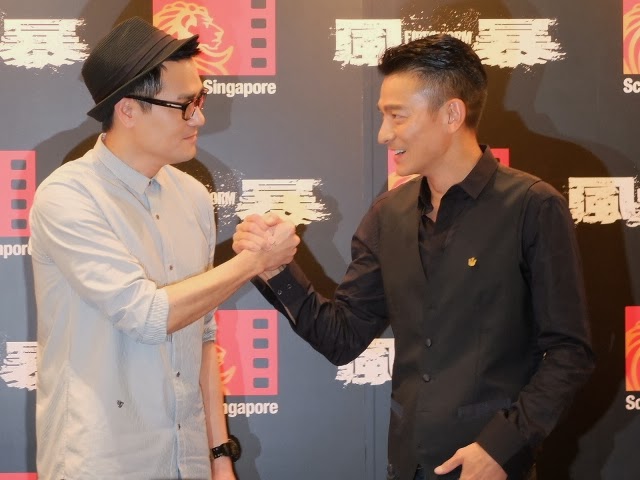


 Firestorm has been post-converted into 3D. When asked
about this method of presentation, Lau said that director Alan Yuen is very
skilled in the area of computer-generated effects and that he has been wanting
to shoot in 3D for some time. “I don’t have expertise in this area, and at
first I was opposed to the idea of Firestorm
as a 3D movie,” he reveals. “He (Yuen) convinced me to shoot one scene as a
test, and that was the fight sequence down the stairwell. After using that to
demonstrate the 3D presentation, I thought it actually didn’t look too bad. Is
3D a necessity for Firestorm? I don’t
think so. This has been a learning experience for me in the area of 3D
filmmaking technique. This is the first 3D cop film to come out of Hong Kong
and we’re very much testing the waters.”
Firestorm has been post-converted into 3D. When asked
about this method of presentation, Lau said that director Alan Yuen is very
skilled in the area of computer-generated effects and that he has been wanting
to shoot in 3D for some time. “I don’t have expertise in this area, and at
first I was opposed to the idea of Firestorm
as a 3D movie,” he reveals. “He (Yuen) convinced me to shoot one scene as a
test, and that was the fight sequence down the stairwell. After using that to
demonstrate the 3D presentation, I thought it actually didn’t look too bad. Is
3D a necessity for Firestorm? I don’t
think so. This has been a learning experience for me in the area of 3D
filmmaking technique. This is the first 3D cop film to come out of Hong Kong
and we’re very much testing the waters.”  Lau also
voiced his support for the Singapore film industry, inviting would-be directors
to pitch projects to him and even approach him to star in local films. “Oddly
enough, nobody from Singapore has contacted me about investing in a film here,”
he said. “I saw Ilo Ilo on the plane
and I
Lau also
voiced his support for the Singapore film industry, inviting would-be directors
to pitch projects to him and even approach him to star in local films. “Oddly
enough, nobody from Singapore has contacted me about investing in a film here,”
he said. “I saw Ilo Ilo on the plane
and I